IT
IT  EN
EN  DE
DE  RU
RU  PT
PT  JA
JA  ES
ES 

|
Stop treating perimeter guarding as an afterthought. For Robot Integrators, a “successful runoff” isn’t just about cycle time—it’s about safety buy-off. You shouldn’t be wasting billable engineering hours fabricating custom brackets for safety switches on-site or dealing with wobbly fences that trigger optical sensors. We provide the modular, rigid backbone your automation cell needs to pass inspection the first time. |
The Integrator’s Dilemma: Speed vs. Compliance
As a System Integrator (SI), your value proposition is the seamless operation of the robotic cell, whether it’s an automotive welding station or a pick-and-place unit. However, the physical barrier—the Recinzioni di sicurezza per macchine—is often the friction point that delays final sign-off.
You face a specific set of challenges: layout constraints that don’t match standard panel widths, the need to integrate third-party interlocks (Omron, Sick, Keyence) without voiding warranties, and the requirement for a structure that can withstand the kinetic energy of a rogue payload. Mdfence is engineered to solve these specific integration headaches.
1. Solving the “Frankenstein” Interlock Mounting
The most common failure point during a safety audit is the door interlock integration. Using generic brackets or drilling holes into the mesh frame on-site looks unprofessional and can compromise the structural integrity required by ISO 14120.
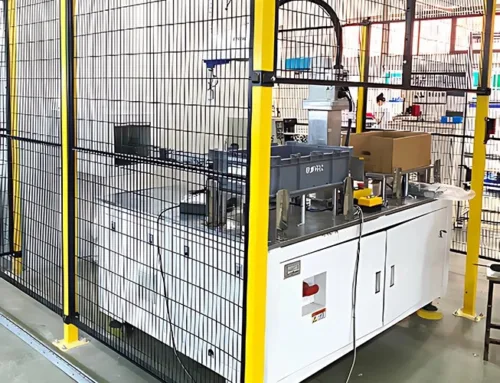
The Mdfence Logic: We don’t just sell steel; we sell a “Safety Interlock Carrier.” Our system includes pre-engineered mounting kits specifically designed for major safety switch brands. This means your electrical team isn’t fabricating mounts from scrap metal. The door arrives ready to accept the switch, ensuring the tongue key aligns perfectly every time.

Figure 1: Pre-configured mounting options and L-brackets eliminate on-site fabrication for safety switches.
2. Structural Rigidity for High-Inertia Zones
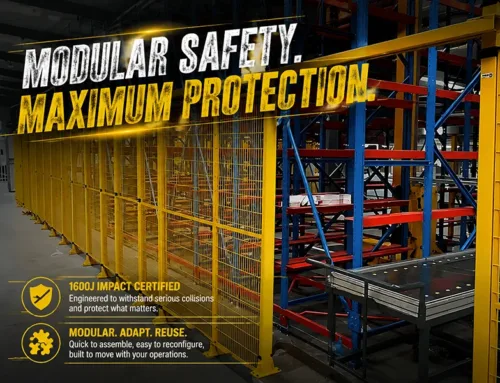
In heavy robotic applications, a lightweight wire mesh fence is a liability. If a robot arm carrying a 200 lb payload creates vibration, or if a forklift bumps the perimeter, flimsy fencing can trigger sensitive light curtains or door contacts, causing nuisance trips and downtime.
The Mdfence Logic: Utilizziamo Acciaio al carbonio Q235 for our posts and frames. Unlike frameless “bent wire” systems, our Pannello incorniciato design (20x30mm tube frame) provides the stiffness required to maintain safety distances. The posts are 60x60mm (approx 2.4 inches) with a 2.0mm wall thickness, anchored by heavy-duty expansion bolts. This passes TUV impact tests, ensuring the barrier holds even if the automation fails.

Figure 2: Heavy-duty 60x60mm Q235 Carbon Steel posts provide the rigidity needed for robotic cells.
3. Managing Footprint and Access in Tight Layouts
Factory floor space is expensive. A standard swing door on a robot cell might be impossible if it blocks an AGV aisle or a forklift path. Yet, operators need access for loading, and maintenance needs access for teaching.
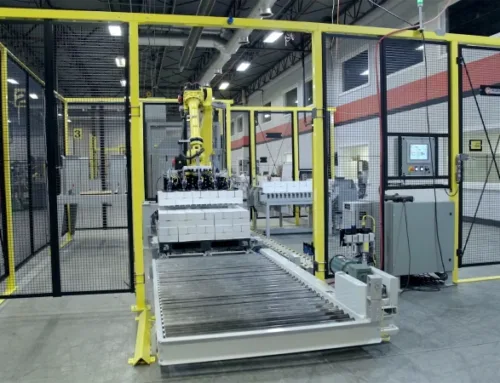
The Mdfence Logic: Il nostro Recinzione di sicurezza per robot system is modular. We offer suspended sliding doors (no floor track to trip over) that are perfect for tight aisles. For larger openings required to move in heavy dies or motors, our folding door systems can span up to 15 feet (approx 4800mm) without sacrificing stability.

Figure 3: Double sliding door systems maximize aisle space while allowing full access for robot maintenance.
4. Installation Velocity: The “Cut-to-Fit” Myth
Many “modular” systems claim flexibility but require hours of cutting and re-welding on site when the layout changes by a few inches. This generates metal dust in clean assembly areas and delays the project.
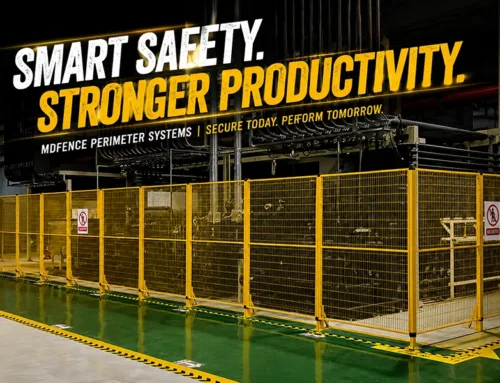
The Mdfence Logic: We work from your CAD layout. Whether it’s a complex polygon shape or a simple square cell, we provide a mix of standard and adjustable panels. Our installation utilizes a clamp-and-bolt system that allows for tolerance adjustments without an angle grinder. The Resistenza agli urti is maintained through engineered connections, not field welding.

Figure 4: We translate complex CAD layouts into a precise bill of materials, minimizing on-site modifications.
Frequently Asked Questions for Integrators
Q1: Can your fencing system integrate with trapped key interlock systems like Fortress or Castell?
A: Yes. While we have standard kits for electronic switches (Omron, Sick), we can provide reinforced mounting plates specifically for heavy-duty trapped key systems often used in high-risk robot cells.
Q2: Do you provide CAD files (STEP/DWG) for us to drop into our cell layout?
A: Absolutely. We understand that the fence is part of the larger Digital Twin. We provide detailed 3D models of posts, panels, and door assemblies to ensure collision checking is accurate before ordering.
Q3: What is the lead time for a custom-colored fence (e.g., to match a specific brand identity)?
A: Standard RAL 1023 (Safety Yellow) and RAL 9005 (Black) are usually in stock. Custom powder coating adds approximately 5-7 working days to the production schedule, but ensures your client’s branding requirements are met.
Q4: Does the system meet OSHA and ISO 14120 standards for reach-over and reach-through?
A: Yes. Our standard mesh openings (typically 20x100mm or 50x50mm) are designed according to ISO 13857 safety distance calculations. We can also provide polycarbonate filling for areas requiring closer proximity to the hazard.
Q5: How do you handle floor unevenness in older factories?
A: Our posts feature adjustable mounting capabilities. Additionally, the ground clearance is designed to meet safety standards (preventing crawl-under) while allowing for minor floor undulations common in brownfield integration projects.