IT
IT  EN
EN  DE
DE  RU
RU  PT
PT  JA
JA  ES
ES 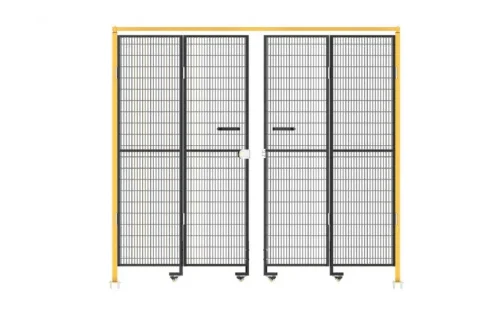

|
Integrating a high-speed 6-axis robot cell? You are likely wrestling with the integration dilemma: laser scanners drop the ball in blind spots, while cheap frameless wire mesh creates optical interference and nuisance tripping that kills your OEE. When an AGV strays off its path or a CNC machining center ejects a heavy part, optical sensors alone won’t stop the kinetic energy. You need a hybrid physical-optical barrier that guarantees PL e / SIL 3 compliance without eating up your valuable floor space. |
Are Robot Fencing Systems Compatible with Laser Scanners? The Integration Dilemma
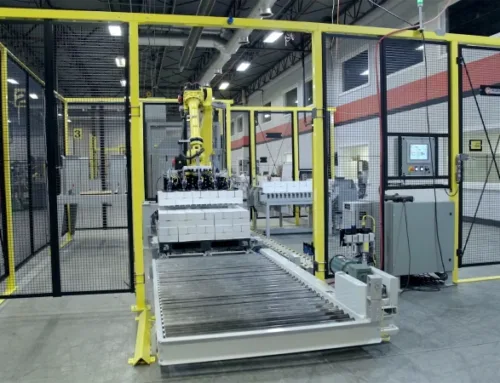
In automotive manufacturing and automated assembly lines, relying purely on area laser scanners for your robot safety fencing systems is a recipe for chronic downtime. Scanners are excellent for mapping dynamic AGV/AMR paths, but they suffer in harsh, high-traffic environments. Coolant mist from CNC machining centers, welding sparks, and forklift traffic constantly trigger “nuisance tripping,” bringing your KUKA or FANUC robots to a grinding halt.
Furthermore, a laser scanner provides zero physical protection against a 220 lbs (100 kg) ejected part or a forklift collision. When system integrators try to patch this by combining scanners with generic, frameless wire mesh, a new problem arises: the shiny, uneven zinc-plated wires reflect the laser beams, causing ghost readings and continuous sensor faults.
The Hybrid Solution: Merging Optical Scanners with Physical Perimeter Guarding
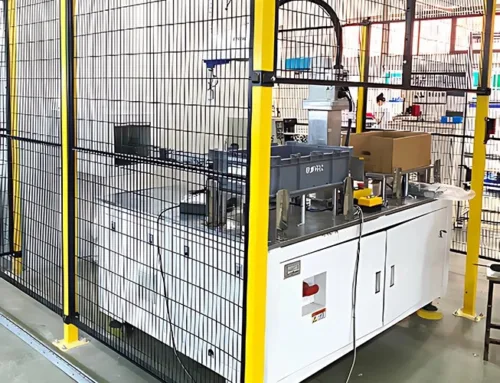
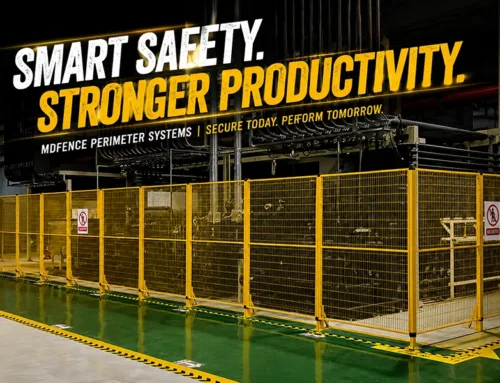
This is where the Mdfence system bridges the gap. Our Pannelli di recinzione per protezione macchine are engineered specifically to complement, not conflict with, electro-optical elements in your turnkey solutions.
First, we utilize a RAL 9005 deep black electrostatic powder coating on our panels. This matte finish absorbs light, eliminating the glare and laser reflection that confuses area scanners. Second, vibration is the enemy of optical alignment. Our panels feature a fully welded 20x30mm (0.78″ x 1.18″) tubular frame, providing extreme out-of-plane stiffness. This prevents the mesh from sagging or vibrating when operators lean on it, ensuring your safety light curtains and scanner heads remain perfectly aligned.

Achieving PL e / SIL 3 Compliance Without Killing OEE
By integrating scanners with our recinzione di sicurezza industriale, facility managers can drastically shrink the robotic cell footprint. The ISO 13857 compliant “finger-safe” 20x100mm (0.78″ x 3.93″) narrow slot mesh allows the physical perimeter to be installed just 4.7 inches (120mm) away from the hazard zone. This allows you to map your scanner’s protective field perfectly up to the physical barrier without wasting production floor space.
When an operator needs to enter the cell for tooling changes, our pre-engineered lock carriers seamlessly integrate with your PLC. Whether you specify Omron D4NL or Pizzato FS series switches, our custom L-type mounting plates ensure the mechanical separation instantly triggers the Safety Torque Off (STO) circuit. There is no need for on-site drilling, no hot work permits required, and zero alignment drift over time.

Securing High-Traffic Material Handling Areas
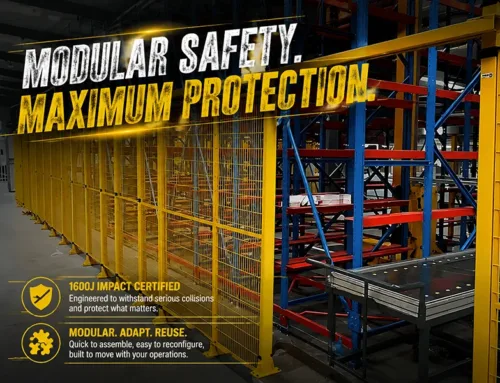
For zones where automated conveyors meet forklift traffic, standard hinged doors often sag under their own weight or block AGV paths when opened. Our modular sliding door systems solve this by providing wide, overhead-track access that doesn’t encroach on the scanner’s warning fields. Combined with our heavy-duty Q235 carbon steel posts anchored by M10 expansion bolts, the system absorbs up to 1600 Joules of impact energy. Your robotics stay protected from catastrophic forklift collisions while maintaining high-speed throughput.

Domande frequenti
1. Can I mount a safety laser scanner directly onto the Q235 steel posts?
Yes. Our 60x60mm (2.36″x2.36″) Q235 carbon steel posts provide a highly rigid, vibration-free substrate, which is critical for maintaining the optical alignment of laser scanners and light curtains in high-speed assembly environments.
2. How does the black powder coating prevent nuisance tripping?
Unlike bare zinc or bright yellow mesh that reflects laser beams and causes ghost readings, our RAL 9005 matte black powder coating absorbs optical signals. This eliminates the glare that typically causes scanners to fault out and stop your automated production line.
3. What happens if an AMR or forklift crashes into the perimeter guarding?
The system is certified to withstand a 1600 Joules impact—equivalent to stopping a 220 lbs object moving at 12 mph. The Q235 steel frame will undergo plastic deformation to absorb the kinetic energy rather than snapping and creating dangerous shrapnel inside the robot cell.
4. Do your systems support third-party interlocks for STO circuits?
Absolutely. We provide pre-engineered mounting plates and lock carriers specifically designed for industry-standard safety switches like Omron D4NL and Pizzato FS series, allowing seamless integration into your PLC’s Safety Torque Off logic.
5. How does the 20x100mm mesh size affect my safety zone calculation?
According to ISO 13857, our 20mm narrow slot design is classified as “finger-safe.” This allows you to legally install the physical barrier as close as 4.7 inches (120mm) from the hazard, freeing up valuable floor space that would otherwise be wasted by the large safety margins required for standard 50x50mm mesh.