IT
IT  EN
EN  DE
DE  RU
RU  PT
PT  JA
JA  ES
ES 

|
Setting up a high-speed mechanical assembly machine or a robotic welding cell? You are dealing with massive electrical loads, servo motor EMI, and strict OSHA/ISO audits. One overlooked detail—like whether your physical perimeter acts as a stray current hazard—can delay commissioning by weeks and fail safety inspections. Let’s resolve the grounding requirements for your automated production lines and ensure your integration is flawless. |
Do Safety Fences Require Grounding or Earthing in Automated Cells?
In the realm of automotive manufacturing and robotics integration, the short answer is: Sì. If your recinzione di sicurezza industriale is installed within the arc flash boundary of a robotic welding station, or enclosing high-voltage control equipment and servo drives, NEC (National Electrical Code) and OSHA standard 1910.304 typically require it to be bonded to the facility’s grounding grid. This prevents the metal structure from becoming dangerously energized due to a live wire chafe, weld spatter melting through insulation, or stray fault currents.
The Hidden Electrical Risks in Robotics Layouts (The Problem)
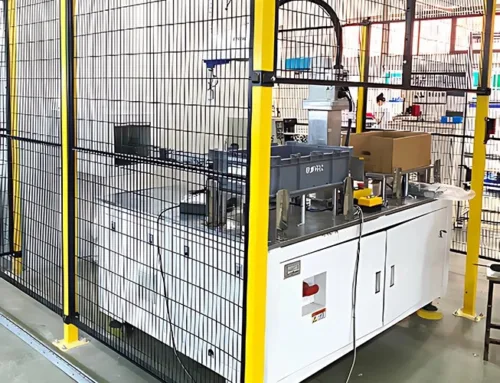
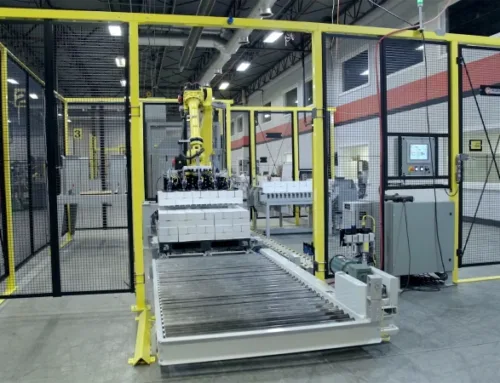
Picture this: You are commissioning a dedicated manufacturing line with multiple 6-axis industrial robots. The area is dense with power cables, pneumatic lines, and heavy material handling equipment. If you use cheap, ungrounded frameless wire mesh, you are introducing a massive risk. A damaged cable from a CNC machining center resting against the fence can turn the entire perimeter into a lethal shock hazard. Furthermore, ungrounded metal can act as an antenna, picking up electromagnetic interference (EMI) from high-power servo motors, which can scramble the signals in your PLC and vision systems, causing phantom machine faults and rejected assemblies.
The Engineering Logic: Q235 Steel & Conductivity (Why It Works)
Unlike aluminum profiles that develop an oxidized insulating layer over time, our Pannelli di recinzione per protezione macchine and posts are constructed from high-tensile Q235 carbon steel. While the exterior features a highly durable, ISO 9227 tested electrostatic powder coating (RAL 1023 Safety Yellow) that acts as an initial insulator against accidental brushing, the steel core provides a highly reliable conductive path.
For system integrators, bonding the Mdfence system is straightforward. The heavy-duty 2.36″ x 2.36″ (60x60mm) posts are anchored directly to the concrete using four M10 x 2.75″ (70mm) expansion bolts. Integrators can easily attach standard grounding lugs to the base plates or utilize the standardized M8 connection nodes to bridge panels with grounding straps, ensuring comprehensive electrical continuity across the entire robotic work cell.

Integrating Safety Interlocks Without Compromising the Circuit (The Result)
When engineering mechanical assemblies, the physical barrier must seamlessly communicate with your control equipment. The worst thing an installer can do is perform “hot work” (drilling or welding) on site to mount safety switches. This burns off the powder coating, invites rapid oxidation from automotive cutting fluids, and can disrupt your grounding path.
We engineered specific lock carriers (like the KKCK-LCK-B-D4NL-SET) designed to perfectly house industry-standard safety interlocks such as Omron D4NL or Pizzato. These pre-fabricated mounting plates bolt directly onto our tubular frames. This means your Safety Torque Off (STO) signals remain pristine, the grounding integrity is untouched, and your factory acceptance test (FAT) passes on the first try.

Preventing Downtime in High-Speed Mechanical Assembly Machines
In an automotive plant, an AGV or forklift bumping into a perimeter guard is a daily occurrence. If you are using cheap, un-framed wire mesh, the impact causes the fence to sag like a hammock. Instantly, your precision-mounted safety interlocks misalign. The PLC registers a breach, the robots emergency-stop, and you suffer a $5,000-per-hour downtime nightmare just to bend a piece of wire back into place.
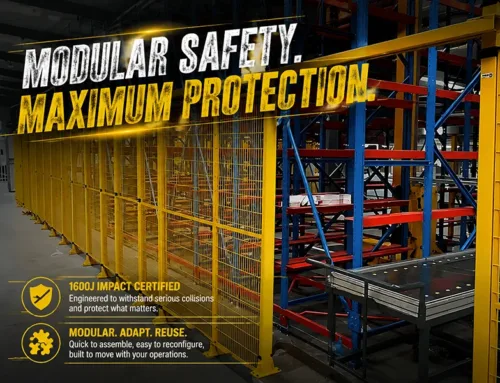
Il nostro robot safety fencing systems utilize a fully welded 0.78″ x 1.18″ (20x30mm) tubular steel frame around every mesh panel. Certified to withstand a 1600 Joule impact—equivalent to stopping a 220 lbs object moving at 12.4 mph—the kinetic energy is transferred through the frame to the heavy-duty posts, not the mesh. The physical structure holds its shape, your interlock keys remain perfectly aligned with the switch bodies, and your automated production line keeps hitting its cycle times.

Managing Access in Electrified Zones with Modular Door Systems
Space is a premium around CNC centers and material handling areas. When maintenance engineers need to access the cell to clear a fault or service a servo drive, they need wide, unobstructed entryways that don’t compromise the structural or electrical integrity of the barrier.
For high-traffic automated zones, we deploy heavy-duty sliding door systems capable of spanning up to 169 inches (4300mm) for forklift access. Every door system includes a heavy-duty top frame beam. This beam ensures the vertical posts remain perfectly parallel, preventing the door from sagging over time. Whether it’s a sliding or folding mechanism, the rigid movement ensures that your safety switches actuate flawlessly every single time the door is cycled, keeping your operators safe and your compliance records clean.

Frequently Asked Questions (Automotive & Automation Integration)
1. How do we electrically ground the Mdfence Q235 steel posts in a robotic welding cell?
Integrators typically scrape a small area of the powder coating near the base plate and attach a standard copper grounding lug using a self-tapping screw or pre-existing bolt hole, then run a grounding strap directly to the facility’s grounding busbar.
2. Will the powder coating on the fence panels interfere with electrical continuity?
Yes, the epoxy polyester powder coating acts as an insulator. To achieve full equipotential bonding across the entire perimeter, grounding jumper wires with star washers (to bite through the coating) should be installed across the panel-to-post connection nodes.
3. Can we mount our Siemens PLC remote I/O blocks directly to the fence panels?
Yes. Because our panels feature a rigid 20x30mm tubular steel frame (unlike flimsy frameless mesh), they possess the structural rigidity to support lightweight electrical enclosures and I/O blocks without warping, though proper cable management and grounding must be observed.
4. What happens to our safety interlock alignment if an AGV hits the fence?
The system is certified to absorb 1600 Joules of impact. The energy is dissipated through the Q235 steel posts and expansion bolts rather than deforming the door frame. This prevents the door from sagging and ensures your Omron or Pizzato interlock keys remain perfectly aligned with the switch.
5. Does the 0.78″ x 3.93″ (20x100mm) mesh size comply with ISO 13857 for robotic reach distances?
Absolutely. The narrow 20mm (0.78 inch) slot prevents fingers from reaching through to the hazard zone. This allows you to install the barrier as close as 4.72 inches (120mm) to the moving parts of your high-speed assembly machine, saving highly valuable floor space in your layout.