IT
IT  EN
EN  DE
DE  RU
RU  PT
PT  JA
JA  ES
ES 

|
In high-throughput automotive assembly plants, your Automated Guided Vehicles (AGVs) and Autonomous Mobile Robots (AMRs) are only as efficient as the pathways they travel. Unplanned pedestrian encroachment and accidental forklift impacts don’t just cause minor delays—they trigger LiDAR safety scanners, initiating cascading E-stops that cripple your line’s Overall Equipment Effectiveness (OEE). You need a physical barrier engineered specifically for dynamic automated logistics. |
The Silent OEE Killer: AGV Pathway Encroachment
Before: The “False Stop” Epidemic
On a busy chassis assembly line, workers frequently take shortcuts across designated AGV routes. Every time a worker’s boot crosses the invisible safety zone of an AMR, the vehicle’s onboard laser scanners trigger an immediate Safe Torque Off (STO). These “false stops” require manual resets, bottlenecking payload transfers and causing upstream CNC machining centers to idle while waiting for material clearance.
Why Our Logic Works: Optical & Physical Superiority
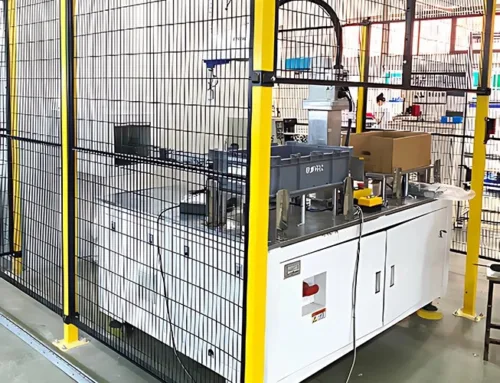
By deploying Recinzione di sicurezza industriale with a specialized framed architecture, you create an undeniable physical boundary. The Mdfence system utilizes a 0.78″ x 3.93″ (20x100mm) narrow mesh. More importantly, the mesh is powder-coated in RAL 9005 (Deep Black). This leverages optical absorption to eliminate glare, ensuring that the AGV’s sensitive vision systems and LiDAR scanners aren’t confused by reflections, while the RAL 1023 (Safety Yellow) posts provide a stark, unmistakable visual warning to human operators.
After: Uninterrupted Material Flow
Pedestrian traffic is strictly funneled through designated, interlocked crossing points. The AGVs can run at their maximum programmed speed (e.g., 2.0 m/s) without constantly decelerating for ghost obstacles, stabilizing your cycle times and maximizing throughput.

Reclaiming Floor Space in High-Density Body Shops
Before: The 33-Inch Dead Zone
When integrating a new robotic welding cell alongside an AGV corridor, space is your most expensive asset. Standard 2″x2″ wire mesh requires a safety reach distance of over 33.4 inches (850mm) according to ISO 13857. Pushing the perimeter guard out that far chokes the AGV pathway, forcing you to program wider, slower turning radii or even preventing two AGVs from passing each other simultaneously.
Why Our Logic Works: The “Finger-Safe” Mesh
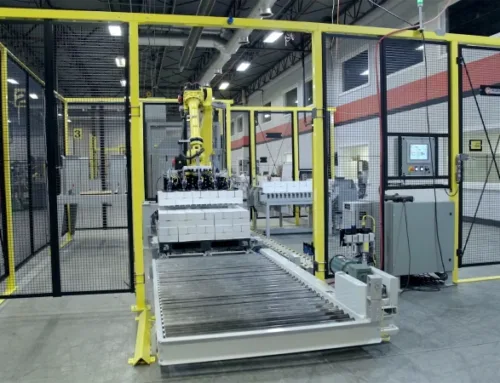
Il nostro Recinzione di sicurezza per robot uses a precision-welded 20x30mm tubular frame housing a 20x100mm mesh. This “anti-climb, finger-safe” geometry strictly limits penetration to the fingertip. Because of this, ISO standards permit the fence to be installed a mere 4.7 inches (120mm) from the hazard zone.
After: Optimized Layouts
You reclaim over 2 feet of linear floor space along the entire length of the automation cell. This extra clearance allows for dual-lane AGV traffic and smoother cornering, entirely eliminating logistics bottlenecks without expanding your facility’s footprint.
Surviving the Forklift Zone: 1600J Impact Resistance
Before: Catastrophic Hardware Damage
In mixed-traffic zones where manual forklifts load heavy engine blocks near AGV charging stations, accidents happen. A reversing forklift bumps into a cheap, frameless wire fence. The fence collapses instantly, and the forklift forks pierce a $50,000 automated charging dock, halting operations for days.

Why Our Logic Works: Engineered Kinetic Dissipation
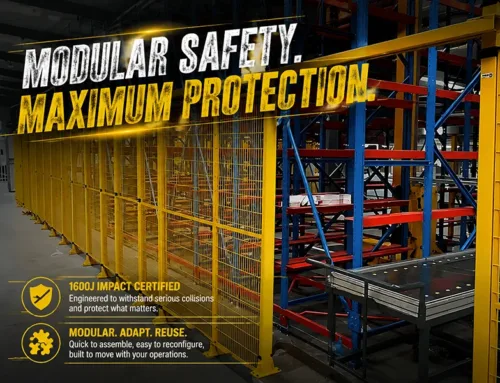
This isn’t just wire; it’s a highly calibrated Sistema di protezione delle macchine. The 2.36″ x 2.36″ (60x60mm) posts are manufactured from high-tensile Q235 cold-rolled carbon steel and secured to the concrete slab via four heavy-duty M10x70mm expansion bolts. When impacted, the Q235 steel undergoes plastic deformation rather than brittle fracture. It is TUV certified to absorb 1600 Joules of impact energy—equivalent to catching a 220 lbs (100 kg) payload moving at 12.4 mph (20 km/h).
After: Asset Preservation
The fence acts as a crumple zone. The post may bend under a severe forklift strike, but it will not break or allow penetration. Your critical AGV infrastructure remains untouched, and replacing a single damaged fence panel takes a maintenance tech exactly 10 minutes using standard hex keys.
Seamless AGV Integration: Wide-Span Sliding Doors
Before: The Swing-Door Bottleneck
Your AGVs need to enter a restricted robot cell to drop off a chassis. Standard hinged doors require massive swing clearance, which forces you to leave large areas of the floor completely empty, wasting premium manufacturing space. Furthermore, heavy single-swing doors tend to sag over time, misaligning the safety interlock switches and causing the line to fault out.

Why Our Logic Works: Track-Guided Sliding Access
Our modular double sliding door systems are engineered for automated logistics. They glide on heavy-duty bearing rails parallel to the fence line, requiring zero swing radius. Capable of spanning up to 14.1 feet (4300mm) wide, they easily accommodate large automated payloads. The rigid framed panels ensure the door never sags, guaranteeing that pre-mounted safety interlocks (like Omron D4NL or Pizzato) align perfectly every single time.
After: High-Speed Payload Transfers
AGVs maneuver through wide, unobstructed entry points without hesitation. The sliding doors interface flawlessly with your PLC, ensuring the cell is in a safe state before the doors open, maintaining strict OSHA and ISO 14120 compliance without sacrificing operational speed.
Frequently Asked Questions (FAQs)
| Will the black mesh interfere with our AGV’s LiDAR scanners? | No. The RAL 9005 deep black powder coating is specifically chosen for its low light-reflectance value. Unlike bright silver or raw aluminum which can cause laser scattering and false readings, the matte black finish absorbs the light, allowing your AGV’s vision systems to clearly distinguish the physical boundary without optical confusion. |
| How close can we install this fence to our automated assembly line? | Thanks to the tightly woven 20x100mm (0.78″ x 3.93″) mesh design, the system restricts human reach to just the fingertips. In accordance with ISO 13857 safety distance calculations, this allows you to install the perimeter guard as close as 4.7 inches (120mm) from the hazard, saving critical floor space. |
| Can the sliding doors integrate with our existing PLC safety interlocks? | Absolutely. We provide dedicated lock carrier plates (such as the KKCK-LCK-B-D4NL-SET) designed specifically to mount industry-standard electronic safety switches like Omron and Pizzato. This ensures a seamless hardware integration into your Safe Torque Off (STO) circuits without the need for on-site drilling or custom fabrication. |
| What happens if a forklift accidentally backs into the perimeter post? | The system is engineered for high-traffic logistics environments. The 60x60mm Q235 carbon steel posts, anchored by heavy-duty expansion bolts, are TUV certified to withstand a 1600 Joule impact. Instead of shattering, the steel undergoes plastic deformation, absorbing the kinetic energy and protecting the automated equipment behind it. |
| Our facility layout changes every time a new vehicle model is introduced. Is this fence reusable? | Yes, the system is 100% modular. It utilizes a mechanical bolt-on connection system (no on-site welding required). During a line changeover, your technicians can quickly unbolt the panels, relocate the posts, and reassemble the entire perimeter in a new configuration, ensuring maximum asset reusability. |