IT
IT  EN
EN  DE
DE  RU
RU  PT
PT  JA
JA  ES
ES 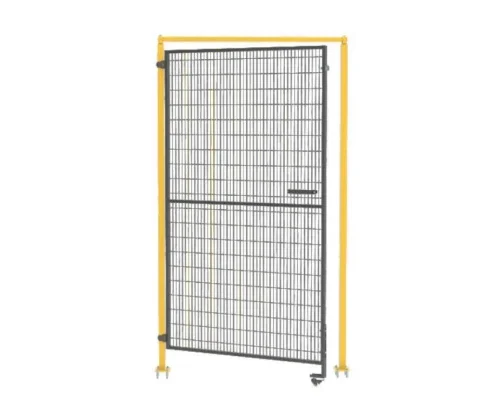

|
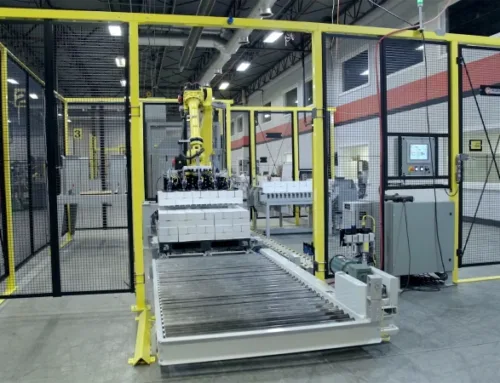
In End-of-Line (EOL) packaging, your palletizing robot’s cycle time is entirely dependent on the reliability of its safety perimeter. When a forklift carrying a 2,000 lbs pallet nudges a flimsy wire mesh, or a sagging access door misaligns your Omron safety switch, the PLC triggers an immediate Safe Torque Off (STO). Your line stops, and OEE plummets. You need a physical barrier engineered specifically for high-payload robotics and heavy forklift traffic, eliminating false trips and protecting your automation investment. |
Reclaiming Floor Space in Tight EOL Layouts: The 4.7-Inch Rule
The EOL Pain Point (Before): Palletizing cells are notorious space hogs. If you use standard 2″x2″ (50x50mm) chain-link or cheap wire mesh, ISO 13857 standards dictate a safety distance of over 33 inches (850mm) to prevent operators from reaching through the mesh and getting struck by the End-of-Arm Tooling (EOAT). This forces system integrators to push the fence far out into the warehouse aisle, constricting forklift traffic and eating up valuable staging footprint.
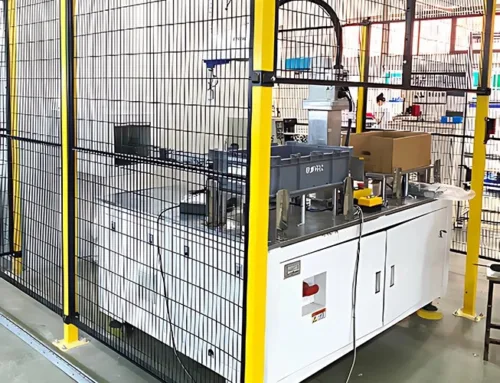
Our Logic (Why it works): We engineered our Recinzione di sicurezza per robot with a highly specific 0.78″ x 3.93″ (20x100mm) “finger-safe” mesh profile. Welded flat into a rigid 20x30mm tubular frame, this narrow slot physically restricts human reach to just the fingertips.

The Actual Benefit (After): By restricting the reach distance, you are legally compliant to install the fence just 4.7 inches (120mm) away from the robot’s maximum dynamic reach. For a standard 6-axis palletizing layout, this reclaims up to 10 square feet of floor space per cell, widening your AGV paths and allowing more automation equipment in the same facility.
Surviving the Forklift Zone: 1600J Impact Resistance
The EOL Pain Point (Before): The staging area where full pallets are picked up is a high-collision zone. When a forklift driver misjudges a turn and backs into a standard frameless fence, the mesh buckles, pops out of its clips, and encroaches into the robot’s work envelope. This requires a complete line shutdown, hot-work permits for welding repairs, and hours of lost production.
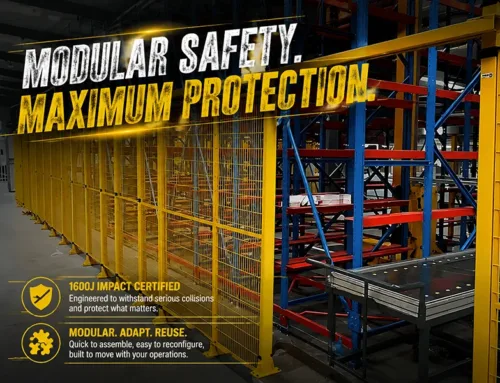
Our Logic (Why it works): Our system relies on structural integrity, not just wire tension. Built from Q235 cold-rolled carbon steel, the 60x60mm posts and fully welded framed panels act as a kinetic energy dissipation system. Certified to withstand a 1600 Joules impact—equivalent to intercepting a 220 lbs mass moving at 12 mph—the steel will plastically deform rather than shatter or detach.
The Actual Benefit (After): When the inevitable forklift bump happens, the Sistemi di protezione delle macchine absorb the blow. The barrier remains intact, the robot continues its cycle safely, and if a panel is severely dented, your maintenance crew can unbolt and swap it out in under 10 minutes with a single hex wrench—zero welding required.
Eliminating Interlock Faults with Rigid Door Systems
The EOL Pain Point (Before): Wide access is mandatory for pallet jacks and maintenance carts. But wide doors are heavy. Over a few months of continuous opening and closing, standard hinges sag. When the door sags even a fraction of an inch, the physical key on the door fails to align with the electronic safety interlock switch (like a Pizzato or Omron unit). The PLC reads this as a breach, abruptly halting the robot mid-cycle and causing a massive headache for the controls engineer.
Our Logic (Why it works): We treat doors as precision mechanical components, not just gates. For wide access, our double hinged doors are supported by heavy-duty caster wheels, while our sliding doors utilize overhead bearing rails. Furthermore, we provide pre-engineered “lock carriers”—standardized mounting plates perfectly matched to the bolt patterns of major safety switches.

The Actual Benefit (After): The geometric stability of the door is guaranteed. The safety key slides perfectly into the interlock every single time, completely eliminating nuisance STO trips caused by mechanical misalignment. Your system integrators save hours on site because they no longer need to drill custom brackets for safety switches.
Frequently Asked Questions (Palletizing Automation Scenarios)
1. How close can we install the fence to a high-speed palletizing robot?
Thanks to our 20x100mm finger-safe mesh design, ISO 13857 calculations allow the fencing to be installed as close as 4.7 inches (120mm) from the robot’s hazard zone, significantly reducing the overall footprint of the cell.
2. Can the fencing withstand a forklift collision in the EOL staging area?
Yes. Our Q235 carbon steel posts and framed mesh panels are certified to absorb 1600 Joules of impact energy. This prevents the barrier from collapsing into the robot’s work envelope during accidental forklift bumps.
3. Do your doors support heavy-duty safety interlocks like Omron or Pizzato for our PLC integration?
Absolutely. We provide pre-fabricated lock carriers and mounting plates specifically designed for industry-standard electronic safety switches, ensuring perfect alignment without on-site drilling.
4. What is the standard height required for a heavy payload robot cell?
For high-reach palletizing robots, we typically deploy our 78.7-inch (2000mm) or 86.6-inch (2200mm) standard heights. If your EOAT swings higher, we can customize post and panel heights up to 96 inches (2440mm) to ensure full compliance.
5. How do we accommodate pallet conveyor outfeeds through the fence?
We utilize modular tunnel guards. We customize the mesh opening to perfectly wrap around your outfeed conveyor, allowing full pallets to exit the cell while maintaining the strict safety distances required to prevent operator entry.