IT
IT  EN
EN  DE
DE  RU
RU  PT
PT  JA
JA  ES
ES 

|
When integrating 6-axis robots or high-speed CNC machining centers into existing facilities, every square inch of floor space translates to thousands of dollars in manufacturing real estate. Traditional fencing forces you to waste valuable aisle space to meet safety distances, choking your AGV pathways and material handling routes. You need a physical barrier that shrinks the footprint without compromising ISO compliance or PLC integration. |
The “Reach Distance” Dilemma in High-Density Automation Cells
The Pain Point (Before): In tight automated assembly lines, using generic 2×2 inch (50x50mm) wire mesh is a critical engineering mistake. Because human fingers can easily pass through large gaps, ISO 13857 standards dictate that the fence must be installed up to 33.5 inches (850mm) away from the hazard. This massive safety buffer eats into your operational footprint, making it impossible for forklifts or autonomous mobile robots (AMRs) to navigate narrow aisles between robot work cells.
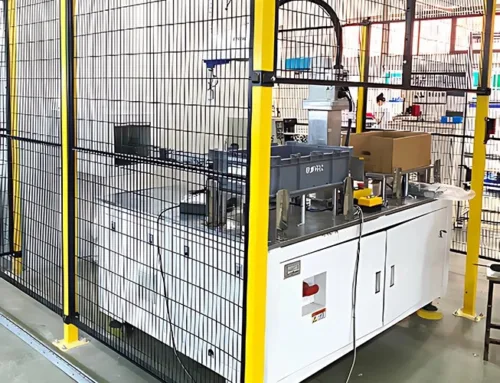
Our Logic (Why it works): We engineered our Recinzione di sicurezza industriale with a highly restrictive 0.78 x 3.93 inches (20x100mm) mesh profile. This anti-climb, finger-safe design physically blocks the upper limbs from reaching through the barrier.
Actual Benefit (After): By restricting access to just the fingertips, you can legally and safely shrink the installation distance to a mere 4.7 inches (120mm) from the hazard. For a standard 150-foot robotic welding line, this reclaims over 350 square feet of premium floor space, allowing you to widen logistics channels or squeeze in an additional CNC machine.

Surviving AGV Traffic and Forklift Collisions
The Pain Point (Before): Flimsy, frameless wire mesh panels bend permanently when an operator leans on them. Worse, if a forklift or a stray AGV bumps into the perimeter, the entire structure collapses, triggering emergency stops, damaging your $100k KUKA robot, and causing catastrophic downtime for the entire shift.
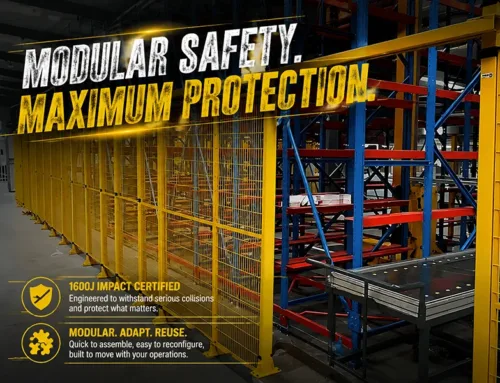
Our Logic (Why it works): Our system relies on heavy-duty Q235 carbon steel posts (2.36 x 2.36 inches / 60x60mm) anchored directly into the concrete with four M10x70mm expansion bolts. The panels feature a fully welded 20x30mm tubular steel frame. This engineered structure is TUV-certified to withstand an impact force of 1600 Joules.
Actual Benefit (After): The fence acts as a physical insurance policy. It can successfully absorb and deflect the kinetic energy equivalent to a 220 lbs (100 kg) object crashing into it at 12 mph (20 km/h) without structural failure. Your expensive automation equipment remains untouched, and cycle times continue uninterrupted.

Seamless PLC Integration Without “Hot Work”
The Pain Point (Before): System integrators often waste hours on the shop floor drilling into painted steel posts to mount safety interlocks. This “hot work” creates metal shavings that can contaminate nearby sensitive servo drives and vision systems. Furthermore, field-drilled holes instantly compromise the powder coating, leading to rust within months.
Our Logic (Why it works): We treat Sistemi di recinzione di sicurezza per robot as an active component of your control logic, not just dumb steel. We provide pre-engineered lock carriers specifically designed for industry-standard electronic safety switches (like Omron D4NL or Pizzato). The entire system utilizes a modular clamp-and-bolt design.
Actual Benefit (After): You achieve a 100% cold-assembly process. Your technicians can bolt on the safety switches perfectly aligned on the first try, seamlessly integrating the access doors into the machine’s Safety Torque Off (STO) circuit. Commissioning time is slashed by 40%, and you completely eliminate the need for hazardous hot work permits.
Maximizing Clearances with Sliding Door Systems
The Pain Point (Before): In tight material handling areas, a standard hinged door requires a massive swing radius. When opened, it blocks the aisle, forcing AGVs to halt and disrupting the entire logistics flow.
Our Logic (Why it works): For confined layouts, we deploy heavy-duty sliding doors utilizing upper bearing rails or bottom rollers, supporting spans up to 14.1 feet (4300mm) wide.
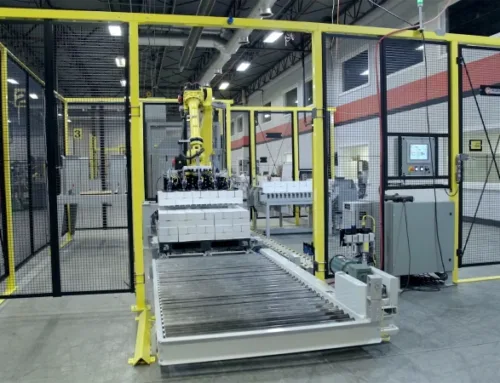
Actual Benefit (After): The door glides parallel to the fence line, consuming zero aisle space during operation. Forklifts can easily access the robotic palletizing cell to remove finished goods without forcing adjacent traffic to stop.

Frequently Asked Questions for Automation Integrators
| How close can I install the fence to a 6-axis robot? | Thanks to our 20x100mm narrow mesh design, ISO 13857 standards allow the fencing to be installed as close as 4.7 inches (120mm) from the hazard, maximizing your usable floor space. |
| Can we mount Omron safety switches without drilling on-site? | Yes. We provide pre-engineered lock carriers (e.g., KKCK-LCK-B-D4NL-SET) designed specifically for Omron and Pizzato interlocks, enabling plug-and-play integration into your PLC without any hot work. |
| What is the impact rating against AGV or forklift collisions? | The system is TUV-certified to withstand up to 1600 Joules of impact energy, which is equivalent to stopping a 220 lbs (100 kg) mass moving at 12 mph (20 km/h) without structural penetration. |
| Do your sliding doors sag over large spans in material handling areas? | No. Our sliding doors are constructed with 20x30mm framed panels and utilize a heavy-duty upper bearing rail system and door frame beams to ensure smooth, sag-free operation even at widths up to 14.1 feet (4300mm). |
| How does the system accommodate overhead crane loading? | The modular design allows for a top-open layout. You can easily define the perimeter to protect floor-level workers while leaving the top clear for overhead cranes to drop heavy engine blocks or CNC tooling directly into the cell. |