IT
IT  EN
EN  DE
DE  RU
RU  PT
PT  JA
JA  ES
ES 
Safety fencing machine guarding for press machines?

|
Operating high-tonnage press machines and press brakes means dealing with violent stamping cycles, the constant threat of flying metal shrapnel, and tight floor space. When your facility relies on cheap, frameless wire mesh, a single piece of ejected scrap or an accidental forklift bump during a heavy die changeout can destroy the barrier, leading to immediate OSHA citations for unguarded pinch points and costly unplanned downtime. You don’t just need a visual boundary; you need a structural energy-absorbing shield engineered for the harsh realities of the metalworking floor. |
The Reality of Press Room Hazards: Why Standard Mesh Fails
In a metal stamping plant, the environment is unforgiving. A 500-ton mechanical press generates severe vibrations that can rattle standard T-slot aluminum or flimsy welded wire apart within months. Furthermore, the risk of part ejection or tooling failure requires a barrier that won’t behave like a hammock when struck. Before upgrading to engineered Sistemi di protezione delle macchine, many EHS managers struggle with continuous maintenance headaches: weld points snapping under vibration, doors sagging and causing safety interlocks to misalign, and aggressive oil mist corroding the steel.

The Engineered Solution for Metal Stamping Lines
1. Defeating Flying Scrap with 1600J Impact Resistance
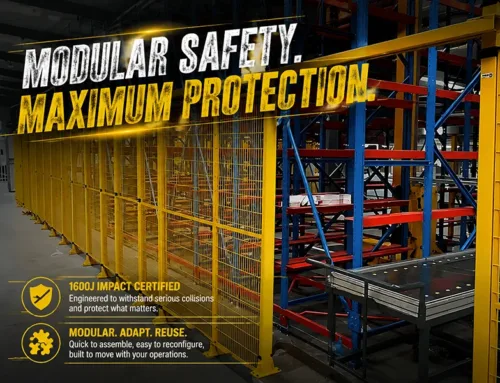
To survive a press room, a guard must absorb kinetic energy without fracturing. The Mdfence system utilizes high-tensile Q235 carbon steel. Unlike frameless designs, our panels feature a fully welded 20x30mm (0.78″ x 1.18″) tubular steel frame. This architecture distributes point loads across the entire panel structure. Certified to withstand an impact force of 1600 Joules—equivalent to stopping a 220 lb (100 kg) object moving at 12 mph—it effectively contains flying workpieces and prevents catastrophic secondary injuries, ensuring your point-of-operation guarding remains intact.
2. Reclaiming Floor Space with Finger-Safe Mesh
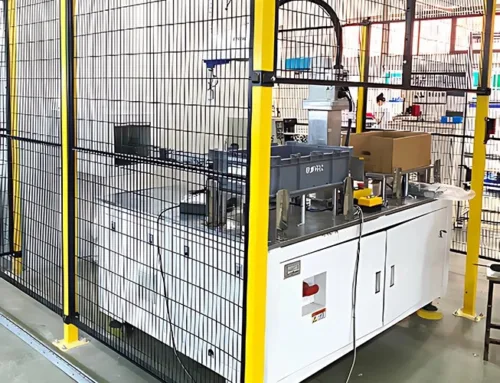
Space around a press is premium real estate needed for scrap conveyors, coil feeders, and operator movement. Standard 2″x2″ (50x50mm) mesh allows fingers to pass through, forcing you to install the perimeter up to 33.5 inches (850mm) away from the hazard zone to comply with ISO 13857 reach distances. Our specialized 0.78″ x 3.93″ (20x100mm) anti-climb mesh restricts penetration to just the fingertips. This simple physical property allows you to legally and safely shrink the safety distance down to just 4.7 inches (120mm) from the press pinch points, reclaiming nearly 10 square feet of usable floor space per machine.
3. Streamlining Die Changeouts with Modular Access
Tooling changes are the bottleneck of stamping operations. When a massive progressive die needs to be swapped, overhead cranes and heavy-duty forklifts must access the press bed. Fixed, welded-in-place fencing turns a 30-minute die changeout into a 4-hour ordeal. Mdfence solves this with top-open layouts and heavy-duty sliding door systems.

Our double sliding doors provide massive clear openings (up to 14 feet / 4300mm wide) without consuming swing space. Equipped with heavy-duty bearing rails, these doors glide effortlessly and maintain perfect alignment, ensuring that forklift operators have unimpeded access to load dies directly onto the bolsters.
Integrating with Press Machine Safety Controls
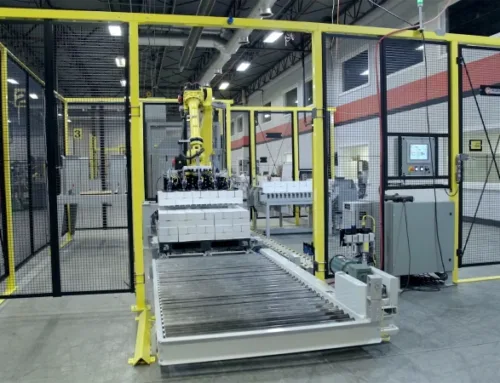
A physical barrier is only half the equation; it must communicate with the press’s control logic. Whether you are guarding a standalone hydraulic press or integrating Recinzione di sicurezza per robot for an automated press-tending cell, the access doors must tie into the Safety Torque Off (STO) circuit. We provide pre-engineered lock carriers and mounting plates specifically designed for industry-standard interlocks (like Omron D4NL or Pizzato switches). This eliminates the need for on-site drilling—which creates metal shavings and ruins the anti-corrosion powder coating—ensuring a plug-and-play integration with your PLC.

Before & After: Upgrading Your Press Guarding
| Operational Phase | Before (Traditional Welded Mesh) | After (Mdfence Modular System) |
|---|---|---|
| Installation & Setup | Required hot work permits. Welding sparks threatened nearby oil mist, forcing complete line shutdowns. | Cold assembly using only wrenches. No sparks, no dust. Installed alongside active press lines without halting production. |
| Daily Stamping Operations | Vibration caused hinges to sag. Safety interlocks misaligned, triggering phantom E-stops and ruining production rhythm. | Rigid tubular frames and bearing-guided sliding doors maintain perfect millimeter alignment. Zero false machine stops. |
| Die Changeouts & Maintenance | Maintenance crews had to cut fencing away with angle grinders to access the press bed for major repairs. | Standardized clips allow technicians to unbolt and remove a panel in 10 minutes, fully restoring the Recinzione di sicurezza industriale afterward. |
Frequently Asked Questions (Press Machine Guarding)
1. Can this fencing withstand the constant vibration of a high-speed stamping press?
Yes. Unlike aluminum profiles where T-nuts vibrate loose, our Q235 steel system uses M8x16 hex screws and heavy-duty connection clips that rigidly lock the framed panels to the 60x60mm posts, easily absorbing continuous mechanical shock.
2. How does the powder coating hold up against stamping lubricants and oil mist?
Our epoxy-polyester electrostatic powder coating undergoes rigorous ISO 9227 salt spray testing. It acts as a highly durable barrier against aggressive industrial cutting fluids, drawing oils, and ambient oil mist common in stamping facilities.
3. We use overhead cranes to load dies. Will the fencing get in the way?
Not at all. The modular nature of our system allows for “top-open” configurations. We can design wide sliding doors or easily removable panels specifically to accommodate the vertical drop paths of overhead cranes during tooling changes.
4. What is the required safety distance for your 20x100mm mesh?
According to ISO 13857 standards for preventing upper limb access, a 20mm slot width prevents finger and hand penetration. This allows the guarding to be legally installed as close as 120mm (4.7 inches) from the hazard zone.
5. Can we mount our existing light curtains directly to your fence posts?
Yes. The flat surfaces of our 60x60mm steel posts provide a stable, vibration-resistant mounting base for light curtain transmitters and receivers, seamlessly integrating optical safety with physical perimeter guarding at manual loading stations.