IT
IT  EN
EN  DE
DE  RU
RU  PT
PT  JA
JA  ES
ES 

|
When designing automated production lines or high-speed mechanical assembly machines, relying solely on electro-optical sensors leaves your high-value assets vulnerable. A light curtain will trigger an Emergency Stop, but it cannot physically stop a 220 Lbs (100kg) metal part ejected from a CNC machining center, nor can it prevent a forklift from backing into a $100,000 KUKA robot. To truly secure your robotics layouts without sacrificing OEE, you need a physical barrier engineered for impact. |
The Fundamental Difference: Active Sensing vs. Passive Physical Defense
In the realm of industrial automation safety, understanding the distinction between a safety light curtain and a Recinto di sicurezza industriale system is critical for EHS managers and system integrators. A safety light curtain is an optoelectronic device; it creates a virtual sensing field at manual loading stations. If an operator’s hand breaks the beam, the PLC instantly cuts power to the servo motors. However, it provides zero physical resistance.
Conversely, a physical safety fence is a passive defense mechanism. It is designed to absorb and dissipate kinetic energy. In an automotive welding station where weld spatter, flying debris, or runaway AGVs are daily realities, a robust physical perimeter is the only way to comply with OSHA machine guarding requirements and protect both personnel and sensitive electro-optical elements.
The Pain Point in Robotics Layouts: Wasted Space and Sagging Doors
Before implementing a standardized solution, system integrators often face a nightmare with generic wire mesh. Traditional, cheap frameless mesh uses large 2×2 inch (50x50mm) openings. According to ISO 13857 standards for reach distances, this large mesh allows a worker’s entire arm to pass through, forcing you to install the Pannelli di recinzione per protezione macchine up to 33.5 inches (850mm) away from the hazard. In a tight CNC machining cell, wasting nearly 3 feet of perimeter space per machine destroys your floor plan efficiency and blocks AGV paths.
Furthermore, traditional installations require “hot work” (on-site welding). This means halting adjacent production lines, dealing with toxic fumes, and ending up with misaligned doors. When a cheap door sags, the safety interlock switch (like an Omron D4NL) misaligns. The PLC reads an open circuit, causing phantom machine stops that plummet your Overall Equipment Effectiveness (OEE).
The Engineering Logic: Framed Architecture & Finger-Safe Mesh
To eliminate these integration bottlenecks, the Mdfence system utilizes a heavily engineered, fully welded structural approach.

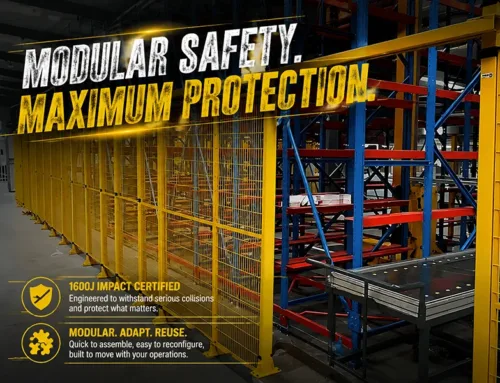
Unlike flimsy alternatives, our framed panels feature a continuous 0.78″ x 1.18″ (20x30mm) Q235 carbon steel tubular frame. The wire mesh is flat-welded directly to this frame, eliminating burrs and creating exceptional out-of-plane stiffness. This structure is TUV-certified to withstand a 1600 Joules impact—capable of stopping a 220 Lbs object moving at 12.4 mph (20 km/h).
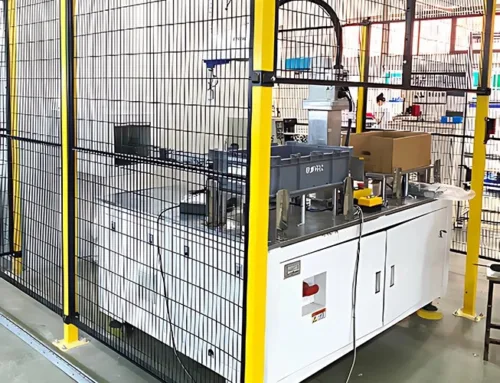
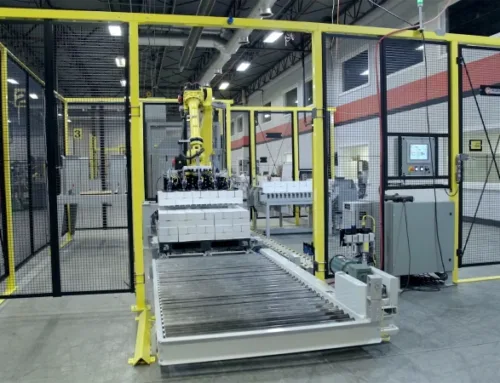
More importantly, the mesh spacing is optimized to a narrow 0.78″ x 3.93″ (20x100mm). This “finger-safe” design strictly limits penetration, allowing you to legally and safely install the Sistemi di recinzione di sicurezza per robot just 4.7 inches (120mm) away from the moving robotic arm. This reclaims massive amounts of high-value manufacturing real estate.
The Aftermath: Plug-and-Play PLC Integration
For system integrators, a physical fence must communicate with the control equipment. Field drilling into painted steel to mount safety switches ruins the powder coating and invites rust.

Mdfence solves this with pre-engineered safety interlock carriers (e.g., KKCK-LCK-B-D4NL-SET). These mounting plates are precisely machined to fit industry-standard switches like Omron or Pizzato. This transforms a passive barrier into an active node in your emergency stop circuit. The assembly is 100% cold-work—using bolts and brackets—dropping your Mean Time To Repair (MTTR) and eliminating the need for hot work permits.
Workflow Transformation: Traditional vs. Modular Guarding
| Integration Phase | Traditional Welded Mesh (Before) | Mdfence Modular System (After) |
|---|---|---|
| Installazione | Requires hot work permits. Sparks and grinding dust contaminate CNC coolant and optical sensors. | Cold assembly using M8 bolts. Zero dust, zero sparks. Can be installed directly next to running assembly lines. |
| Space Optimization | Large 2×2″ mesh requires up to 33.5″ safety clearance from moving robots, wasting floor space. | Finger-safe 0.78×3.93″ mesh allows installation just 4.7″ from hazards, widening AGV pathways. |
| Control Integration | Hinges sag over time, causing safety interlocks to misalign and triggering false PLC stops. | Rigid framed doors with pre-drilled brackets ensure Omron/Pizzato switches align perfectly every time. |
Managing Material Flow: Sliding Doors and AGV Access
In dedicated manufacturing lines, material handling areas require wide access points for forklifts and automated guided vehicles (AGVs). A standard hinged door requires too much swing clearance.

By integrating a double sliding door system suspended on heavy-duty bearing rails, you can achieve an opening width of up to 169 inches (4300mm) without compromising the structural integrity of the perimeter. This setup is ideal for combining with safety light curtains at the entry point: the physical fence protects the static perimeter, while the light curtain mutes temporarily to allow the AGV to enter the testing of products area, maintaining a seamless, turnkey solution.
Wide Access for Heavy Machinery Maintenance
When routine maintenance requires swapping out heavy servo motors or tooling inside a CNC center, you need maximum clearance.

Our double hinged doors are equipped with caster wheel kits to support the weight of wide spans (up to 118 inches / 3000mm). This prevents the door frame beam from bowing and ensures that the mechanical assemblies remain perfectly square. The result is a door that opens smoothly for a forklift carrying a heavy die, and closes precisely to re-engage the safety circuit without tedious manual realignment.
Frequently Asked Questions (FAQs)
1. Can a safety light curtain replace a physical fence in a CNC machining center?
No. A light curtain only sends an electrical stop signal. It cannot physically block flying debris, broken tooling, or ejected parts from a lathe or milling machine. A physical Q235 steel fence is required to absorb kinetic impacts and protect operators.
2. How does the 20x100mm mesh save floor space in robotics layouts?
According to ISO 13857, the distance a hazard must be guarded depends on the size of the fence opening. Our narrow 0.78″ (20mm) slot prevents fingers from reaching through, allowing the fence to be legally installed just 4.7″ (120mm) from the robot, saving valuable square footage compared to standard 2×2″ mesh.
3. Do I need to drill holes to mount my Omron or Pizzato safety switches?
No. Field drilling compromises the powder coating and structural integrity. We provide pre-engineered safety interlock carriers (mounting plates) that bolt directly onto the frame, ensuring perfect alignment with your PLC control equipment out of the box.