IT
IT  EN
EN  DE
DE  RU
RU  PT
PT  JA
JA  ES
ES 
 |
The end-client just requested a last-minute layout change. The robot’s end-of-arm-tooling has a wider swing than the initial CAD file showed. Now, the entire safety perimeter for the new automated production line is off by six inches. With a traditional welded fence, this means angle grinders, hot work permits, and a blown project timeline. There is a better way. |
Absolutely. You can and should be able to adjust your safety fence after installation. In the world of automation integration, change is the only constant. Client needs evolve, equipment footprints are finalized late, and unforeseen obstacles emerge during commissioning. The critical question isn’t just if you can adjust your fence, but how that adjustment process impacts your project’s timeline, budget, and final EHS acceptance.
A rigid, welded-on-site barrier system treats your Sistemi di protezione delle macchine as a permanent, immovable fixture. This philosophy clashes directly with the dynamic reality of modern manufacturing. Let’s break down why a modular, bolt-together approach is not just a convenience, but a core requirement for successful system integration.
The Old Way: The High Cost of “Permanent” Fencing Adjustments
Imagine the scenario: a conveyor line needs to be rerouted, or a maintenance access point is suddenly required. With a guard fence that was welded in place, the “adjustment” process is actually a demolition and reconstruction project:
- Hot Work Permits: First, you halt production in the surrounding area and apply for a hot work permit. This involves safety checks, fire watches, and significant administrative overhead.
- Destructive Removal: An angle grinder is brought in, sending sparks and abrasive dust everywhere. The original powder-coated finish is destroyed, and the floor is often scarred.
- Fabrication & Rework: The cut sections are modified, re-welded, and ground down. The process is loud, messy, and creates fumes.
- Compromised Protection: The area is then repainted with a brush or spray can, which never matches the durability of the original factory finish. These reworked joints become the first points of failure and rust, especially in environments with cutting fluids or wash-down cycles.
This entire ordeal can take a full day or more, leading to costly downtime and project delays—all to move a fence line by a few inches.
The Mdfence Logic: A System Engineered for Adaptation
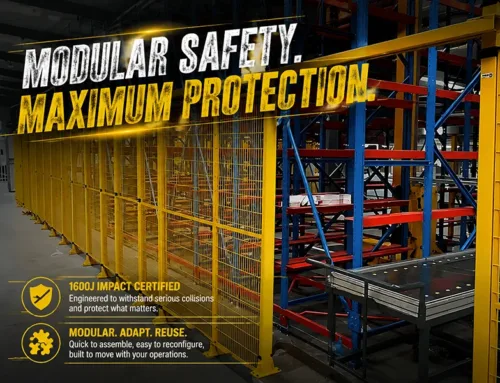
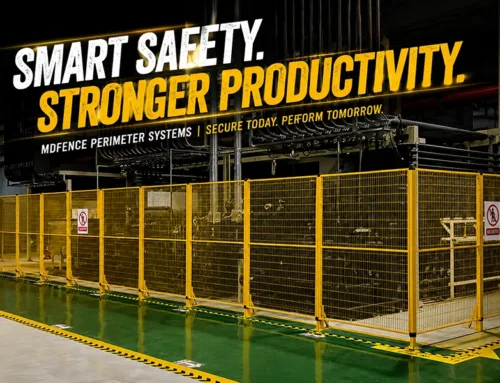
Our entire philosophy is built on the premise that your facility’s layout will change. Mdfence is not just a barrier; it’s a modular construction system designed for rapid, non-destructive reconfiguration. The ability to adjust is built into its DNA.
Bolt-Together Assembly: The Key to Flexibility
Instead of welding, the Mdfence system relies on high-strength steel clamps and M8 bolts. Our robust 60x60mm posts, made from Q235 carbon steel, are pre-drilled or designed to be used with clamps that require no drilling at all. This preserves the structural integrity and the corrosion-resistant powder coating of every component.

The process of erecting or modifying a fence line is a simple, mechanical “cold assembly” process:
- Position the Post: The post is anchored to the concrete floor using expansion bolts.
- Attach the Clips: Steel fixing rings are loosely bolted onto the post.
- Set the Panel: The framed mesh panel is seated into the bottom clips.
- Secure the Top: The top clips are put in place and all bolts are tightened with a standard hex wrench.
That’s it. No sparks, no fumes, no compromised coatings. Adjusting a panel is as simple as reversing this process, which can be done by a single technician in under 10 minutes.
Standardization That Empowers Customization
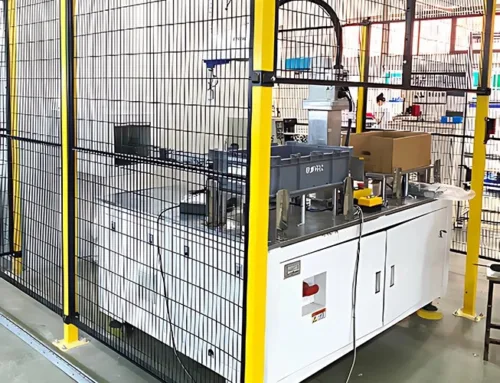
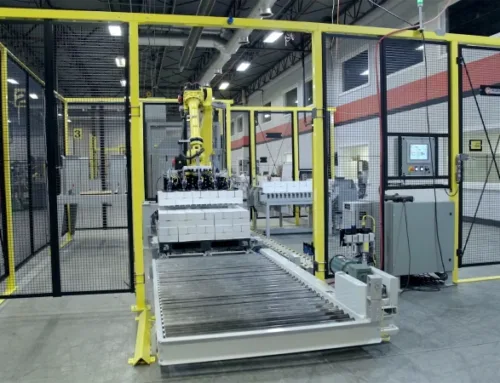
Because all our components—panels, posts, doors, and hardware—are standardized, they are completely interchangeable. Need to replace a solid 1200mm wide panel with a single hinged door? Simply unbolt the panel and bolt in the pre-assembled door kit. The mounting points are identical. This modularity allows you to adapt your Recinzione di sicurezza per robot as your automation needs evolve, whether that means adding a new cell, expanding an existing one, or creating a temporary quality inspection area.

From Theory to Reality: Adjustability That Protects Your Project
The ability to easily adjust your safety fence translates directly into tangible benefits for any automation integrator or plant manager.
| Scenario | The Mdfence Solution (The “After”) |
| Last-Minute Layout Shift | A robot work cell needs to be shifted by 10 inches. The entire fence line is unbolted from the floor, moved, and re-anchored in a matter of hours, not days. All components are reused with zero material waste. |
| New Maintenance Access Point | During commissioning, a technician realizes they need easier access to a motor. A standard mesh panel is unbolted and replaced with a pre-configured hinged door kit, complete with a mounting plate for the required safety interlock switch. The change is completed during a lunch break. |
| Production Line Re-tooling | An automotive line is being retooled for a new model. The existing Recinto di sicurezza industriale is completely disassembled and stored. It is then re-deployed in a new configuration for the new line, resulting in a 95% asset reuse rate and massive cost savings. |
Ultimately, a modular safety fence transforms from a sunk cost into a flexible, long-term asset. It de-risks your projects by giving you the power to adapt to the inevitable changes that occur on the factory floor. You can confidently pass the final EHS audit, knowing that every component meets ISO 14120 standards and that no on-site modifications have compromised its certified safety rating.
So, can you adjust your safety fence after installation? With the right system, the answer is an emphatic “yes”—and doing so will save your timeline, your budget, and your sanity.
Frequently Asked Questions for Automation Integrators
1. How quickly can a section of Mdfence be reconfigured?
A single standard panel can typically be removed or replaced by one person in about 10-15 minutes using a basic hex wrench. Moving an entire multi-panel fence line depends on the length, but the process is mechanical and predictable, avoiding the lengthy delays associated with welding and fabrication.
2. Do I need special tools or a hot work permit to make adjustments?
No. All assembly and adjustments are done with standard hand tools (like hex wrenches and a socket set for floor anchors). This is a “cold assembly” process, completely eliminating the need for hot work permits, fire watches, and the associated risks and administrative burdens.
3. Can I add a new gate or access point to an existing fence line later?
Yes. This is a primary advantage of our modular system. You can easily unbolt one or more standard panels and install a pre-assembled hinged, sliding, or folding door kit in their place. We also provide pre-engineered mounting plates for common safety interlock switches (like Omron or Pizzato) to make integration seamless.
4. How does the system accommodate uneven factory floors?
Our posts can be shimmed at the base during anchoring to ensure they are perfectly plumb, even on slightly sloped or uneven concrete floors. The flexibility in the mounting clips also allows for minor variations, ensuring a secure and aligned fence line.
5. Are all Mdfence components interchangeable if I want to expand a work cell in the future?
Absolutely. All our standard posts, panels, and doors are designed with interchangeability in mind. You can purchase additional components years later and they will integrate perfectly with your existing installation, protecting your initial investment and allowing your safety infrastructure to scale with your operations.