IT
IT  EN
EN  DE
DE  RU
RU  PT
PT  JA
JA  ES
ES 
 |
Your new robotic welding cell is a productivity powerhouse, but the makeshift guarding around it is an EHS nightmare. Weld spatter is already pitting the surface, maintenance requires a hot work permit to cut and re-weld the cage, and you know it wouldn’t pass a serious safety audit. The risk of a part ejection or a failed interlock is a constant source of anxiety, threatening both your team and your production targets. |
Stop Treating Your Welding Cell Guarding as an Afterthought
A robotic welding cell is one of the most hostile environments in modern manufacturing. It’s a concentrated zone of intense heat, UV radiation, high-speed motion, and corrosive fumes. Yet, many facilities protect these six-figure investments with little more than locally welded angle iron and “chain-link” style mesh. This “good enough” approach isn’t just a compliance risk; it’s a direct threat to your Overall Equipment Effectiveness (OEE).
Traditional welded barriers or low-cost fencing create predictable problems:
- Spatter Damage and Corrosion: Hot weld spatter instantly burns through cheap paint, exposing the raw steel underneath. Within months, especially in humid environments, these burn points become rust blooms, creating an unprofessional look and failing EHS inspections.
- Maintenance Nightmares: When a robot needs servicing or a fixture needs to be swapped, a welded cage becomes a prison. Maintenance teams are forced to get a hot work permit, bring in an angle grinder, and physically cut an opening—a process that can take hours, filling the air with hazardous dust and halting production.
- Compliance Gaps: Most generic fencing uses large 2×2 inch (50x50mm) mesh. Per ISO 13857, this requires a significant safety distance, wasting valuable floor space. Worse, they lack the structural integrity to contain a part ejected by a malfunctioning robot, turning a process failure into a catastrophic safety event.
Engineered Defense: A System Built for Welding’s Realities
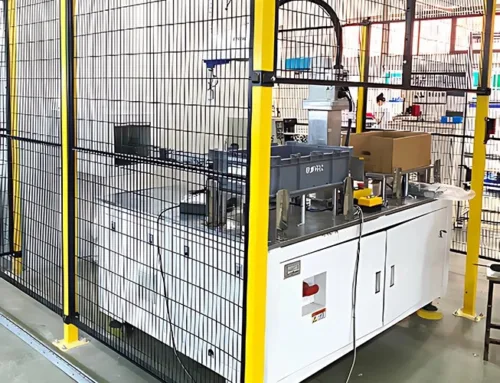
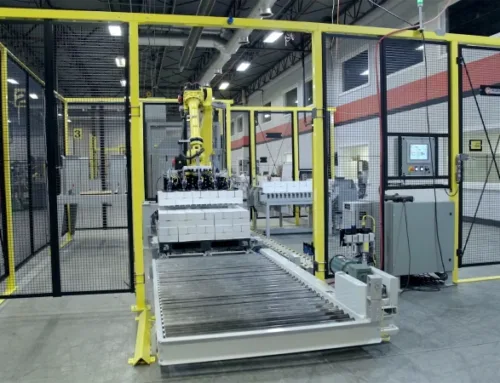
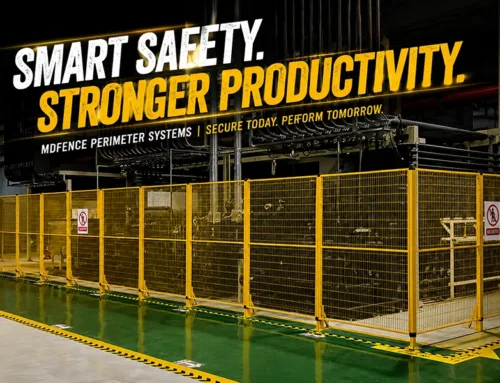
A professional Recinzione di sicurezza per robot system isn’t just a barrier; it’s an integrated component of your automation. Mdfence systems are designed from the ground up to counter the specific hazards of a welding cell.
The Foundation: Material Science That Resists the Heat
The core of our system is high-tensile Acciaio al carbonio Q235, but the real defense against the welding environment is its surface. Each component, from the 2.4×2.4 inch (60x60mm) posts to the panel frames, is protected by an electrostatic powder coating. Unlike spray paint, this process creates a thick, durable polymer shell that is thermally bonded to the steel.
Why it matters for welding: This tough coating resists pitting from incidental weld spatter and provides a robust barrier against the corrosive effects of cleaning agents or cutting fluids present in the cell, passing ISO 9227 salt spray tests to ensure long-term structural integrity.

The Structure: Certified Impact Resistance for a Volatile Process
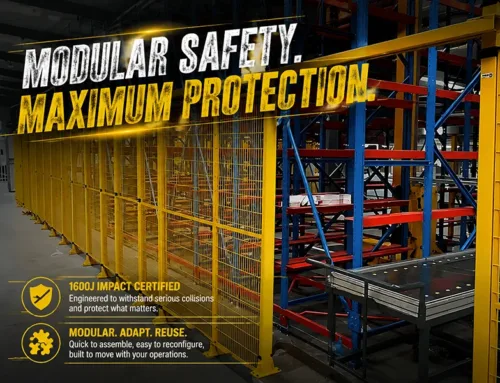
A welding cell is a dynamic environment. A robot arm can malfunction, or a pneumatic clamp can fail, launching a 50-pound fixture or workpiece at high speed. Our Protezione delle macchine panels are not just wire mesh; they are a fully-welded assembly. A 0.8×1.2 inch (20x30mm) tubular steel frame provides exceptional rigidity, and the entire panel is certified to withstand an impact of 1600 Joules.
What does 1600J mean? It’s the equivalent of stopping a 220-pound (100kg) object moving at over 12 mph (20 km/h). This certified performance ensures that in a failure scenario, the energy is absorbed and contained, preventing a projectile from escaping the cell and injuring personnel or damaging adjacent equipment.

The Access: Modularity That Boosts Uptime
The biggest hidden cost of a welded cage is downtime. Our modular, bolt-together system transforms maintenance access from a destructive, multi-hour ordeal into a simple, 10-minute task. Need to get a forklift in to swap a large fixture? Simply unbolt a few panels. Need to replace a single panel damaged by a collision? It’s a quick swap with a standard wrench.
More importantly, our door systems are designed for seamless integration with your safety PLC. We provide pre-engineered mounting plates for industry-standard safety interlocks like Omron, Pizzato, or Schmersal. This eliminates custom fabrication and ensures your gate’s “door open” signal reliably triggers the Safe Torque Off (STO) function in your robot controller, every single time.

From a Liability to a Lean Asset
By switching to a purpose-built Recinzione di sicurezza industriale system, your welding cell transforms. You move from a state of constant worry to one of confident control.
| Dimension | Before: Welded or Low-Cost Fencing | After: Mdfence Modular Guarding System |
|---|---|---|
| Safety & Compliance | Fails EHS audits due to rust, structural weakness, and improper safety distances. High risk of injury from projectiles. | Passes stringent Tier-1 automotive and OSHA audits. Certified 1600J impact rating contains hazards. |
| Maintenance (MTTR) | 2-4 hours of downtime for access, requiring hot work permits, angle grinders, and post-repair welding/painting. | 10 minutes to remove a panel with a single tool. No hot work, no fumes, no repainting required. |
| Flessibilità | Permanent installation. If the cell is moved or modified, the entire cage becomes scrap metal, a total loss of investment. | 100% reusable. The system can be disassembled and reconfigured as your production layout evolves, protecting your investment. |
| Visual Management | Galvanized or yellow mesh creates glare from the welding arc, making visual inspection difficult for operators. | Standard black mesh absorbs light, reducing glare and providing a clear, unobstructed view of the process for better monitoring. |
Frequently Asked Questions for Welding Cell Applications
1. How does the powder coating hold up against direct, heavy weld spatter?
While the electrostatic powder coating is highly durable and resists incidental spatter and heat, no coating is indestructible against a direct, sustained molten metal blast. For areas in the immediate path of heavy spatter (e.g., directly beside a spot-welding tip), we can substitute standard mesh panels with solid steel sheet panels to provide a non-combustible, fully protective barrier.
2. Can I mount my company’s standard safety interlock switch, or am I locked into your hardware?
Our system is designed for open integration. We offer a range of pre-drilled mounting plates and lock carriers specifically designed for popular safety switches from manufacturers like Omron (e.g., D4NL series), Pizzato, Schmersal, and Allen-Bradley. This ensures a clean, robust, and reliable installation without any on-site drilling or fabrication.
3. We use an overhead crane to load heavy jigs and fixtures into our welding cells. How does your system accommodate this?
This is a common requirement. Our systems are typically designed with an open-top configuration, allowing full, unobstructed access for overhead cranes. We engineer the post height and layout to create a secure perimeter at ground level while leaving the vertical space clear for material handling operations.
4. Why is a 1600 Joule impact rating so important for a welding application?
In robotic welding, the robot is often handling heavy, awkwardly shaped metal parts or entire sub-assemblies. A programming error, a dropped part, or a pneumatic gripper failure can turn that workpiece into a dangerous projectile. The 1600J rating provides certified assurance that the physical barrier can withstand this predictable failure mode, containing the hazard within the cell and preventing a serious incident.
5. You mentioned black mesh is better for visibility. Doesn’t it make the area darker?
It’s a principle of optics. A light-colored or metallic fence (like galvanized chain-link) reflects the intense light from the welding arc, creating glare and visual “noise” for the operator. A black mesh absorbs light, making the fence itself seem to disappear. This allows operators and supervisors to see *through* the barrier and clearly monitor the robot’s motion and the quality of the weld, enhancing both safety and process control.