IT
IT  EN
EN  DE
DE  RU
RU  PT
PT  JA
JA  ES
ES 
 |
Your new robot cell is ready, but the safety fence just stole your forklift aisle. Now you’re facing a choice: compromise production flow or fail the safety audit. There is a third option that reclaims your valuable floor space without compromising on safety. |
The High Cost of “Safe”: When Machine Guarding Steals Your Production Floor
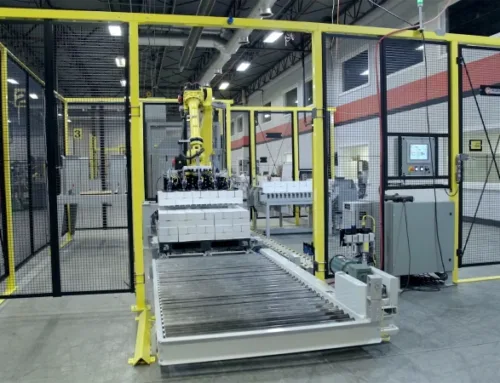
In the relentless push for automation, every square foot of your plant floor is prime real estate. You’re tasked with fitting more robotic cells, more CNC machines, and more conveyors into a fixed footprint. This inevitably leads to narrower aisles and tighter layouts. The problem? Traditional Recinto di sicurezza industriale solutions often force a painful trade-off. To be compliant, they demand a massive safety distance, effectively creating dead zones around your machinery and choking your AGV and forklift traffic.
Consider a standard 50x50mm (2″x2″) wire mesh guard. Due to the large openings that allow fingers and hands to pass through, safety standards like ISO 13857 mandate a setback of up to 850mm (~33.5 inches). For a 50-foot-long automated line, that’s over 120 square feet of your production floor lost to an empty buffer zone—space that could have housed another machine or a wider, safer transit corridor.
Reclaim Your Aisle: The Physics of Space-Saving Guarding
The solution isn’t to compromise on safety, but to adopt smarter safety technology. The critical factor isn’t the fence itself, but the engineering behind its design—specifically, the mesh aperture.
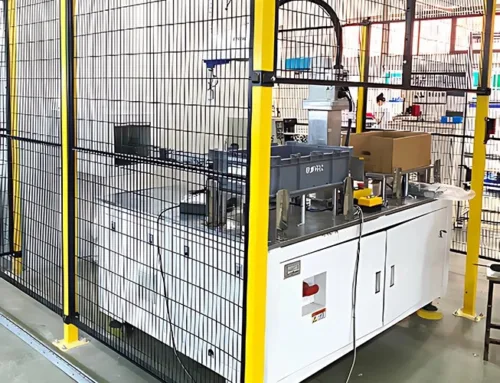
Mdfence Sistemi di protezione delle macchine are built around a key design principle: the 20x100mm (0.79″x3.94″) “finger-safe” mesh. This narrow opening is not an arbitrary dimension; it’s precisely calculated to prevent even a fingertip from reaching the hazard zone inside the cell. According to ISO 13857, this physical limitation legally allows the barrier to be installed just 120mm (4.7 inches) from the machinery’s work envelope.
Strength to Match Proximity
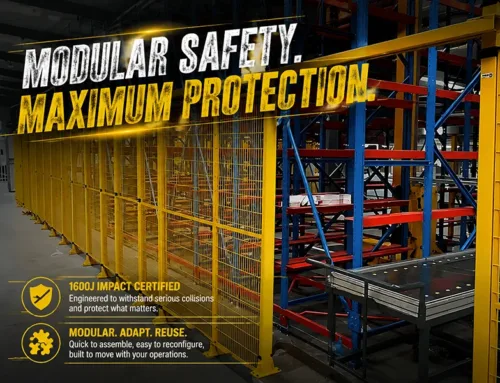
Placing a guard this close to powerful machinery is only possible if the structure can withstand significant force. This is where cheap, frameless mesh fails. The Mdfence system utilizes a full 20x30mm steel tube frame around every panel. This architecture, combined with robust Q235 carbon steel posts, provides a certified impact resistance of 1600 Joules—enough to stop a 220 lbs object moving at 12.5 mph, preventing a thrown workpiece or a misstep from causing a catastrophic line-down situation.

From Layout Drawing to Reality: The ROI of Reclaimed Space
Let’s revisit that 50-foot automated line. By replacing the 850mm setback with a 120mm one, you instantly reclaim 730mm (2.4 feet) of width along the entire line. The result:
- You gain back over 120 sq. ft. of usable floor space.
- Your main forklift aisle goes from dangerously tight to safely compliant.
- Maintenance teams have better access, reducing Mean Time To Repair (MTTR).
- You create the space needed for that additional robot, boosting plant output.
This isn’t just a theoretical gain; it’s a strategic advantage, allowing for denser, more efficient automation layouts without compromising the safety of your personnel or the flow of your logistics.

Designed for a Dynamic Plant: Modularity in Tight Spaces
In automotive and high-volume manufacturing, production lines are not static. A model year changeover or a re-tooling project often requires layout modifications. Welded-in-place guarding becomes a costly liability in these scenarios, requiring hot work permits, fire watches, and destructive removal with angle grinders.
The Mdfence modular system is designed for this reality. Every component—panels, posts, and doors—is connected with high-strength bolts. When a line needs to be moved or modified, the system can be quickly disassembled with basic hand tools and reconfigured in the new location. Your safety guarding transforms from a sunk cost into a reusable, depreciable asset with over 95% re-use value, drastically reducing the total cost of ownership over the life of your equipment.

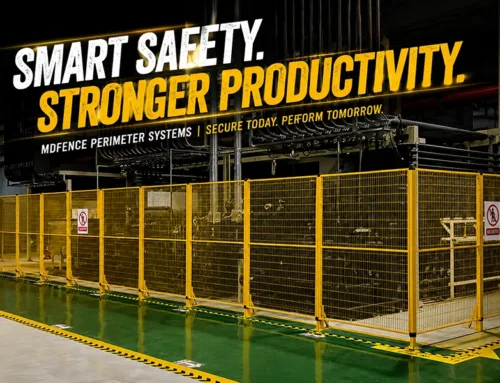
Don’t let outdated safety fencing dictate your plant’s efficiency. In an era of narrow aisles and high-density automation, the right Recinzione di sicurezza per robot doesn’t just protect—it enables smarter, more productive, and more flexible manufacturing.
Domande frequenti
1. How does the 20x100mm mesh specifically comply with ISO 13857 for close-proximity guarding?
ISO 13857 provides a table correlating the size of an opening in a guard with the minimum safe distance required. The 20mm narrow dimension of our mesh is small enough to prevent the “finger” test body from passing through to the hazard point, which allows for the minimum calculated safety distance of 120mm. This is a tested, certified standard, not an estimation.
2. We have AGVs and forklifts. How does this fencing withstand impacts in narrow aisles?
The system’s strength comes from its full-frame design and Q235 steel construction. It is certified to withstand 1600 Joules of impact. For areas with heavy forklift traffic, we also recommend installing our bolt-on post base protectors, which provide an additional layer of defense against accidental nudges and bumps at the most vulnerable point.
3. Our automation cell has conveyors passing through the guard line. How do you handle that?
We provide custom-sized tunnel guards and cutouts. These openings are designed to precisely fit your conveyor’s profile, allowing materials to pass through while maintaining the ISO 13857 safety standard, ensuring a person cannot use the opening to access the hazard zone.
4. Can we integrate our standard safety interlocks (like Omron, Pizzato, or Schmersal) with your door systems?
Absolutely. This is a core feature. We offer a range of pre-engineered mounting plates and lock carriers specifically designed for industry-standard safety switches. This eliminates the need for on-site drilling or welding, ensuring a clean, reliable installation and seamless integration with your machine’s safety PLC and STO (Safe Torque Off) circuits.
5. How much faster is installing a modular fence compared to a welded one during a line shutdown?
Installation speed is typically 40-70% faster. A two-person team can assemble over 150 feet of Mdfence in a single day using only basic hand tools. This is a “cold assembly” process, meaning no hot work permits, fire watches, or delays for paint to dry. In a time-critical shutdown, this can save you days of lost production compared to a traditional weld-and-paint job.