IT
IT  EN
EN  DE
DE  RU
RU  PT
PT  JA
JA  ES
ES 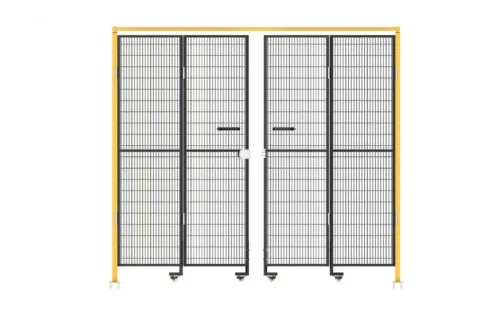

|
Is your floor plan fighting against your production targets? Squeezing a new robotic welding cell into an existing layout or rerouting AGV paths shouldn’t require a civil engineering degree. If you are struggling with rigid guarding that wastes valuable square footage or fails to integrate with your PLC safety logic, your “safety” measures might be the bottleneck. |
The “Tetris” Problem in Automated Manufacturing
In the automotive and system integration sector, space is a premium asset. Whether you are setting up a Tier 1 supplier assembly line or retrofitting a high-speed packaging zone, the challenge is always the same: How do we maximize equipment density without violating ISO 13857 safety distances?
Standard, off-the-shelf fencing often forces you to waste floor space because the panels come in fixed increments that don’t align with your specific machinery footprint. This results in “dead zones” behind the Recinzioni di sicurezza per macchine—space that collects dust and scrap but contributes zero value to production.

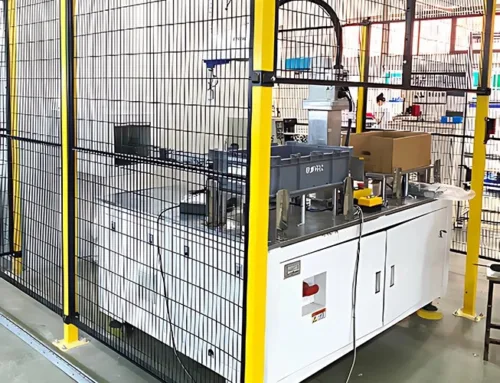
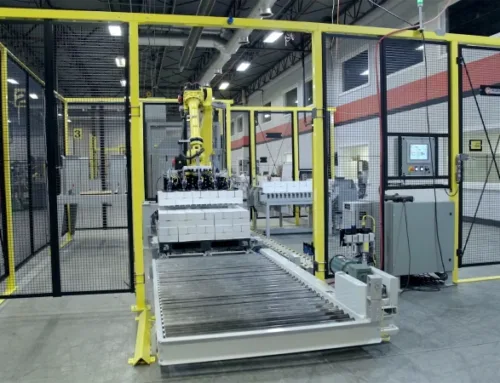
Optimized layout planning reduces dead space around complex automation cells.
Hardware that “Talks” to Your Control System
A physical barrier is only half the solution. In modern robotic cells (KUKA, FANUC, ABB), the fence is an active component of the safety circuit. A common headache for electrical engineers is the mechanical integration of safety interlocks (like Omron D4NL or Pizzato switches).
The Pain Point: Fabricating custom brackets on-site to mount switches. This often leads to misalignment, false trips, and machine downtime.
The Optimization: Utilizing a dedicated Supporto per interblocco di sicurezza. Our system provides pre-engineered mounting kits (KKCK-LCK-B-D4NL-SET) that integrate seamlessly with the fence post and door. This ensures that when an operator requests entry, the signal is reliable, and the E-stop circuit functions exactly as designed, eliminating the “jerry-rigged” switch mounts that plague many audits.

Solving the Access vs. Aisle Width Conflict
In a busy warehouse or production floor, aisle width is critical for forklift traffic and AGV paths. Traditional hinged doors are the enemy here—opening a 1000mm swing door into a traffic lane is a recipe for collision or traffic jams.
To optimize your layout, the Recinzione di sicurezza per robot must accommodate the flow of goods.
- Sliding Doors: Perfect for wide openings (up to 4300mm) required for bringing in pallets or large molds, without obstructing the aisle.
- Porte pieghevoli: Ideal when you need a large opening but lack the side clearance for a sliding track.

Double sliding doors allow large equipment access without blocking AGV paths.
Engineering for Impact: Beyond the Wire Mesh
In heavy industrial environments, a fence isn’t just a visual boundary; it’s a shield. A snapped robot axis or a forklift fork penetrating the perimeter can cause catastrophic damage to expensive automation hardware.
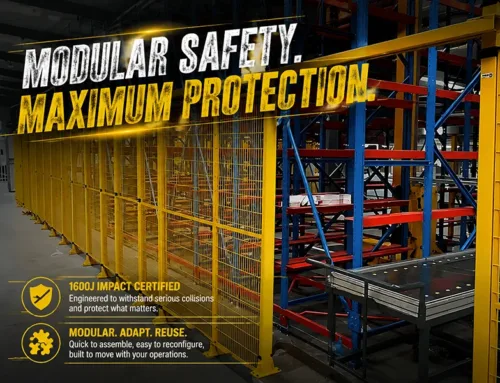
Il nostro sistema utilizza Acciaio al carbonio Q235 with a Pannello incorniciato design (20x30mm tube frame). Unlike “frameless” wire mesh that bends upon minor impact, the framed structure distributes energy, offering superior Resistenza agli urti. The connections are fully welded—not spot welded—preventing the “pop” failures common in lower-grade fencing when subjected to vibration or impact.
Furthermore, the Rivestimento in polvere (RAL 1023 Yellow for posts) isn’t just for aesthetics; it provides the corrosion resistance needed in environments with cutting fluids or high humidity.

Conclusion: Turning Safety into a Productivity Asset
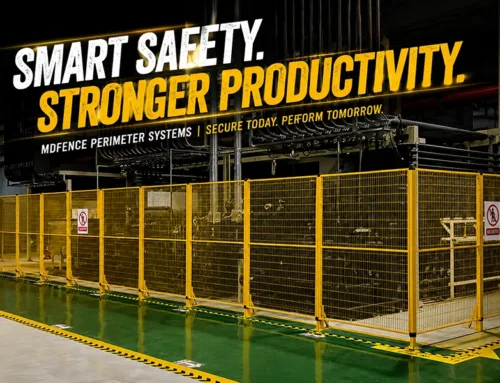
Optimizing your warehouse or factory layout with the right safety fencing isn’t about buying steel; it’s about buying uptime. By selecting a modular system that offers flexible door configurations, robust integration with safety PLCs, and high structural integrity, you transform a mandatory compliance requirement into a seamless part of your production flow.
Domande frequenti
Q1: Can Mdfence integrate with our existing Omron or Euchner safety switches?
Yes. We offer specialized “Safety Interlock Carrier” kits designed to mount standard industrial safety switches directly to our door systems without the need for custom fabrication or drilling on site.
Q2: We have a robotic welding cell that emits sparks. Is the mesh safe?
For high-risk areas like welding cells, we can replace the standard wire mesh with solid steel sheet panels or polycarbonate inserts to contain sparks and protect personnel from UV radiation and debris.
Q3: How do we anchor the posts if our floor is uneven?
Our posts use heavy-duty base plates secured with M10 x 70mm Expansion Bolt anchors. For uneven floors, we can provide leveling shims or adjustable base options to ensure the fence remains plumb and structurally sound.
Q4: Can the layout be modified after installation if we change the production line?
Absolutely. The Mdfence system is modular. Panels and posts are connected via clamps and bolts, not welded together on-site. This allows you to disassemble, reconfigure, and expand the perimeter as your production needs evolve.
Q5: What is the lead time for a custom layout design?
Because we stock standard modular components (posts, framed panels, sliding kits), we can often configure a custom layout proposal from your CAD files within 48 hours, significantly faster than fabricating a bespoke solution from scratch.