IT
IT  EN
EN  DE
DE  RU
RU  PT
PT  JA
JA  ES
ES 
Proper height for Machine Fencing to prevent reach-over?

|
In high-speed automated production lines, a jammed mechanical assembly or a misaligned sensor often tempts operators to bypass safety protocols. If your perimeter barrier is too low, workers will attempt to reach over the top to clear the fault without triggering the E-stop. In a robotics layout featuring 6-axis industrial robots moving at high speeds, this “shortcut” is a fatal hazard waiting to happen. To protect your personnel and avoid catastrophic line shutdowns, calculating the exact height to eliminate reach-over hazards is non-negotiable. |
The “Reach-Over” Hazard in Automotive Automation
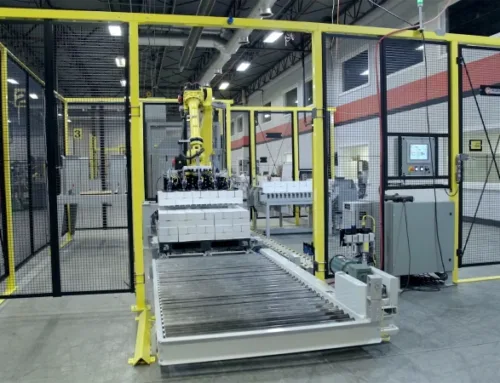
System integrators designing turnkey solutions for automotive welding stations or CNC machining centers often face strict footprint constraints. However, compromising on barrier height to save costs or improve visibility introduces severe risks. When an operator reaches over a low boundary to adjust a pneumatic component or retrieve a dropped part, they enter the hazard zone while the PLC still registers the area as “clear.” Standard commercial fencing fails here because it isn’t engineered to the specific kinematics of industrial robots. You need recinzione di sicurezza industriale that strictly adheres to dynamic hazard calculations.
ISO 13857 Compliance: The Engineering Logic Behind Fence Height
The required height of your Sistemi di protezione delle macchine is dictated by the ISO 13857 standard, which calculates safe distances to prevent hazard zones being reached by upper and lower limbs. If the hazard (e.g., a robotic arm’s maximum reach or a high-speed spindle) is located close to the perimeter, the fence must be taller to compensate.
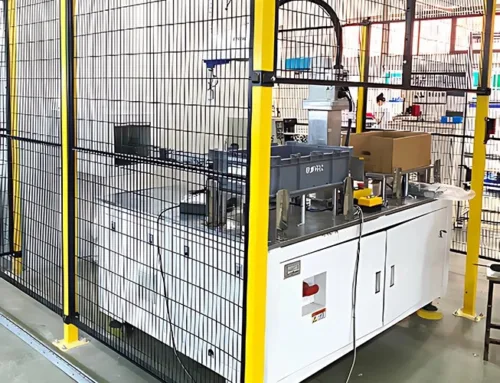
For most dedicated manufacturing lines, a standard height of 78.7 inches (2000mm) o 86.6 inches (2200mm) is required to effectively eliminate the reach-over risk for an average-height worker. But height alone isn’t enough. If the mesh size is too large, operators can simply reach through the fence. Our system utilizes a framed panel architecture with a tight 20x100mm (0.78″ x 3.93″) mesh spacing. This “finger-safe” design prevents upper limbs from penetrating the barrier, allowing the fence to be installed as close as 4.7 inches (120mm) to the moving hazard.

Maximizing Floor Space in High-Speed Assembly
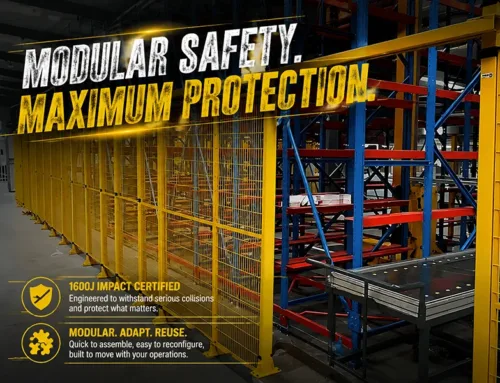
By combining the proper 2000mm vertical height with our 20x100mm narrow-slit mesh, automation integrators can drastically shrink the required safety footprint. Instead of placing a low-cost, 50x50mm mesh fence 33.5 inches (850mm) away from the machine, our Recinzione di sicurezza per robot can be safely positioned just 120mm away. For a 160-foot automated production line, this reclaims hundreds of square feet of premium factory floor space. Furthermore, the Q235 carbon steel structure is tested to withstand a 1600 Joules impact—capable of absorbing the kinetic energy of a 220 lbs (100 kg) object moving at 12.4 mph (20 km/h)—ensuring that a dropped engine block or a forklift bump won’t breach the perimeter.
Integrating Proper Access Control for Tall Enclosures
When you install a 78.7-inch barrier to prevent reach-over, you must provide safe, designated entry points for maintenance personnel to access servo motors or clear conveying jams. We utilize heavy-duty sliding doors designed for wide access in robotics layouts. These doors are equipped with pre-engineered safety interlock carriers (compatible with Omron D4NL or Pizzato switches). When the door is opened, the mechanical key is withdrawn, instantly sending a Safety Torque Off (STO) signal to the PLC, safely halting the industrial robots before the worker can even step inside.

Height Specifications for Custom Machinery
Depending on your specific robotics integration and the trajectory of potential flying debris from CNC milling or turning operations, you may need to adjust your system specifications. Below is a quick reference for our modular height configurations:
| System Configuration | Post Height | Dimensione della maglia | Typical Automotive Application |
|---|---|---|---|
| Standard Robot Guarding | 78.7 in (2000 mm) | 20 x 100 mm | High-speed mechanical assembly machines, preventing reach-over. |
| Extended Height Protection | 86.6 in (2200 mm) | 20 x 100 mm | Heavy payload robot work cells with elevated hazard zones. |
| Custom Tall Enclosure | 96.0 in (2440 mm) | Mixed (Framed panels + PC) | Large CNC machining centers requiring overhead gantry clearance. |
| Area Demarcation | 48.0 in (1200 mm) | 50 x 50 mm | Warehouse AGV/AMR paths (Not for point-of-operation guarding). |
Frequently Asked Questions (FAQs)
1. What is the minimum ISO 13857 compliant height for robot safety fencing?
While it depends on the distance to the hazard, a height of 2000mm (78.7 inches) is the industry standard for industrial robotics to effectively eliminate the risk of an operator reaching over the barrier into a high-speed motion zone.
2. How does mesh size affect the reach-over and reach-through distance?
A smaller mesh size like our 20x100mm prevents fingers and arms from passing through. This allows the fence to be installed just 120mm away from the hazard, whereas a larger 50x50mm mesh would require a safety distance of up to 850mm, consuming valuable factory floor space.
3. Can the fencing height be customized for overhead gantry clearance?
Yes. For heavy machinery and automotive tooling areas where overhead cranes load engine blocks or molds, we offer custom post heights up to 2440mm (96 inches) with a top-open layout to accommodate vertical crane drops.
4. How do you integrate safety light curtains with a 2000mm tall fence?
For material handling areas requiring frequent forklift access, we utilize dedicated 80x80mm light curtain posts. These seamlessly integrate the electro-optical elements with the physical Q235 steel fencing, ensuring continuous safety without slowing down production cycles.
5. Will a taller fence lose stability if impacted by an AGV or forklift?
No. Our system uses 60x60mm Q235 carbon steel posts anchored with four M10x70mm expansion bolts. The framed panel architecture distributes kinetic energy effectively, allowing the system to pass 1600 Joules impact tests without structural failure or collapse.