IT
IT  EN
EN  DE
DE  RU
RU  PT
PT  JA
JA  ES
ES 

|
In high-speed CNC machining and robotic assembly, a dropped payload or a shattered spindle tool isn’t just a hiccup—it’s a deadly projectile. When a 15-lb aluminum workpiece is ejected at 50 mph from a turning center, a standard frameless wire mesh will stretch like a trampoline and fail, sending shrapnel across the shop floor. You need a rigid, framed barrier engineered to absorb massive kinetic energy through plastic deformation. Here is how true industrial machine guarding handles catastrophic ejections without compromising your automated production line. |
The Reality of Workpiece Ejections in Automation Cells
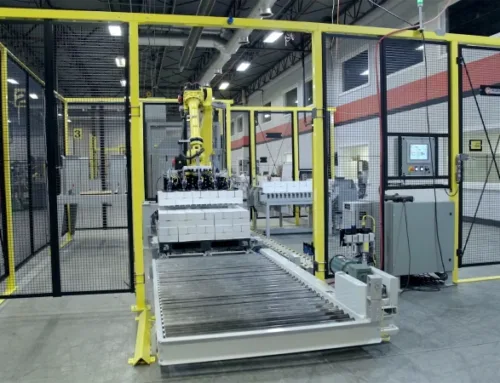
System integrators and plant managers know the inherent risks of high-speed mechanical assembly machines. Whether it’s a 6-axis industrial robot losing its grip on a heavy engine block during a high-speed transfer, or a CNC mill experiencing a catastrophic tool breakage, the result is a high-velocity ejection.
The Before Scenario: Facilities often rely on cheap, frameless wire fencing (like standard chain-link or bent-wire panels). These lack out-of-plane stiffness. When struck by a flying metal component, the kinetic energy is localized. The weak spot-welds pop, the wire stretches, and the projectile penetrates the perimeter, endangering personnel and neighboring AGV (Automated Guided Vehicle) paths.
The Physics of Impact: Absorbing 1600 Joules
To stop an ejection, the barrier must act as a kinetic energy dissipator. This is where the structural integrity of Sistemi di protezione delle macchine becomes critical.

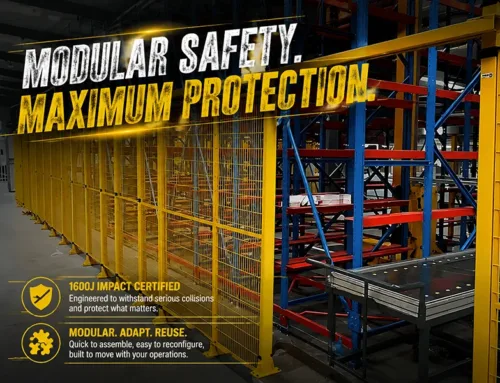
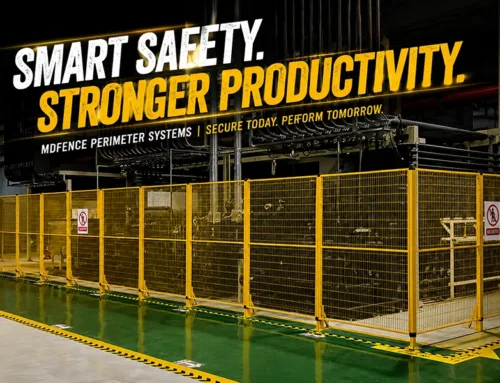
Why It Works: The Mdfence system utilizes a fully welded 20x30x1.5mm tubular steel frame for its panels, bolted to heavy-duty 60x60mm Q235 carbon steel posts. When a projectile hits the mesh, the point load is immediately dispersed across the rigid frame. The energy travels to the connection clips and down the cantilevered post. Instead of shattering into dangerous shrapnel (brittle fracture), the Q235 steel undergoes plastic deformation—it bends, absorbing the shock.
The After Result: Certified to withstand up to 1600 Joules of impact energy, this system successfully intercepts the equivalent of a 220-lb (100kg) object moving at 12.4 mph (20km/h). The ejection is contained within the robotics layout, preventing secondary collisions and avoiding massive line-down situations.
ISO 13857 Compliance: Containing Shrapnel While Saving Floor Space
The Before Scenario: Standard industrial fences often use a 2×2 inch (50x50mm) mesh. Not only can small, high-speed CNC chips or broken tool bits fly right through these large gaps, but ISO 13857 reach-distance standards dictate that such large openings require the fence to be installed up to 33.5 inches (850mm) away from the hazard. In a facility where every square foot is optimized for conveyors and assembly systems, this is wasted real estate.
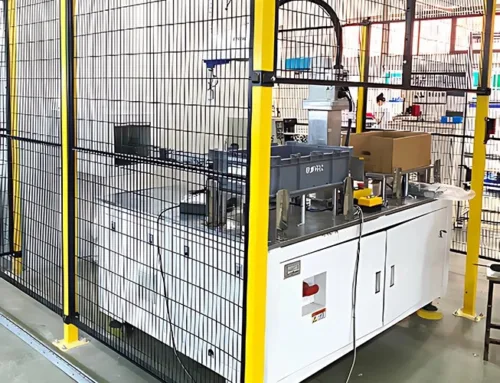
Why It Works: By implementing a tight 20x100mm (approx. 0.78″ x 3.9″) finger-safe mesh, the physical barrier blocks smaller ejected debris. More importantly, the restricted opening size legally and safely allows the Recinzione di sicurezza per robot to be installed a mere 4.7 inches (120mm) from the moving machine parts.
The After Result: You reclaim over 2 feet of perimeter space around every CNC center or robotic welding station, allowing wider aisles for material handling and forklift traffic without compromising operator safety.
Securing the Weakest Link: Doors and Safety Interlocks
Access doors are traditionally the most vulnerable point during an ejection event. If a heavy part strikes a flimsy door, the latch shears off, and the door flies open.

Why It Works: Mdfence sliding door systems are constructed with the same 20x30mm rigid framed panels as the static walls. They utilize heavy-duty top bearing rails that prevent sagging. Furthermore, the system features pre-engineered mounting plates (lock carriers) specifically designed for PLe/SIL3 rated safety switches, such as Omron D4NL or Pizzato.
The After Result: Because the door frame remains perfectly rigid even after years of use or minor impacts, the mechanical key of the interlock never misaligns with the switch body. This eliminates the frustrating “phantom machine stops” that plague automation lines. If an ejection forces a door open, the STO (Safety Torque Off) signal is instantly and reliably transmitted to the PLC, cutting power to the servos before a secondary disaster occurs. You get a turnkey Recinzione di sicurezza industriale solution that integrates flawlessly with your control equipment.
Frequently Asked Questions (FAQs)
| Can this fencing withstand a direct hit from a dropped robotic payload? | Yes. The system is TUV certified to absorb up to 1600 Joules of kinetic energy. The Q235 carbon steel structure is engineered to undergo plastic deformation (bending) to dissipate the shock of a dropped payload rather than snapping and failing. |
| How does the 20x100mm mesh handle CNC coolant and flying chips? | While no mesh is liquid-tight, the narrow 20mm (0.78″) slot significantly reduces the trajectory angles for flying metal chips compared to standard 50x50mm mesh. For heavy coolant splash zones, the modular system allows for the integration of solid polycarbonate (PC) or sheet metal panels on the lower half of the frame. |
| Will the impact from an ejection misalign our safety interlocks? | No. Standard fences sag under impact, causing switch misalignment. Our system uses a rigid 20x30mm tubular frame and dedicated, pre-drilled lock carriers for brands like Omron and Pizzato, ensuring the mechanical key remains perfectly aligned with the switch body even after perimeter stress. |
| Do we need to halt the assembly line for hot work (welding) to install or repair this? | Absolutely not. The entire system uses a modular bolt-on design with M8 flange bolts and connection clips. It requires zero on-site welding, meaning no hot work permits, no sparks near your electro-optical elements, and rapid MTTR (Mean Time To Repair) if a panel needs replacing after a severe ejection. |
| What is the required safety distance for high-speed mechanical assembly machines? | Because our mesh opening is restricted to 20mm (preventing fingers from reaching through), ISO 13857 standards allow this fencing to be installed as close as 120mm (4.7 inches) from the hazardous motion, saving significant floor space compared to standard fencing. |