IT
IT  EN
EN  DE
DE  RU
RU  PT
PT  JA
JA  ES
ES 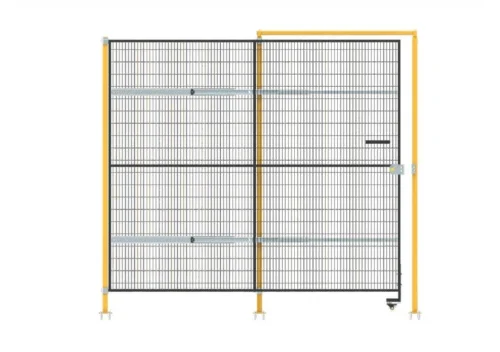
 |
Your client just changed the robot cell layout. The conveyor I/O point has moved by three feet. Is the guarding you already specified now a pile of expensive scrap metal? For automation integrators, this isn’t a hypothetical. It’s a costly reality that kills project margins and timelines. The choice of guarding system dictates whether a layout change is a simple adjustment or a catastrophic sunk cost. |
Can industrial safety fencing be reused in new layouts?
Yes, but with a critical condition: only if it was engineered as a modular asset from the beginning. For system integrators and plant managers, the difference between a welded, “permanent” guard and a modular Protezione delle macchine system is the difference between a disposable expense and a long-term, reusable asset.
Traditional welded-on-site fencing presents a fundamental problem in dynamic manufacturing environments. Once the welder’s torch is off and the paint is dry, that configuration is locked in. Any change—relocating a PLC cabinet, adjusting a conveyor path, or retooling a robot cell—requires an angle grinder, a hot work permit, and a complete write-off of the original materials and labor. The asset recovery value is zero.
This approach is fundamentally incompatible with modern, agile production. A truly reusable system must be designed for disassembly and redeployment.
The Mechanics of Reusability: Deconstructing the Modular System
Reusability isn’t a vague marketing term; it’s the direct result of specific engineering choices. A system like Mdfence is built not as a single monolithic structure, but as a library of standardized, interoperable components.
1. The Foundation: Standardized Posts and Panels
Instead of custom-welded frames, a modular system is based on pre-fabricated components. The core elements are the vertical posts, typically made from high-strength Q235 carbon steel, and the infill panels. Each component is manufactured to precise tolerances, ensuring that a panel purchased today will fit perfectly with a post purchased two years from now.
This standardization means you are not locked into a single, static design. The components are like industrial-grade building blocks, ready to be assembled into any required configuration.

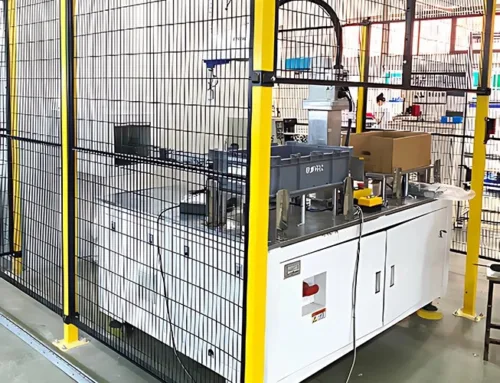
Q235 steel posts are anchored, not welded, providing a stable yet removable foundation. |

Framed panels provide rigidity and are designed for simple bolt-on installation. |
2. The Connection: Non-Destructive, High-Strength Fastening
The key to reusability lies in the connection method. Mdfence systems utilize high-strength steel brackets and M8 bolts to connect panels to posts. This “cold assembly” process is entirely mechanical and fully reversible.
- No Welding, No Grinding: Installation and disassembly require only standard hand tools. This eliminates the need for hot work permits, fire watches, and the associated production downtime in adjacent areas.
- Preserved Integrity: The bolt-on method preserves the structural integrity and the corrosion-resistant powder coating of every component. There are no burn marks to clean or raw steel to repaint, which is a common failure point for on-site welded solutions that often leads to rust within months.

The entire assembly process is mechanical, ensuring components can be removed without damage.
The ROI of Reconfiguration: From Project Crisis to Simple Task
The true value of a reusable recinzione di sicurezza per robot system is realized when change occurs. What was once a budget-breaking problem becomes a straightforward logistics exercise.
Scenario: Mid-Project Layout Redesign
The “Before” (Welded Fencing): The end-client requests moving the main access point for a robot cell by 5 meters. The already-installed welded fence must be scrapped. The project manager has to issue a change order for new materials and re-fabrication, adding weeks to the timeline and thousands to the cost.
The “After” (Mdfence Modular System): The automation engineer simply updates the CAD layout. The existing posts, panels, and door assembly are unbolted by a small team in a few hours. They are then re-anchored and re-assembled in the new location. The only new cost might be a few extra panels if the perimeter expands. The project stays on schedule and largely on budget. The fence is treated as the reusable asset it is.
Future-Proofing Your Facility’s Safety Infrastructure
Choosing a modular, reusable industrial safety fencing system is a strategic decision that pays dividends over the entire lifecycle of your automated equipment. It transforms your safety guarding from a fixed, one-time construction expense into a flexible, long-term asset.
When the next production line is retooled, a new robot is added, or a process is optimized, your existing guarding system can be adapted with minimal cost and downtime. This agility is essential for any facility aiming to remain competitive and responsive to market demands. The initial investment in a modular system is offset the very first time a layout change is required, protecting your capital and empowering operational flexibility.
Domande frequenti (FAQ)
1. How long does it typically take to reconfigure a 20-foot section of modular fencing?
For a trained two-person crew using standard tools, disassembling and reassembling a 20-foot (approx. 6-meter) section of Mdfence can typically be completed in 2-3 hours, compared to a full day or more required for cutting, re-welding, and refinishing a traditional fence.
2. If we expand our facility in five years, will new components be compatible with our old system?
Yes. Because Mdfence systems are built on standardized component dimensions and connection points, new posts, panels, and doors are designed to be fully backward-compatible. You can expand or modify your existing layout with new parts seamlessly.
3. What happens if a forklift damages a single post or panel?
This is a key advantage of modularity. You simply unbolt and replace the single damaged component. With a welded system, a minor collision often requires cutting out a large section and fabricating a replacement, leading to significantly more downtime and cost.
4. Can we integrate our existing safety interlock switches (e.g., Omron, Pizzato, Schmersal) into a reconfigured layout?
Absolutely. Mdfence provides pre-engineered mounting plates and lock carriers designed for industry-standard safety switches. These mounts are also modular, allowing you to easily move a safety door with its integrated interlock to a new position in the layout without custom fabrication.
5. Does disassembling and reassembling the fencing affect its safety compliance or impact rating?
No. As long as the system is reassembled according to manufacturer specifications using the original-grade hardware, its safety integrity is maintained. The system’s compliance with standards like ISO 14120 is based on the design of its components and their proper assembly, not on a permanent, one-time installation.