IT
IT  EN
EN  DE
DE  RU
RU  PT
PT  JA
JA  ES
ES OSHA NEP / ESG RISK CONTROL · HSAFETY WAREHOUSE GUARD RAILS
Guardrail in acciaio a lamiera ondulata per la conformità dei magazzini a livello di rete
For a large distribution network, corrugated steel beam warehouse guard rails provide visible, floor-mounted passive separation around racks, conveyors, walls, and equipment. Hsafety gives EHS and facilities teams a repeatable Q235 steel guardrail platform for forklift impact protection, pedestrian-vehicle separation, and the physical evidence expected in a documented safety program.
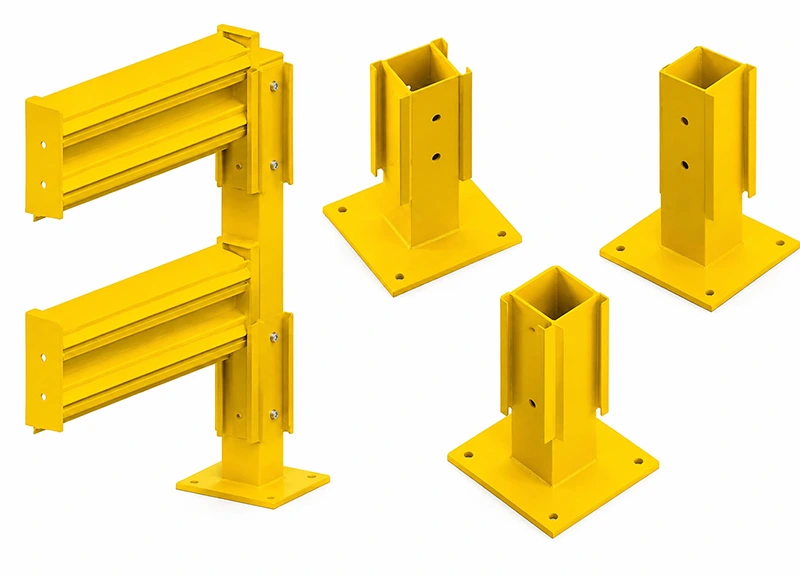
From OSHA and ESG Accountability to Physical Site Controls
An OSHA NEP or internal ESG review does not stop at written procedures. Auditors and corporate safety teams also need to see how a site separates moving vehicles from people and protected assets. Older steel pipe railing, wooden barriers, concrete bollards, or rope and strap barriers often create inconsistent boundaries: they may be difficult to standardize across sites, lack clear visual continuity, or leave rack ends and conveyor approaches exposed. Hsafety turns the control into a documented, modular bolted guard rail system rather than a temporary obstruction. It is passive infrastructure that complements operator training, traffic rules, sensors, alarms, and other active safety systems; it is not a standalone certification or a substitute for site-specific engineering review.
| Audit and deployment requirement | Hsafety design basis |
|---|---|
| Visible separation at vehicle interfaces | Yellow powder-coated double-rail or single-rail layouts; reflective tape is available for lower-light areas. |
| Repeatable physical asset protection | Q235 carbon steel corrugated steel beam, square posts, base plates, and bolted connections form a consistent industrial guard rail system. |
| Multiple site lengths | Common 1,500 mm modules can be combined with custom-length panels for straight runs, corners, and irregular zones. |
| Concrete-floor installation | Floor-mounted posts use base plates and expansion anchors; final anchor type, concrete condition, and spacing require project confirmation. |
| Scalable network rollout | A repeatable Q235 manufacturing platform helps control cost for a multi-location warehouse or distribution center program. |
Evidence in the Structure: What the Site Photos Show
Rack-End Protection Starts at the Floor
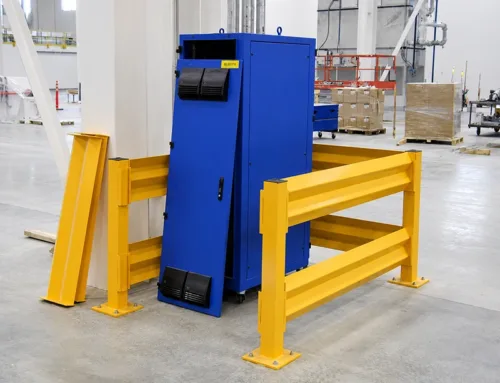
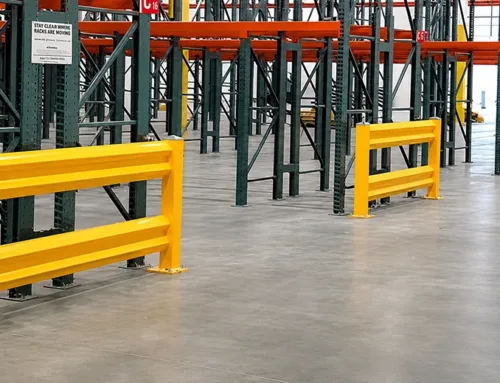
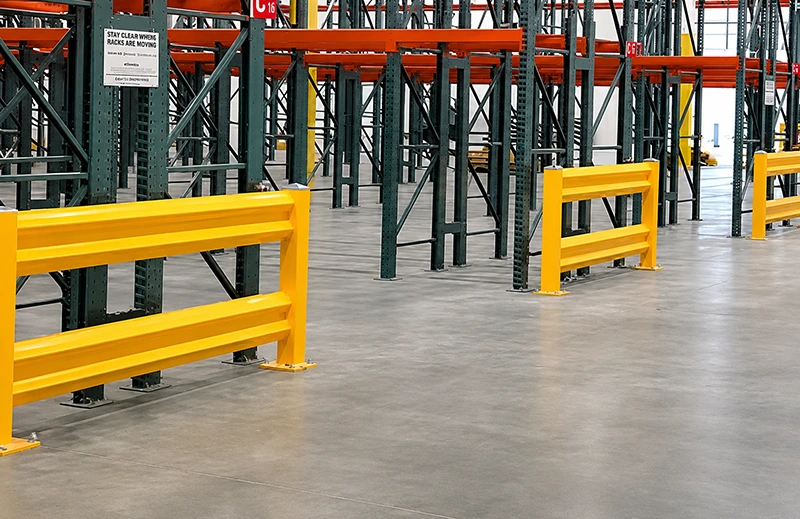
At a rack end, the old approach often relies on a painted post or a short improvised barrier. The documented Hsafety arrangement uses two horizontal corrugated rails between square posts, with each post secured through a square base plate to the concrete floor. The beam profile adds formed ribs for structural stiffness, while the yellow finish makes the boundary legible to forklift operators. The image shows the physical relationship between the barrier, rack uprights, and traffic aisle—useful evidence when a site records its warehouse safety barrier controls. It does not by itself establish impact capacity; that conclusion must follow the approved engineering basis.
Protect Walls While Separating People and Vehicles
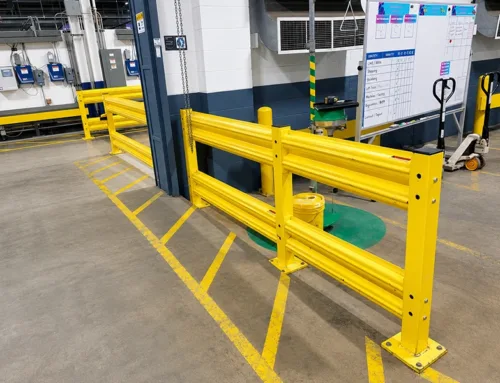
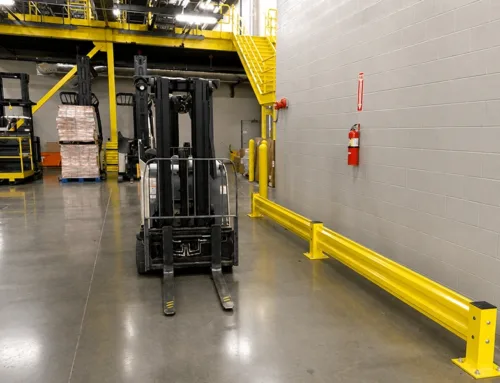
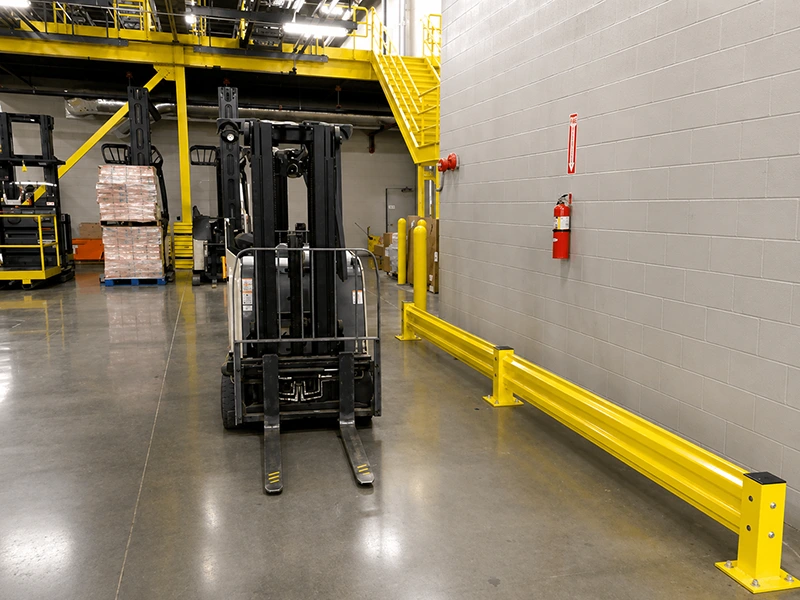
A wall-side route is not automatically safe because it is outside the rack footprint. Forklifts and pallet trucks still need a visible edge, especially where pedestrian routes, doors, or staging areas meet the aisle. This floor-mounted industrial guard rail places a continuous steel boundary between vehicle movement and the wall. Hsafety can be specified as a double rail guardrail, with layout, height, end treatment, and optional bollards selected around the hazard. That makes pedestrian-vehicle separation a visible facility feature rather than a line of paint that can be crossed without consequence.
Keep Conveyor Protection Continuous Through Turns
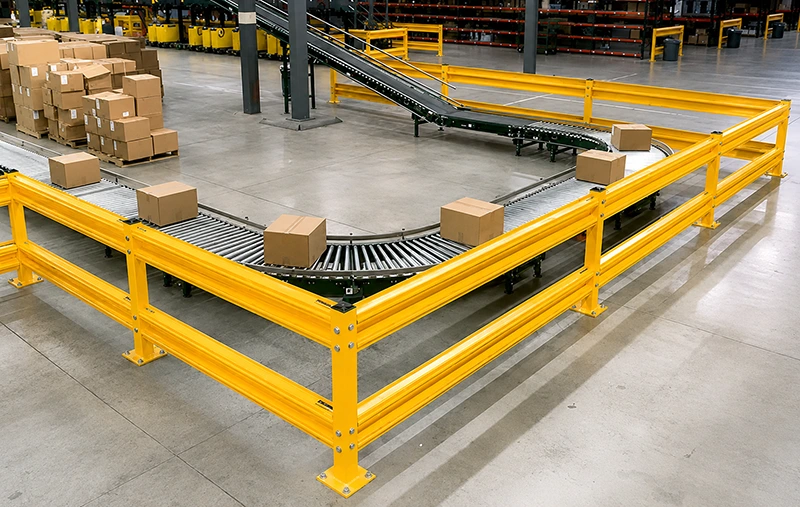
Conveyor guarding fails when protection stops at the straight section and leaves the turn or merge exposed. The warehouse photograph shows double rails following straight runs, corners, and conveyor intersections with anchored posts at the boundary. This modular arrangement supports loading dock protection, aisle protection, and equipment isolation without requiring a single welded frame for every zone. With the correct clearance and engineered anchor detail, the barrier helps protect conveyors and stored goods from impact, reducing the likelihood of collision damage and accident downtime.
Where a Standardized Passive Barrier Fits
- Distribution centers: protect rack ends, conveyor lines, sortation approaches, and loading dock edges from forklift impact.
- Warehouse traffic aisles: establish pedestrian-vehicle separation with a high-visibility yellow safety coating and a defined floor-mounted route.
- Manufacturing and automation: isolate electrical cabinets, robot cells, production lines, and equipment boundaries without confusing the system with machine safety fence.
- Multi-site programs: use common Q235 steel guardrail components while adapting panel length, color, markings, and optional accessories to each facility standard.
For a network with more than 1,500 locations, the advantage is operational consistency: a central specification can define the rail profile, post and base-plate details, finish, signage, inspection method, and replacement process. Local teams can then survey concrete floors and traffic risks without abandoning the corporate standard. Hsafety can also be coordinated with active warning or detection systems to build a layered safety stack.
Specify the Guard Rail Against the Actual Risk
Start with the vehicle type, aisle geometry, protected asset, pedestrian route, concrete condition, and required inspection basis. Hsafety references include Q235 steel, 3 mm or 4 mm beam options, approximately 310 mm beam width, 85 mm wave height, 1,000 mm height configurations, 1,500 mm post spacing modules, 2-rib or 3-rib profiles, and single- or double-rail arrangements. These are selection inputs—not a blanket impact rating. Final drawings should confirm the applicable profile, dimensions, anchors, clearances, and any project load requirement before procurement.
Build Audit Evidence Into Every Warehouse Zone
Send your site count, protected assets, traffic plan, preferred color or markings, and run lengths to the Hsafety team. We can help translate the risk register into a modular corrugated steel beam warehouse guard rail layout that supports OSHA-oriented controls, ESG accountability, and safer daily operations.