IT
IT  EN
EN  DE
DE  RU
RU  PT
PT  JA
JA  ES
ES CROSS-BORDER AUTOMATION PROJECTS / INSTALLATION STANDARDIZATION
Implementazioni di magazzini transfrontalieri: perché Mefence semplifica la replicabilità delle recinzioni di sicurezza industriali
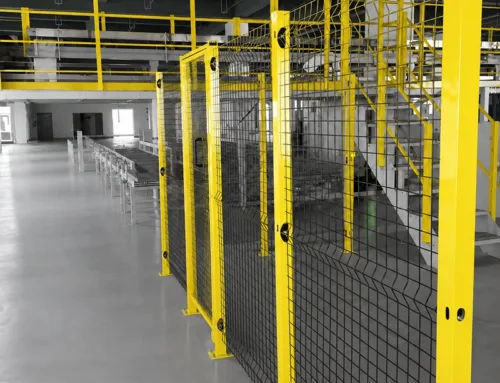
For global integrators and authorized local contractors, Mefence is a frameless safety fence that replaces site welding with clip-fixed assembly—helping different crews reproduce the same warehouse zoning, pedestrian vehicle separation, and machine guarding standard.
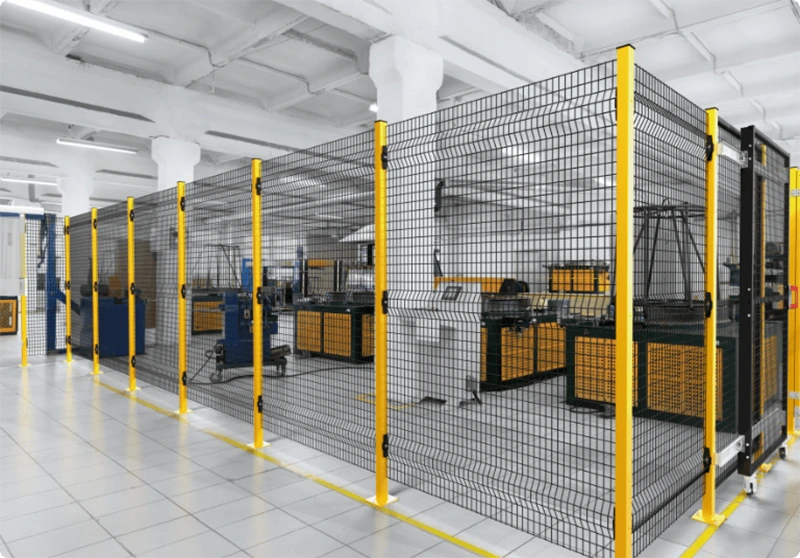
Why Cross-Border Installation Exposes the Limits of Welded Fencing
A multinational warehouse or automation rollout may use the same drawing package in several countries, but the site result can vary sharply. A welded square tube fence depends on local welding skill, approved equipment, supervision, and rework control. Traditional framed fencing also leaves less room for irregular dimensions and late layout changes. When a local crew cannot reproduce the headquarters detail, the integrator absorbs training time, inspection work, and commissioning delays.
| Rollout requirement | Risposta progettuale Mefence |
|---|---|
| Different local contractor skill levels | Plastic clip fixing and self-tapping screws remove the site welding step; installation follows a repeatable three-step method. |
| Irregular bays and retrofit dimensions | Frameless welded mesh panels can be cut on site and specified from 200–1400 mm wide and 200–3000 mm high. |
| AGV, AMR, forklift, and pedestrian routes | Yellow-black panels create visible area demarcation without turning a traffic route into a solid blind wall. |
| Cables or visual shielding added later | The 3D bent profile provides routing space and accepts wood slat inserts where shielding is required. |
How the Frameless 3D Structure Keeps the Standard in the Product
1. Clip-fixed assembly, not local welding judgment
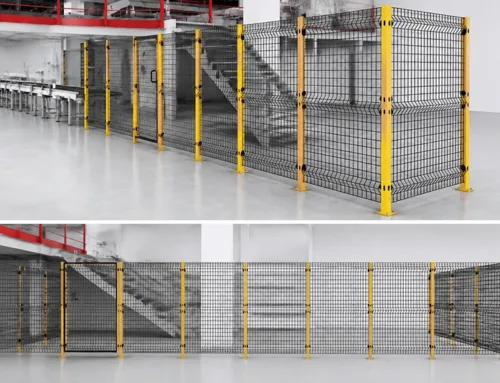
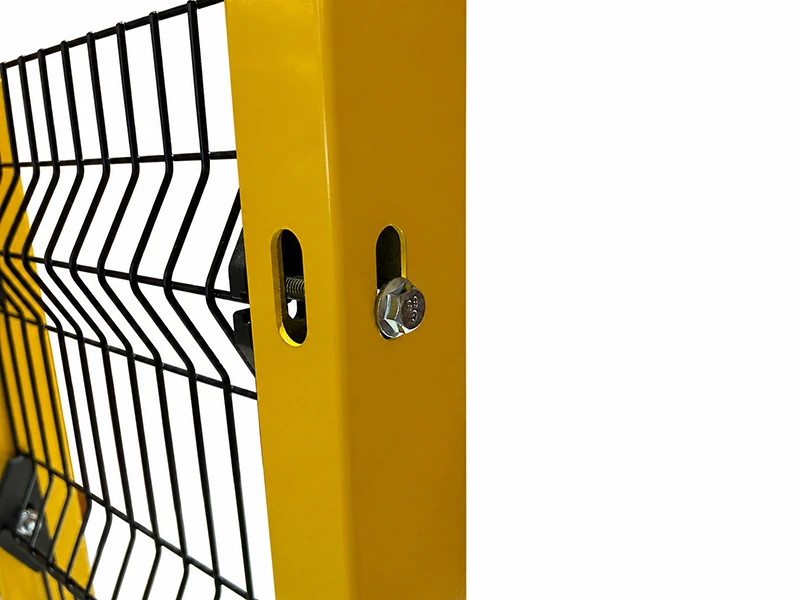
Mefence uses Q235 carbon steel welded wire mesh with a frameless design. Panels connect to powder-coated steel posts through plastic clips and self-tapping screws, with base plate posts and expansion bolts available for floor fixing. The connection detail is visible, teachable, and repeatable in a new country. The documented installation method supports one-person assembly in three steps and states a 50%+ installation-time saving; the result depends less on whether a qualified welder is available on the day.
2. A visible boundary for mixed-traffic operations
For warehouse zoning, forklift path barriers, or AGV lane separation, the goal is controlled movement and readable boundaries—not impact containment. The black mesh and yellow posts make a robot safety fence or pedestrian separation line easy to recognize, while a single access gate can preserve planned entry flow. Mefence is intended for non-high-impact demarcation; projects requiring certified anti-collision protection should be reviewed against the higher-spec Machine Fence line.
3. Modular details that survive layout changes
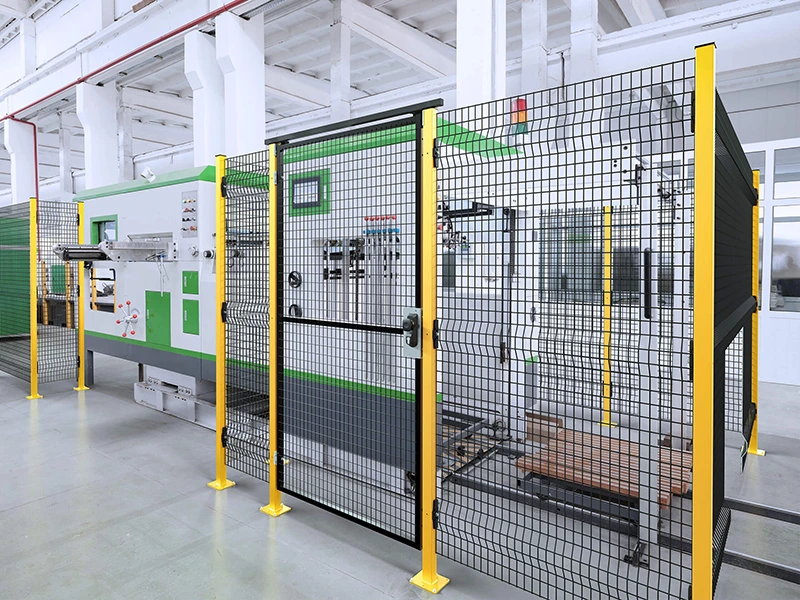
The 3D safety fence uses multiple horizontal T-shaped ridges rather than a perimeter frame. Available wire diameters are 3 mm and 4 mm, with mesh openings of 20×100 mm or 50×50 mm. Posts are available in 40×60 mm and 60×60 mm sizes, with 140 mm ground clearance. The modular panel logic supports workshop isolation, automated equipment guarding, and relocatable partitions when a warehouse expands or a robot workstation moves.
Where Integrators Can Reuse the Same Mefence Installation Logic
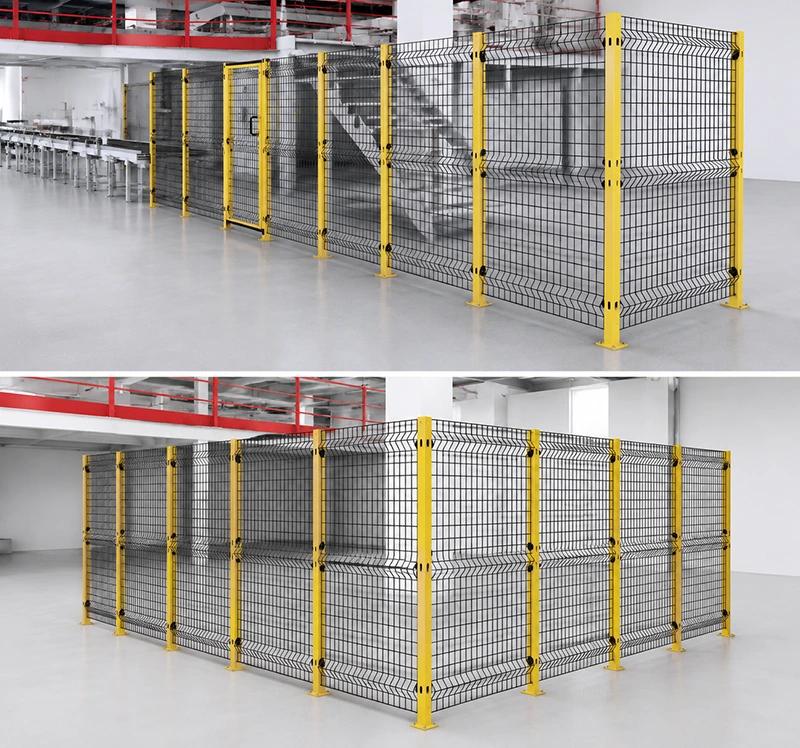
- Zonizzazione del magazzino: separate storage areas, tool crib enclosures, and material segregation zones.
- Separazione pedoni-veicoli: define forklift paths and keep traffic-flow planning visible at crossings.
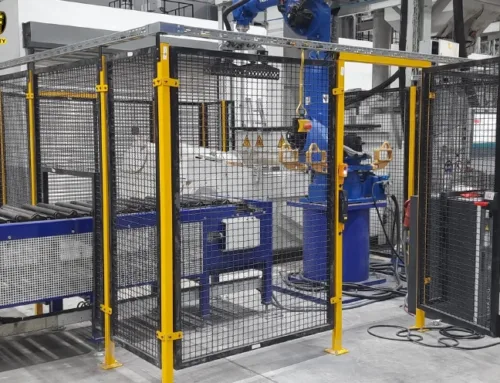
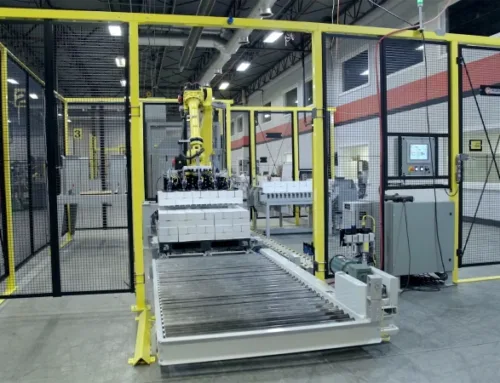
- Recinzione di postazione robot: establish a clear perimeter around robotic cells and automated equipment.
- Recinzione per la gestione dei cavi: use the raised mesh profile to keep line-side cables routed within the barrier geometry.
- Retrofit and temporary partition: cut panels on site, reuse modules, and reconfigure workshop isolation as the layout changes.
The same English technical documentation and training package can therefore be paired with a mechanical installation standard: identify the boundary, position the posts, and clip-fix the panels. Local teams still need to follow the project risk assessment and applicable OSHA, ANSI B11.19, ISO 14120, ISO 14119, ISO 13857, or ISO 13855 review requirements; Mefence should not be presented as a certification by itself.
What to Confirm Before Repeating a Site Standard
Provide the bay dimensions, required panel height, mesh opening, wire diameter, post size, floor condition, gate locations, cable routes, and whether wood slat inserts are needed. The Mefence range answers these inputs with on-site cutting, 200–1400 mm panel widths, 200–3000 mm panel heights, 3 mm or 4 mm wire, 20×100 mm or 50×50 mm openings, 40×60 mm or 60×60 mm posts, base plate fixing, and custom colors when the standard yellow-black safety fence is not suitable. This turns a country-by-country welding dependency into a documented product configuration.
Make the Next Warehouse Rollout Match the First One
Mefence gives global integrators a quick install safety fence for area demarcation, robot safety fence perimeters, and pedestrian vehicle separation—without making local welding credentials the control point for consistency.