IT
IT  EN
EN  DE
DE  RU
RU  PT
PT  JA
JA  ES
ES Flexible Polymer Barrier · AGV / AMR Cell Protection
AGV & Robotic Workcells: Why a Self-Rebounding Polymer Crash Barrier Beats Steel for Expensive AMRs
When forklifts and autonomous mobile robots share an aisle, the barrier has to do more than survive the strike. ARMORFLEX polymer FCBarrier drops the residual force transmitted back to the AGV, absorbs up to 28,950 J, and swaps one damaged segment without taking the robotic workcell offline.
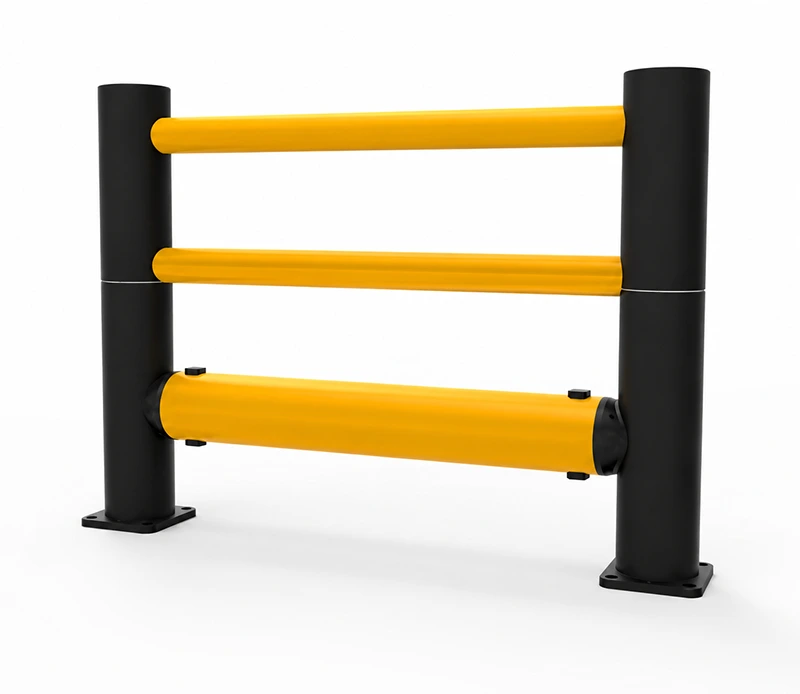
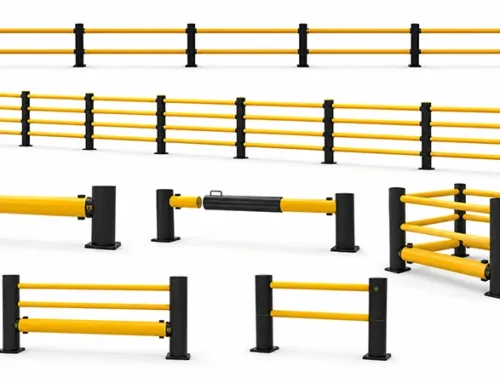
FCBarrier Joule Ladder for AGV / AMR Cells
Pick the rail height and impact rating to match the heaviest vehicle that still reaches the robotic workcell. The same modular post fits every FCBarrier series, so the AGV / AMR cell spec and the rest of the warehouse share one base plate pattern.
| FCBarrier Series | Rated Impact · Vehicle Condition |
|---|---|
| SR100 · Single rail | 3,850 J · 1.5 t @ 8 km/h (AMR pickup point, light end-of-line) |
| SR148 · Single rail | 14,400 J · 4 t @ 9.6 km/h (manual pallet jack at robot cell) |
| DR148 · Double rail | 19,000 J · 6 t @ 9 km/h (robotic palletizer cell boundary) |
| DR190 · Double rail | 28,950 J · 8 t @ 9.6 km/h (AGV pickup lane, high-density) |
| TR190+ · Traffic rail | 28,950 J · 8 t @ 9.6 km/h (AMR / forklift inter-zone barrier) |
| CTR190+ · Column protector | 28,950 J · 8 t @ 9.6 km/h (building column inside AGV lane) |
Why AGV / AMR Lines Pick Polymer Over Steel
Lower Residual Impact Means Lower Robot Repair Cost
Steel stops a forklift by transferring most of the strike energy back into the anchor bolts, the floor, and — too often — the AGV that was sitting two meters behind the barrier. ARMORFLEX polymer absorbs up to roughly 80% of the strike energy and rebounds to its original profile. The robot, the AMR lidar cover and the bumper see a fraction of the secondary force that a rigid steel guardrail would deliver. For an AGV fleet priced well into five figures per unit, that residual-force delta is the spec that protects the AMR field operator from a five-figure-but-bigger repair.
Mortise & Tenon Quick-Release: Replace One Segment, Skip the Cell Shutdown
FCBarrier rails slide into a mortise pocket in each post and lock with a single long pin driven home with a rubber mallet. When a forklift takes out a 2-meter segment at the AMR pickup bay, the maintenance crew removes the two damaged posts and the rail between them, drops in a replacement segment, and re-drives the pin. No welding, no crane, no four-hour shutdown. The robotic workcell stays on the schedule; only the damaged segment is out of service. That is the everyday reality of the mortise quick-release model.
Modular Geometry Moves With the Robot Cell
AGV routes and robotic palletizer footprints shift every 12–18 months as the line re-balances. FCBarrier segments connect by floor-anchored base plates, not welded frames. When the engineering team moves the AMR pickup point, the same FCBarrier segments lift off the same day and re-install at the new boundary. Layout re-derivation cost drops from a CAPEX line to a maintenance task — and the warehouse keeps iterating without scrapping the modular polymer barrier.
Where AGV / AMR Lines Use FCBarrier
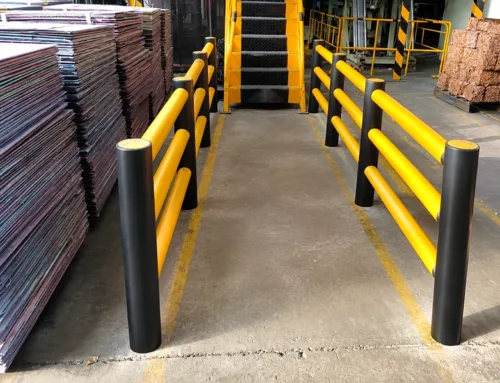
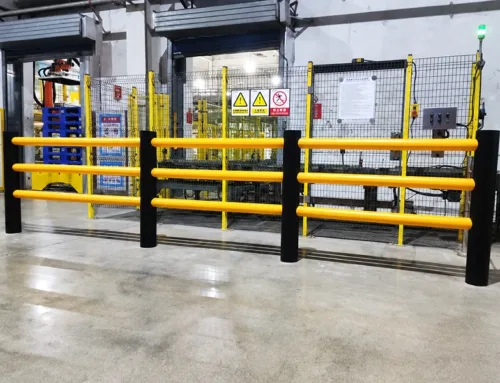
- AGV pickup lanes at the end of palletizer cells — DR190 double rail.
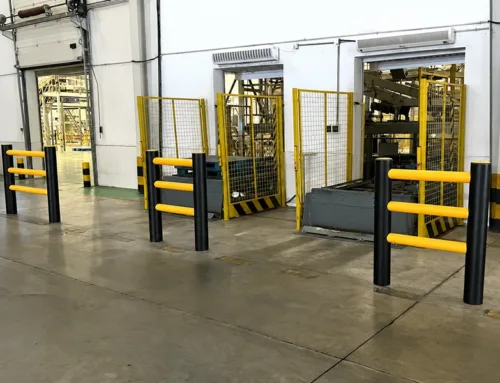
- AMR staging zones outside robotic workcells — SR190 single rail.
- Building columns inside an AGV lane — CTR190+ column protector.
- Pedestrian–AMR intersection on the same aisle — TR190+ traffic rail.
- Robotic palletizer floor, re-balance boundary — DR148 double rail.
- AMR battery charging alcove — SR148 single rail.
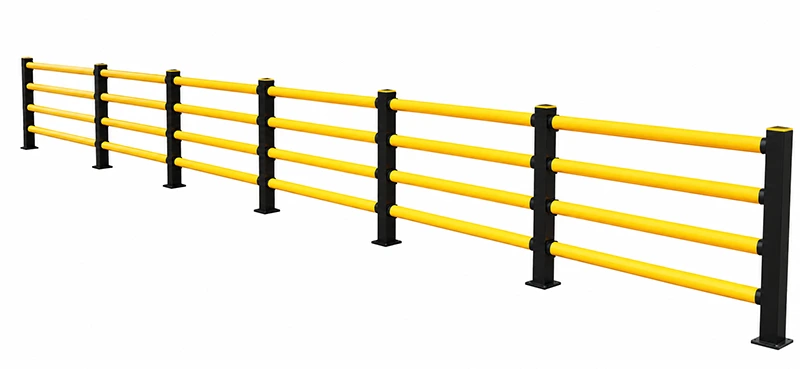
Same base plate, four rail heights. Spec one FCBarrier module per AGV / AMR cell and the rest of the warehouse layout scales around it.
Spec the AGV Cell Before You Spec the Barrier
Send us your heaviest vehicle class, the aisle width, the robot model stop footprint, and the AMR lidar clearance. We return a single FCBarrier rail-by-rail plan with the joule rating, post spacing, and floor-mounted base plate pattern, ready for your maintenance team to install with a rotary hammer and a rubber mallet.
Protect the AGV, Not Just the Aisle
A steel guardrail stops the truck and re-introduces the force into the floor and the robot. FCBarrier stops the arm, drops the residual impact, and re-positions with your cell. Send us the robotic workcell drawing and we will return a joule-rated polymer spec within 48 hours.