IT
IT  EN
EN  DE
DE  RU
RU  PT
PT  JA
JA  ES
ES 
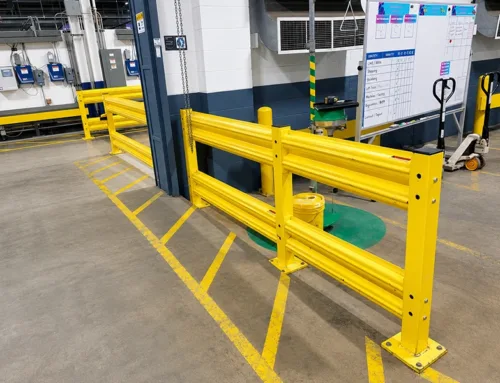
To the facility manager, the safety officer, the operations lead: Let’s talk about the floor of your warehouse or factory. It’s a landscape of carefully planned workflows, a map defined by bright yellow lines. These lines dictate where pedestrians should walk, where forklifts must travel, and where critical equipment resides. They are the language of your facility’s safety grammar, the foundation of your administrative safety controls.
But we need to ask a hard question: What happens when that grammar is ignored?
We’ve all seen it. An experienced forklift operator, at the end of a long shift, cuts a corner a little too tight. A new employee, focused on their task, strays momentarily from the designated walkway. In that split second, the painted line on the concrete offers no argument. It is a suggestion, not a stop sign. It relies on 100% human compliance, 100% of the time—an operational standard that is, frankly, impossible to achieve.
Non si tratta di un fallimento del team o della formazione. È il limite intrinseco di affidarsi esclusivamente ai controlli amministrativi per un problema che coinvolge la fisica di molte tonnellate.
The Unspoken Gap: Moving from Administrative Rules to Engineering Certainty
Nella gestione professionale della sicurezza, c'è una distinzione fondamentale tra una controllo amministrativo e un controllo ingegneristico.
Controlli amministrativi are the rules, procedures, and visual cues we implement. Safety training, operating manuals, and those vital painted lines all fall into this category. They are essential for setting expectations and guiding behavior. Their effectiveness, however, is directly tied to human factors like awareness, training, and attention.
Controlli ingegneristici are physical changes to the workspace that are designed to remove a hazard or place a barrier between the worker and the hazard. They are designed with the assumption that human error is inevitable. A machine’s emergency stop button is an engineering control. A ventilation system is an engineering control. And in the context of traffic management, a parapetto per carichi pesanti è il controllo ingegneristico definitivo.
The gap in many facility safety plans lies in mistaking a robust administrative control (a well-marked floor) for a sufficient engineering one. When a 4.5-ton forklift is moving, even at a slow speed of 4 mph (6.5 km/h), you are no longer in the realm of rules and suggestions. You are in the realm of kinetic energy. And the only thing that reliably stops energy is an opposing physical force, engineered for that specific purpose.
What Your Painted Lines Can’t Tell You
Think about the most critical assets on your floor. Is it the electrical cabinet that powers an entire production line? The fire pump system that is essential for emergency response? The corner of a pallet rack holding thousands of dollars of inventory?
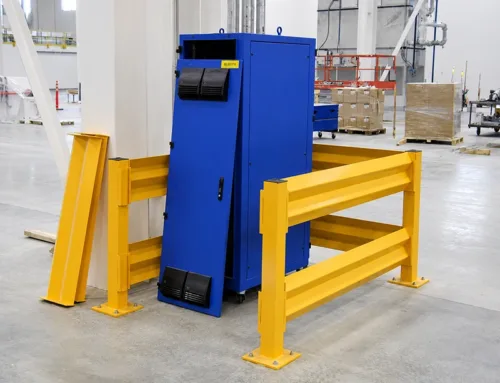
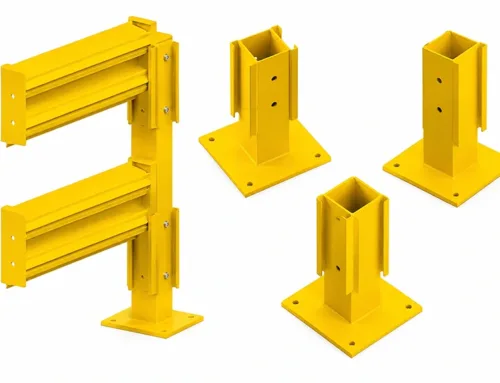
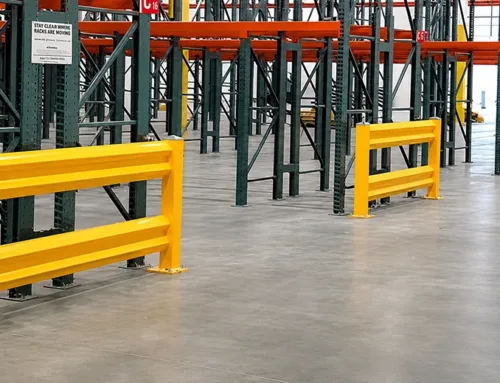
A painted line cannot protect these assets from a direct impact. Its value is purely psychological. A parapetto per carichi pesanti, on the other hand, is a statement of physics. It is engineered with specific material thicknesses and a W-beam design precisely to absorb and redirect the impact force of a common warehouse vehicle. A system rated to stop 10,000 lbs at 4 mph is not a generic barrier; it is a calculated answer to a specific, foreseeable problem.
This is why a shift in mindset is so critical. The goal is not just to demarcate a zone; it is to physically isolate a known risk.
Graduatoria del programma di sicurezza
Relying on painted lines alone is like having a detailed fire evacuation plan but no fire extinguishers. The plan is essential, but it is not a tool for actively controlling the hazard.
Upgrading from painted lines to strategically placed, engineering-grade guardrails is not a failure of your existing system. It is the natural evolution of a maturing safety program. It is the acknowledgment that your people and your assets deserve a level of protection that goes beyond suggestion and enters the realm of physical certainty.
Take a walk through your facility today. Look at those yellow lines. And for every critical asset or busy pedestrian intersection they border, ask yourself: “Is a suggestion enough, or is it time for a solution?” The answer will define the resilience and safety of your operations for years to come.