IT
 EN
 DE
 RU
 PT
 JA
 ES
GLOBAL STANDARD GUARDING MODULES / CE & OSHA ACCEPTANCE
A locally fabricated mesh panel is the most expensive line on a multi-country approval schedule
Storage integrators and racking manufacturers rolling one automated cell across several countries lose time on the fence. Each site finds a local metal fabricator, each draws a different panel, and each EHS reviewer asks for the mesh gauge, coating evidence and gate hardware again. Global standard guarding modules fix one specification in the supplier standard drawing: 60×60 mm posts, 20×30 mm frames, 20×100 mm mesh, RAL1023 / RAL9005 colours, shipped with test and acceptance documents. CE and OSHA compliance still belongs to the local risk assessment; the repeated questions stop.
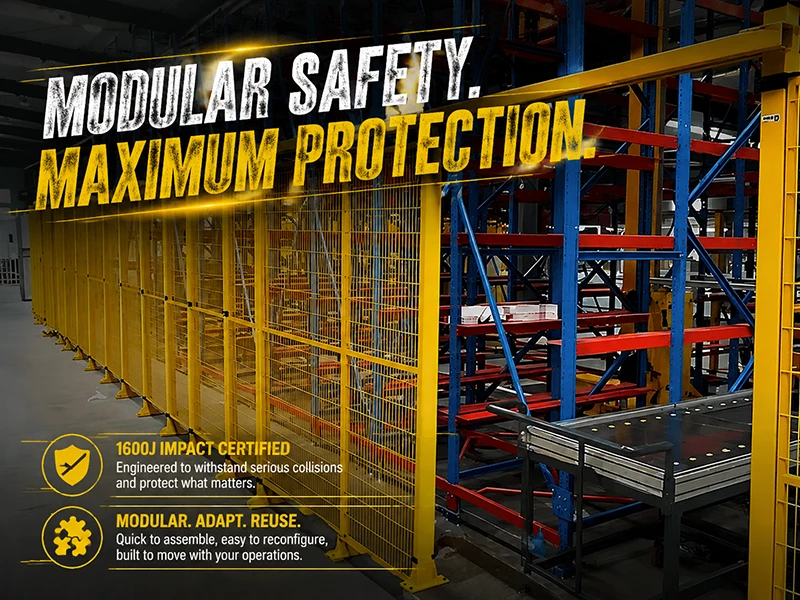
Four columns to fix in the supplier standard drawing
A locally welded panel is described by whatever stock the workshop had: a height and a colour, but no wire diameter, frame section, anchor pattern or crate contents. The next reviewer has no baseline and issues another evidence request. Fix four columns once and every site starts from the same auditable baseline, not a fresh welded safety fencing description.
| Column to lock | What the drawing states |
|---|---|
| Specifiche | 60×60 mm Q235 square tube posts, 20x30x1.5 mm frame, 20×100 mm mesh, 3.0 or 4.0 mm wire, 2000 or 2200 mm height, RAL1023 posts with RAL9005 panels, M8 fixing rings, four M10 expansion anchors per base plate. |
| Certification and test evidence | Q235 material certificate, coating adhesion to GB/T 9286, salt spray to ISO 9227, and impact reports tied to the standard configuration only. Custom sizes and door widths are re-drawn per project, never inherited from a standard rating. |
| Packaging and identification | Fumigated wooden pallets, corner protection, bubble film, strapping and part codes on every bundle, so the crate, BOM and drawing reconcile at goods-in. |
| Acceptance checks | Dimensions, fastener count, welds, coating finish, burr-free joints, post verticality, panel flatness and three to five gate open-close cycles, with tolerance agreed in the contract. |
What a standard module settles, and what it cannot sign for
One specification sheet, one BOM, one answer
A configurable safety fence built from fixed parts gives the reviewer a baseline. Framed mesh panels use a 20x30x1.5 mm tube border with flat full weld and burr-free joints behind 3.0 or 4.0 mm wire on Q235 posts at 2000 or 2200 mm, and the annotated build sheet carries those values. Site four matches the drawing issued for site one. Custom sizes and door widths are confirmed per project, and any published impact figure belongs only to the tested standard configuration.
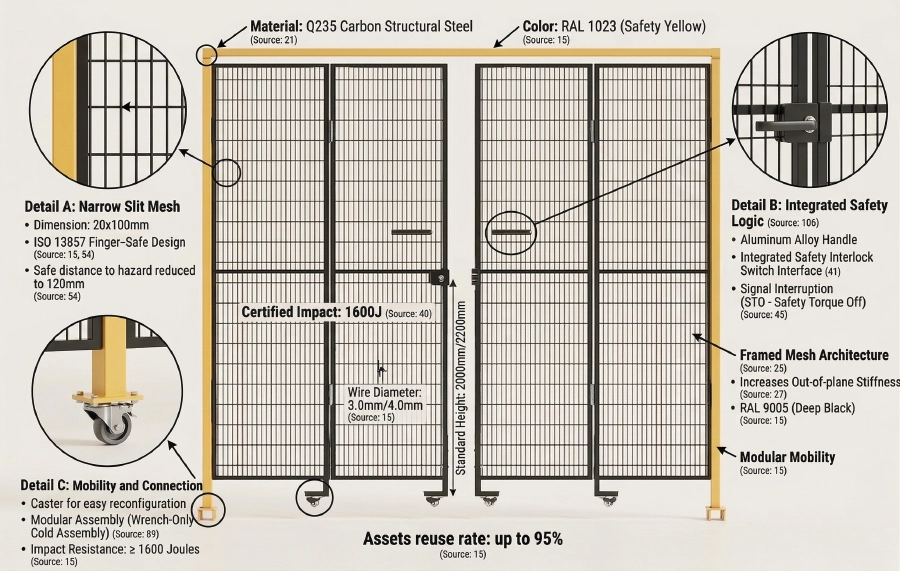
Inspection is per panel, not per shipment story
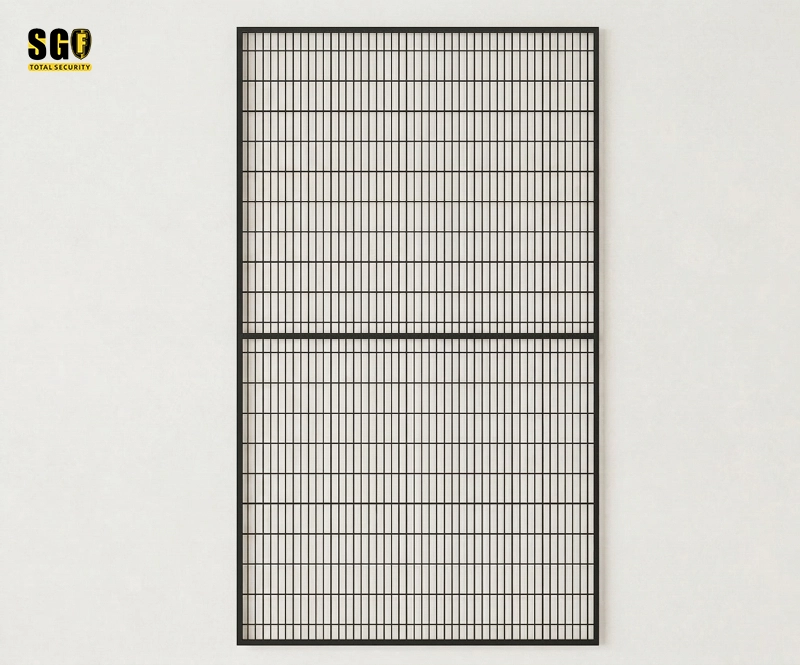
Local fabrication arrives with no unit-level record. A modular safety barrier ships as identifiable parts: a powder coated steel fence panel with its reinforced mid rail, a gate leaf with its lock carrier, a coded bag of fixing rings. The acceptance sheet lists what was checked on each unit and is reused at every destination. Procurement reconciles the crate against the BOM, EHS reconciles the perimeter against the drawing, and the resubmission loop closes.
The local EHS signature is not in the crate
A robot cell guarding perimeter can be identical in five countries and still be accepted differently. Safety distance is calculated to ISO 13857, guard design reviewed against ISO 14120, the safety lock carrier prepared for Omron D4NL or Pizzato FS switches, and the electrical team owns the interlock circuit and LOTO. That risk assessment signature stays with the local EHS engineer. CE marking and OSHA machine guarding requirements are project-level determinations supported by the documents, not a label on a panel. Global standard guarding modules remove inconsistency, not local review.
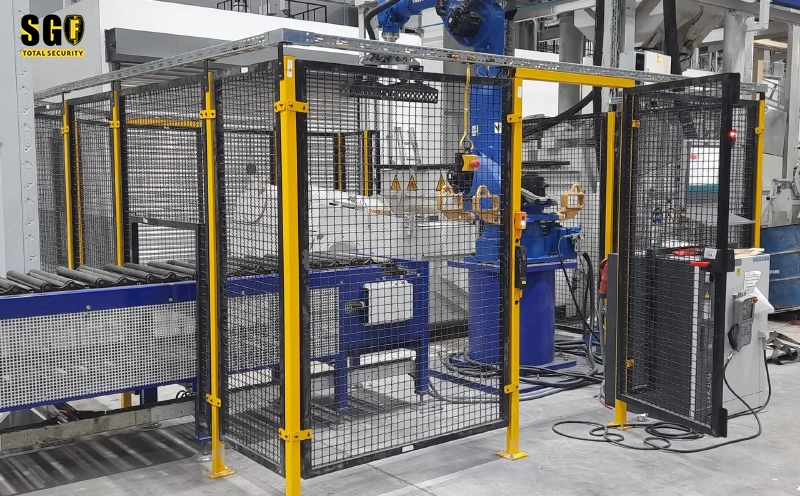
Where one guarding specification pays back across a rollout
- Robot cell guarding and palletizer safety guarding: one gate module and lock carrier everywhere, so a substituted leaf cannot misalign the actuator.
- Protezione di sicurezza per linee di trasporto: transfer openings and light-curtain interfaces defined once, not re-cut on site.
- Automated material handling safety, forklift and pedestrian safety: 60×60 mm posts with four M10 anchors, with vehicle impact still assessed locally before any rating is quoted.
- Smart warehouse zoning and machine perimeter guarding: the same 20×100 mm mesh, RAL1023 / RAL9005 finish and part codes at every plant.
The physical guarding solution is identical at each destination, which shortens automation project cycles and reduces the risk of workplace accidents. One limit stays explicit: this system is not intended for pure pedestrian guidance, queue management or office partitioning.
What ships with the drawing pack, and what the local team adds
Send the layout, the hazard list per zone, access points and door swing, floor and anchor positions, and the safety switch model chosen by the electrical team. The returned pack carries the general arrangement drawing, panel and post quantities, wire diameter, gate type and lock carrier, a coded fastener BOM, test records, the packaging list and the acceptance checklist. The local EHS team adds the risk assessment signature, calculated safety distance, interlock and LOTO scope and any national requirement. Consistent supplier evidence plus a local acceptance decision is what makes approval repeatable.
One drawing, fewer resubmissions
Lock the four columns once, ship the same modules and evidence to every site, and let the local reviewer decide only what belongs to that site. Procurement avoids paying twice for re-verification and commissioning stops waiting on document requests.