IT
IT  EN
EN  DE
DE  RU
RU  PT
PT  JA
JA  ES
ES Beverage Industry Safety Standardization
Why a Multi-Site Bottling Network Needs a Polymer Crash Barrier Spec With Independent Test Data, Not Just a Catalogue
A global beverage brand running 50 or more independent bottling partners keeps failing the same procurement audit: every plant floor orders its own low-cost steel barrier from a local supplier with no documented impact rating, so the central EHS director cannot point to one auditable spec, one PAS 13 test report, or even one consistent Joule figure when the audit closes. FCBarrier ships a polymer crash barrier system with a documented impact rating table from 3,850 J up to 28,950 J across four series (SR, DR, TR, CTR), an ARMORFLEX polymer body that rebounds after impact, and a two-person mortise-and-tenon quick-install build. Third-party PAS 13 laboratory certification is the open workstream — until that lands, HQ procurement has to treat the spec as “documented in-house testing, third-party PAS 13 report pending” rather than a fully closed-out network rollout.
FCBarrier Impact Rating Table — Which Series Matches Which Forklift Zone
Each bottling plant maps the same forklift tonnage, travel speed and impact frequency to a documented Joule rating. The table below is the version FCBarrier publishes for procurement review; values are derived from in-house testing under the PAS 13 methodology, with the vehicle mass and speed combinations stated on the same row so HQ can audit each cell against its own fleet profile. Independent third-party certification of these figures against PAS 13:2017 is the active gap.
| FCBarrier Series | Rated Impact Energy and Vehicle Equivalent |
|---|---|
| SR100 — single rail | 3,850 J — 1.5 t forklift @ 8 km/h |
| SR148 — single rail | 14,400 J — 4 t forklift @ 9.6 km/h |
| SR190 — single rail | 21,350 J — 6 t forklift @ 9.6 km/h |
| DR100 — double rail | 6,500 J — 3 t forklift @ 7.5 km/h |
| DR148 — double rail | 19,000 J — 6 t forklift @ 9 km/h |
| DR190 — double rail | 28,950 J — 8 t forklift @ 9.6 km/h |
| TR100 — pedestrian / traffic | 8,200 J — 3 t @ 8.4 km/h |
| TR148+ — pedestrian / traffic | 19,000 J — 6 t @ 9 km/h |
| TR190+ — pedestrian / traffic | 28,950 J — 8 t @ 9.6 km/h |
| CTR100 — column protector | 8,200 J — 3 t @ 8.4 km/h |
| CTR148+ — column protector | 19,000 J — 6 t @ 9 km/h |
| CTR190+ — column protector | 28,950 J — 8 t @ 9.6 km/h |
Three Reasons a Polymer Crash Barrier Matches a 50+ Site Bottling Network
ARMORFLEX Polymer Self-Rebounding vs. Welded Steel at the Loading Bay
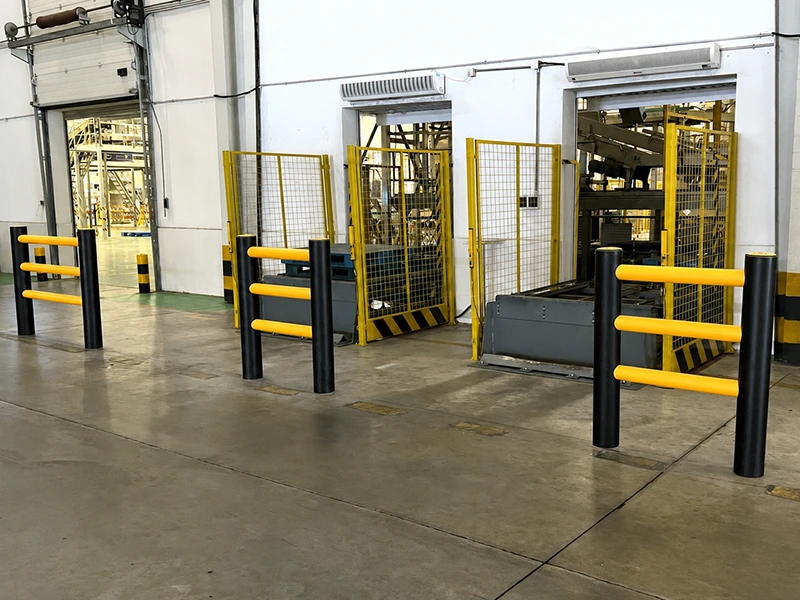
FCBarrier uses an ARMORFLEX polymer body that absorbs up to 80% of impact energy and rebounds. At the loading bay and pallet racking of a bottling plant, the daily forklift nudge becomes a non-event instead of a maintenance ticket. A plant running welded steel barriers has the same rail bent by month three and the same anchor bolt pulled from the same concrete slab by month nine. ARMORFLEX does not eliminate inspection after a hard hit, but it does eliminate the recurring rail-replacement cycle that the central EHS team keeps fielding from every bottling site, and it limits the impact energy that reaches the anchor bolt and the concrete substrate underneath.
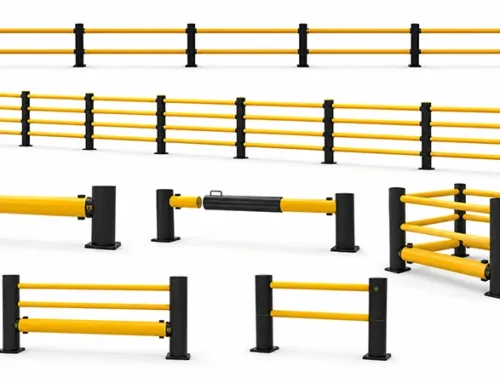
Four Series Cover Every Risk Point on a Bottling Plant Floor
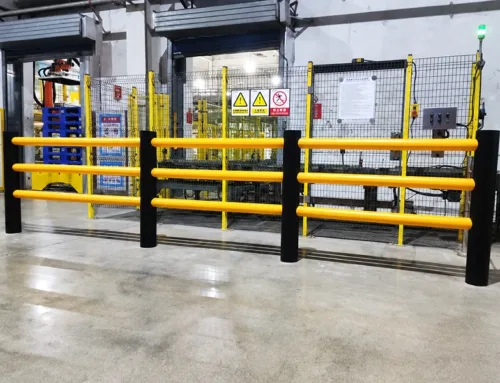
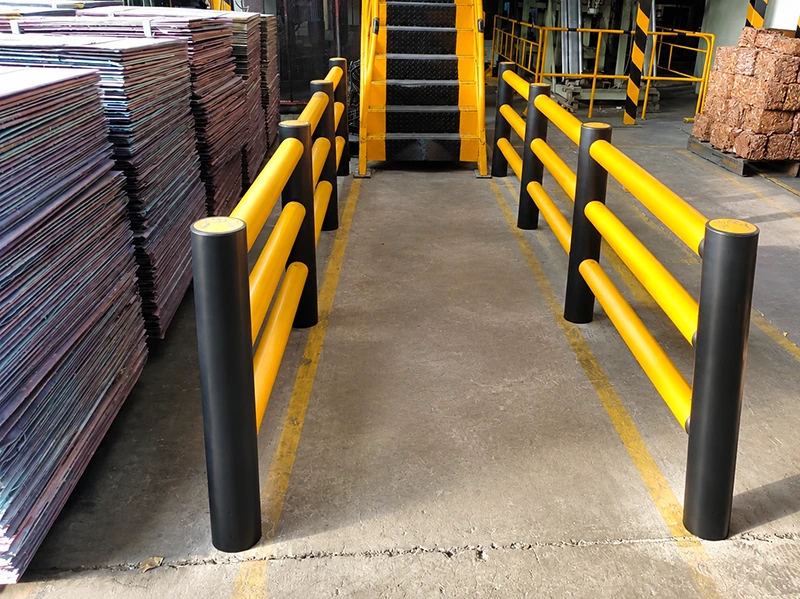
SR for the long warehouse aisle edge, DR for the high-impact pallet rack end and loading dock, TR for pedestrian-vehicle segregation at the production line crossing, and CTR for the building columns that forklifts keep finding. One spec sheet rolled out across fifty or more bottling sites covers the racking, the dock, the line crossing, and the column with the same SKU logic — the layout reads consistently across every audit, and the spare parts inventory at each plant uses the same four series codes instead of a long tail of locally invented brackets and rails.
Two-Person Mortise-and-Tenon Quick-Install Across a Plant Network
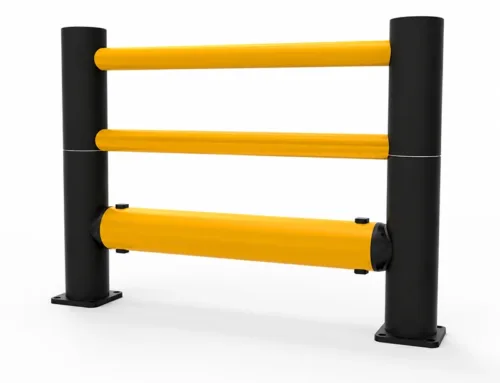
The base unit is three horizontal rails plus two posts joined by a mortise-and-tenon quick-release with a single internal pin driven in with a rubber mallet, then floor-anchored with a rotary hammer, expansion bolt and torque driver. A 50-plant rollout does not require each bottling partner to hire a certified welder — the same two-person crew can install a base unit in a single shift, and a damaged rail or post is replaced individually instead of the full section being scrapped and re-painted.
Where FCBarrier Fits in a Multi-Site Bottling Plant Layout
- Bottling line pallet racking end — DR148 and DR190 for rack end bays with 4 to 8 t forklift traffic
- Loading dock and truck approach — DR190 for truck and forklift bay collision risk at the dock plate
- Production line building columns — CTR148+ and CTR190+ for the structural columns that forklifts keep finding
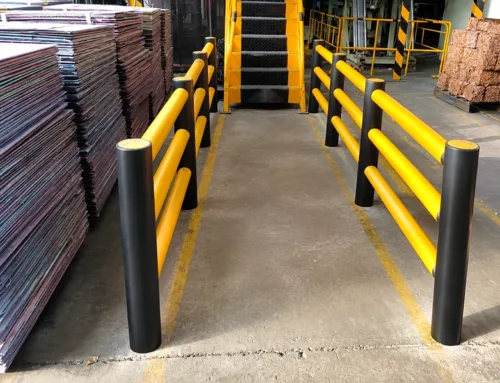
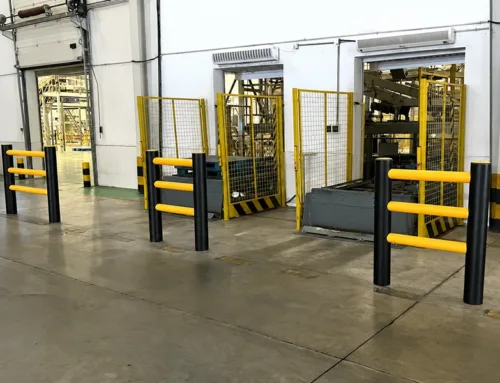
- Pedestrian crossing and operator corridor — TR100 and TR148+ for the personnel route across forklift aisles
- Outdoor storage yard — UV-resistant ARMORFLEX polymer for outdoor finished goods buffer and empty pallet zone
- Sugar syrup room and water treatment area — corrosion-resistant polymer for low-concentration chemical exposure
Every bottling partner maps the same FCBarrier series (SR / DR / TR / CTR) to the same six hazard categories. The audit trail at every plant reads from the same spec sheet, the same Joule value, the same installation manual — and the HQ safety file becomes a single document instead of fifty divergent local orders.
What the Spec Sheet Must Include for HQ Procurement Sign-Off — And Where FCBarrier Stands Today
Before a polymer crash barrier spec clears HQ procurement for a multi-site bottling rollout, the spec sheet must carry: first, the Joule rating per series, with the vehicle mass and speed used to derive each value stated on the same page; second, the concrete floor strength and anchor bolt pull-out data used for the install — FCBarrier’s manual states the requirement for a solid concrete substrate and trained installer crew but does not yet publish the anchor pull-out figure that PAS 13 explicitly calls for; third, a third-party test report against PAS 13:2017 — and this is the open workstream. FCBarrier publishes Joule values from in-house testing and a documented installation method; the third-party PAS 13 test report is the active gap. Until that report lands, the honest position for procurement review is “specification complete, third-party PAS 13 certification in progress” rather than “fully certified.” Closing that gap is the priority investment before the spec can move from a pilot plant to a full network rollout across bottling partners.
Send a Bottling Plant Layout for a Series-by-Series FCBarrier Spec
Send the layout of one representative bottling site — pallet racking plan, loading dock arrangement, production line column grid, and pedestrian crossing points — together with the typical forklift tonnage and travel speed at the site. FCBarrier will return a series-by-series FCBarrier spec sheet covering SR / DR / TR / CTR, a Joule rating per hazard point, an estimated two-person crew install time, and the current PAS 13 third-party certification status. HQ procurement then has the same document to roll out to every bottling partner in the network, and every plant floor reads from the same impact rating table.