IT
IT  EN
EN  DE
DE  RU
RU  PT
PT  JA
JA  ES
ES 
We’ve all seen it. The moment that makes the entire warehouse hold its breath.
It’s late afternoon, the pressure is on to get the last shipments out. Maria, one of your most diligent team members, is focused on her picklist, her back to the main aisle. At the same time, Dave, a forklift operator with a clean record, rounds the corner, perhaps a little too quickly, his view momentarily obscured by a stack of pallets.
Then comes the sound that cuts through everything: the high-pitched screech of tires on polished concrete.
A collective flinch. The deafening silence that follows. You look up to see the forklift stopped, its forks less than a yard from where Maria is standing, her face pale with shock.
Everyone exhales. It was a near-miss. Just a near-miss.
You follow the protocol. You talk to Dave, who is visibly shaken. You check on Maria. You file the incident report, and at the next safety meeting, you re-emphasize the importance of operator awareness and pedestrian vigilance. The yellow line painted on the floor, the one separating the walkway from the vehicle lane, did its job as a visual reminder—or so the thinking goes.
But later that night, as you try to sleep, the image replays in your mind. You start running the variables. What if the floor had been slightly damp? What if Dave’s reaction time had been a fraction of a second slower? That near-miss report could have been a life-altering accident investigation. And the weight of that “what if” rests squarely on your shoulders.
The Uncomfortable Truth About Our Most Common Safety Tool
For decades, the painted yellow line has been the cornerstone of warehouse pedestrian safety. We supplement it with training, signage, and vests. We operate on a system of rules, awareness, and trust. We trust our operators to be vigilant and our pedestrians to stay aware.
But let’s be honest with ourselves: what is that yellow line, really? It’s a psychological boundary, not a physical one. It’s a gentleman’s agreement between a 180-pound person and a 9,000-pound machine. It’s a line that can be instantly erased by a moment of distraction, a blind spot, or simple human error.
We invest thousands in training, demanding perfection from our people in an environment that is, by its very nature, imperfect. We ask them to maintain flawless situational awareness for eight, ten, twelve hours a day, surrounded by noise, pressure, and repetitive tasks. We are basing our safety system on the hope of human infallibility. And as managers, we know that’s a gamble, not a strategy.
Calculating the True Cost of a Gamble
When the gamble fails, the cost is catastrophic. We can talk about the direct financial impact—the worker’s compensation claims, the regulatory fines, the legal fees, and the soaring insurance premiums. In a case like the “Global Logistics incident” in Ohio, fines alone exceeded $150,000. These are the numbers that can be quantified on a spreadsheet, and they are substantial.
But the true cost runs much deeper. It’s the operational cost of shutting down a section of your facility for hours, or even days, for an investigation. It’s the productivity loss from a team that is demoralized and frightened. It’s the management cost—the immense amount of your time and emotional energy consumed by reports, meetings, and the legal fallout.
And most profoundly, it’s the human cost. It’s the impact on a team member and their family. It’s the damage to your company’s culture and reputation. It’s the heavy, personal burden of knowing that a system you were responsible for failed to protect your people.
A near-miss is not a sign that your system is working. It’s a warning that your system is based on luck. And luck, eventually, runs out.
From a System of Hope to a System of Certainty
What if we could engineer luck out of the equation? What if we could create an environment where safety wasn’t dependent on the flawless, split-second decisions of every single person, every single minute of the day? This requires a fundamental shift in mindset: from relying on awareness to guaranteeing protection with engineered solutions like barriere di sicurezza flessibili.
This is the principle behind mandatory physical separation. It’s not about building walls or limiting movement. It’s about creating designated, protected spaces where your team members can do their jobs with the absolute certainty that they are safe from vehicle traffic.
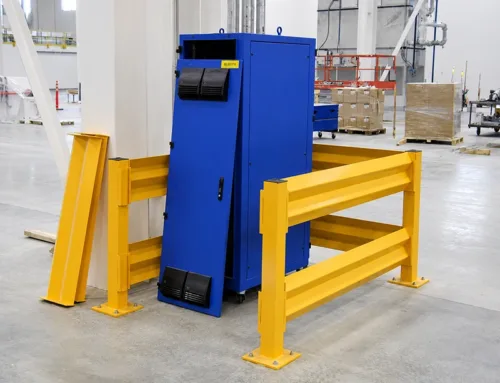
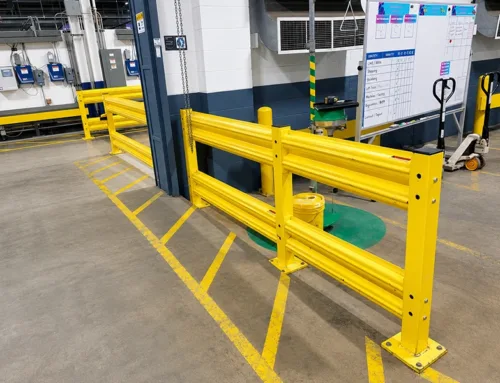
Imagine your warehouse again. Maria is checking her list. Dave is rounding the corner. But now, between them, stands a physical barrier. It’s not an aggressive steel wall that would damage the forklift and its contents upon impact. It’s an advanced polymer guardrail.
When the forklift makes contact, the barrier flexes, absorbing the impact like a cushion. It gently deflects the machine, bringing it to a safe stop. The barrier then returns to its original position, ready to do its job again. Maria might be startled, but she is completely unharmed. The forklift has minimal, if any, damage. The operation barely pauses.
In this scenario, the system didn’t rely on luck. It didn’t rely on perfect human behavior. The engineering did its job. The system worked. For a manager, this is the ultimate value proposition of installing robust barriere di sicurezza flessibili. It’s about trading the constant, low-level anxiety of “hoping for the best” for the profound peace of mind that comes from “engineering for certainty.” It’s about transforming your role from a reactive incident manager to a proactive architect of a genuinely safe workplace.
So, the next time you walk your facility floor and look at that painted yellow line, ask yourself a simple question: Is that a line of trust, or is it a line in the sand you are unwilling to let a preventable accident cross?