IT
IT  EN
EN  DE
DE  RU
RU  PT
PT  JA
JA  ES
ES GLOBAL FACTORY EHS STANDARDIZATION | MEFENCE INDUSTRIAL SAFETY FENCING
Make factory zoning repeatable across 70+ countries
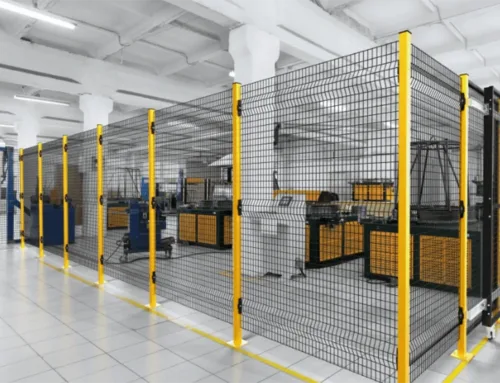
A heavy duty construction fence should not depend on local welding skill. Mefence industrial safety fencing uses standardized welded mesh panels, steel posts, and a no-welding clip fixing system so a maintenance worker can install the same warehouse zoning, machine guarding, and pedestrian vehicle separation layout from one country to the next.
Why multinational factories struggle to copy one zoning standard
A group operating about 340 factories in more than 70 countries may publish one EHS and food-safety standard, yet the physical result can vary sharply by site. A welded square tube fence requires accurate cutting, fitting, welding, finishing, and inspection. Where qualified welders, fixtures, or coating controls are limited, the result is often inconsistent spacing, uneven joints, delayed handover, and expensive rework. Barrier tape or rope barriers may mark a temporary route, but they do not provide a workplace safety barrier for a forklift path, automated equipment, or a hazard zone.
That variation creates a practical management problem: the group can standardize the drawing, but not the installation outcome. It can also make pedestrian vehicle separation and traffic flow planning harder when an AGV lane, forklift path, or production-line boundary must be adjusted at short notice.
| Global deployment requirement | Mefence design response |
|---|---|
| Repeatable site installation | Standard wire mesh panels, posts, plastic clips, self-tapping screws, and expansion-bolt fixing replace field welding. |
| Low dependence on local trade skill | Clip fixing and a visual installation drawing support one-person installation by a factory maintenance worker. |
| Consistent visibility and corporate coding | Yellow-black safety fence configurations or a group-specified custom color can be supplied against one color standard. |
| Different plant footprints | On-site cutting, modular reconfiguration, and panel widths from 200–1400 mm help adapt the same system to local layouts. |
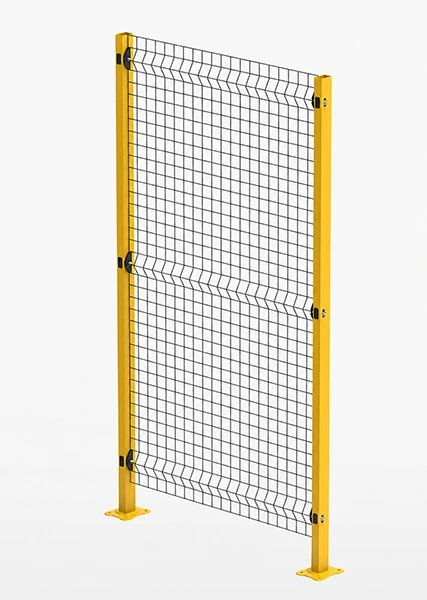
| Different guarding and zoning tasks | 3D welded mesh, T-shaped ridges, base-plate posts, and mesh options such as 20×100 or 50×50 support area demarcation and machine guarding. |
Evidence in the structure: a heavy duty construction fence without field welding
1. A clip-and-bolt connection that is easy to reproduce
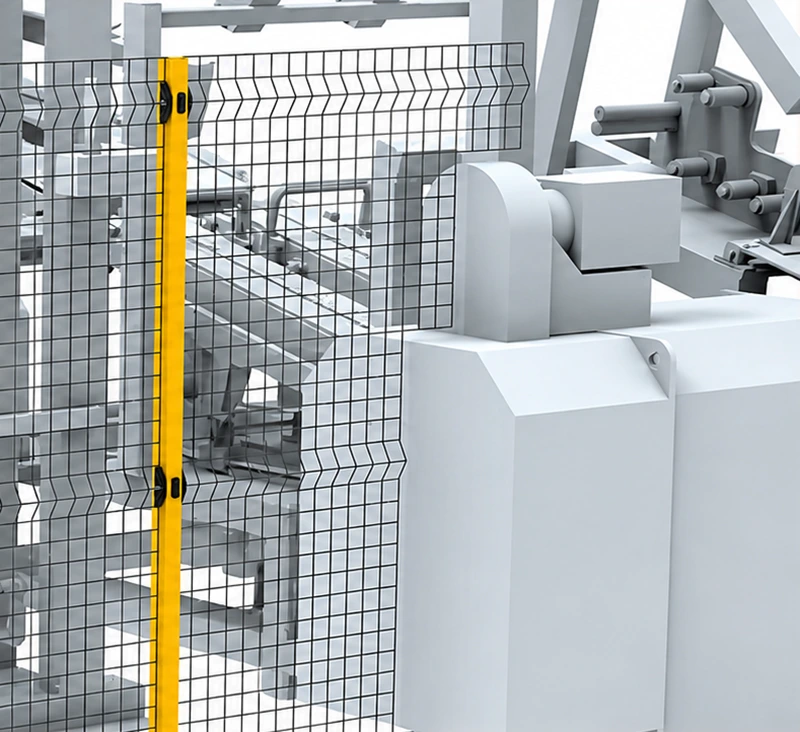
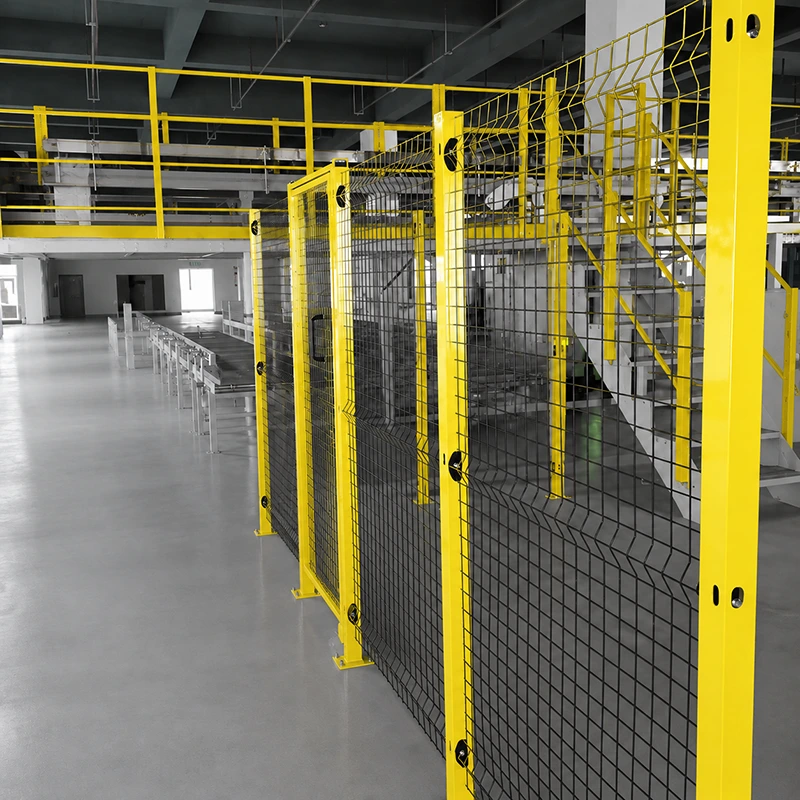
Mefence starts with a frameless design: the 3D welded mesh panel itself supplies the folded shape, while the steel post provides the support line. The connection is made with a plastic clip and bolted hardware rather than a site-welded frame. The slotted post holes shown in the detail image give the installer a clear fixing reference and allow practical alignment during assembly. For a group rollout, that means one installation drawing, one bill of materials, and one repeatable sequence instead of a site-by-site welding interpretation.
2. Standard geometry for machine guarding and access control
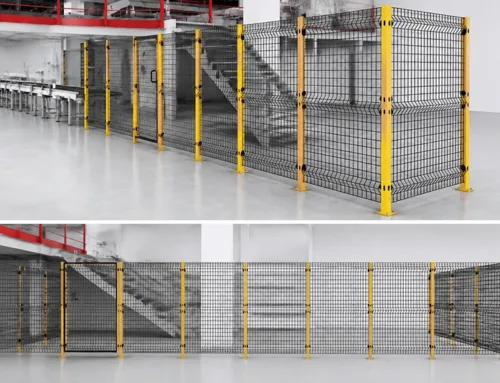
The yellow-black visual code makes a hazard-zone boundary easier to recognize, while welded wire mesh keeps the protected equipment visible for inspection. Mefence panels can be specified from 200–3000 mm in height, with 3 mm or 4 mm wire diameter options and 40×60 or 60×60 post sections. A single access gate can be integrated into an automated equipment enclosure, so operators and maintenance teams use a defined route rather than crossing an improvised barrier. The same logic applies to robotic workstation enclosures, conveyor belt isolation, and CNC machine guarding.
3. A modular boundary that can follow the plant
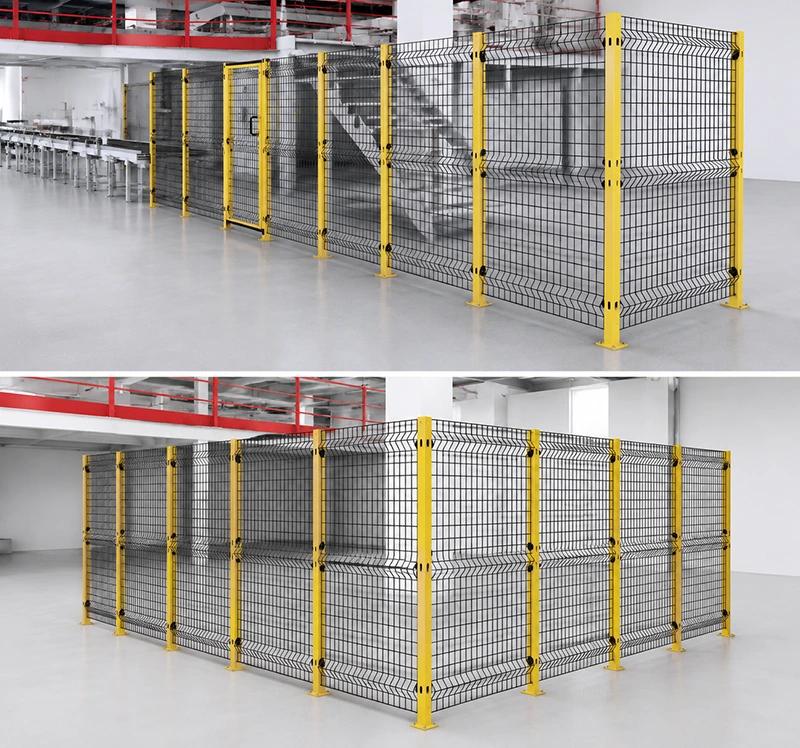
Warehouse zoning is rarely static. A new line, an altered AGV route, or a revised storage area can require a longer run, a corner, or a relocated panel. The modular mesh-panel and base-plate-post arrangement supports relocation and reuse without rebuilding a welded square tube fence. Powder-coated Q235 carbon steel provides the specified material platform, while the slim frameless profile helps maximize floor space around production equipment and pedestrian routes. Plants can order the same core standard in bulk, then adjust the run on site where the layout demands it.
Where one Mefence standard can be copied
- Zonizzazione del magazzino: separate storage areas, tool cribs, and materials with a visible industrial safety fence.
- Pedestrian vehicle separation: define forklift paths, AGV lanes, and crossing points for traffic flow planning.
- Protezione di attrezzature automatizzate: enclose robotic workstations, conveyor belts, CNC machines, and production lines.
- Isolamento dell'officina: create a fixed or semi-fixed partition that can be relocated as the site changes.
- Group procurement: consolidate OEM and bulk orders around one panel, post, color, and accessory specification.
The result is not merely a fence delivered to each country. It is a standard part that EHS teams can specify centrally, purchasing teams can order repeatedly, and local maintenance teams can install without depending on local welding quality. Installation can be completed faster, with the traffic route, equipment boundary, and hazard-zone separation remaining legible from site to site.
Turn a corporate zoning drawing into a global order standard
For a rollout, define the protected area, panel height, mesh opening, wire diameter, post section, gate positions, floor fixing, and approved color. Mefence can then support OEM and batch procurement with a common specification for yellow-black safety fence or a custom group color. The practical handover package is straightforward: layout drawing, standardized components, clip-fixing sequence, and local cutting guidance where required.
Build the same safety boundary at every plant
If local construction capability is creating inconsistent machine guarding or repeated rework, send the group layout, target specifications, and color standard. We can map the requirement to a Mefence heavy duty construction fence package for warehouse zoning, pedestrian vehicle separation, or automated equipment guarding.