JA
JA  EN
EN  DE
DE  RU
RU  PT
PT  ES
ES  IT
IT RECONFIGURABLE GUARDING FOR AUTOMOTIVE PRODUCTION LINES
Industrial Safety Fence for Model Changeovers: Alfence Keeps Robot Cells Reusable
Annual vehicle variants, model changeovers, and incremental automation redraw production lines. Alfence is a modular safety fence built from aluminum profile posts, removable panels, and bolt-free assembly, so teams can reconfigure robot cell guarding and assembly line separation instead of scrapping a welded steel fence.
Why Frequent Line Changes Expose a Welded Steel Fence
A vehicle plant may add a new variant, shift a material-handling robot, extend a conveyor, or open a maintenance route without changing the safety requirement: the hazard perimeter still has to be clear, physically separated, and reviewable. A welded steel cage turns each change into cutting, grinding, re-welding, repainting, and often a new installation. Panels that cannot be removed cleanly become a write-off when the robot cell moves.
| Changeover requirement | Alfence设计响应 |
|---|---|
| New variants change the cell perimeter | Modular frame and post-and-panel construction allow removable, reconfigurable panels to be rearranged for the revised layout. |
| Retrofit work must avoid welding | Connectors lock into T-slot aluminum posts; bolt-free panel assembly removes on-site welding labor and hot-work steps from the standard build. |
| Robot, conveyor, or AGV routes move | 40×40 mm or 45×45 mm posts, floor fittings, doors, and panels can be planned around the new machine and traffic envelope. |
| Access and visibility must stay practical | Welded wire mesh, transparent PC or acrylic panels, hinged/sliding/folding doors, safety interlock switches, and light curtains can be combined by zone. |
Structure and Image Evidence Behind the Reuse Case
1. A modular perimeter that follows the robot cell
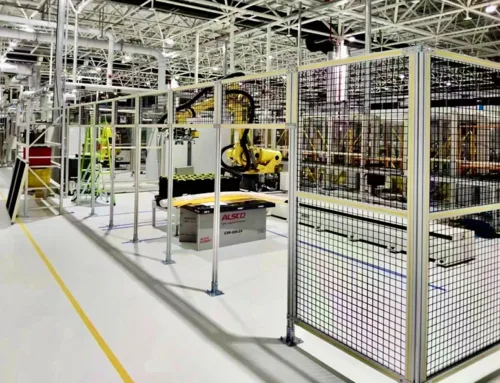
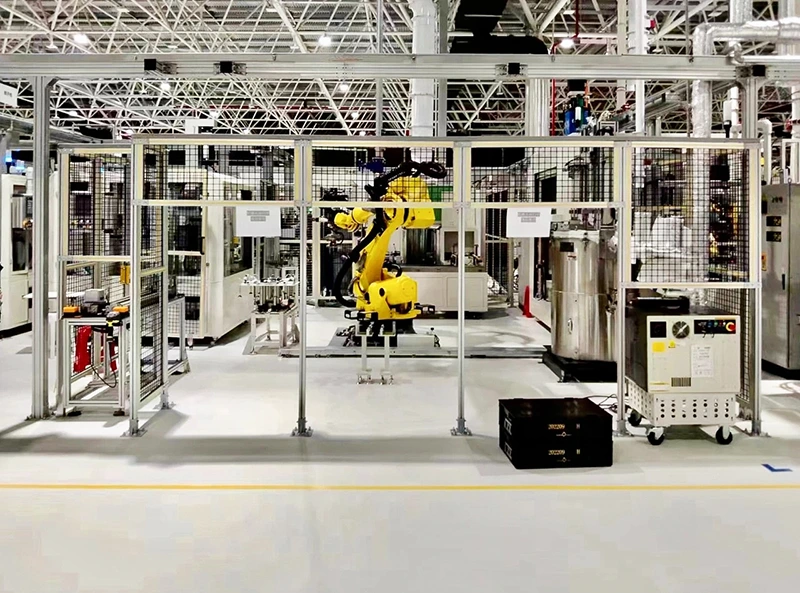
The installed cell shown here uses a compact mesh perimeter around a yellow industrial robot and adjacent equipment. For an indoor robot cell guarding or CNC machine guarding project, the relevant Alfence architecture is a modular frame with T-slot aluminum posts, steel wire mesh panels, connectors, and floor-mounted fittings. Standard post options are 40×40 mm and 45×45 mm; post length can extend up to 2200 mm, subject to the project drawing. This is a physical machine guarding fence, not an open painted line.
2. Access hardware is part of the layout, not an afterthought
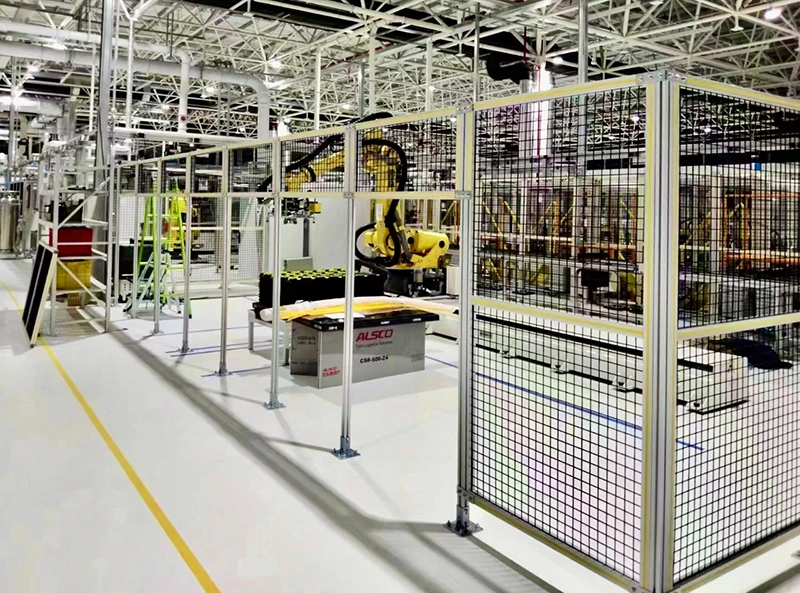
Frequent model changeovers often move the maintenance opening as well as the machine. The door evidence shows hinged access doors, warning identification, and floor anchors around a robot work area. Alfence can be specified with hinged, sliding, folding, or telescopic safety doors; a single hinged door is referenced up to 1500 mm, while a double sliding door can reach up to 6000 mm depending on configuration. Safety interlock switches and safety light curtains can be coordinated with the revised access route. Final opening, reach-distance, and stopping-distance decisions remain project-specific.
3. The boundary can be re-planned without buying a new cage
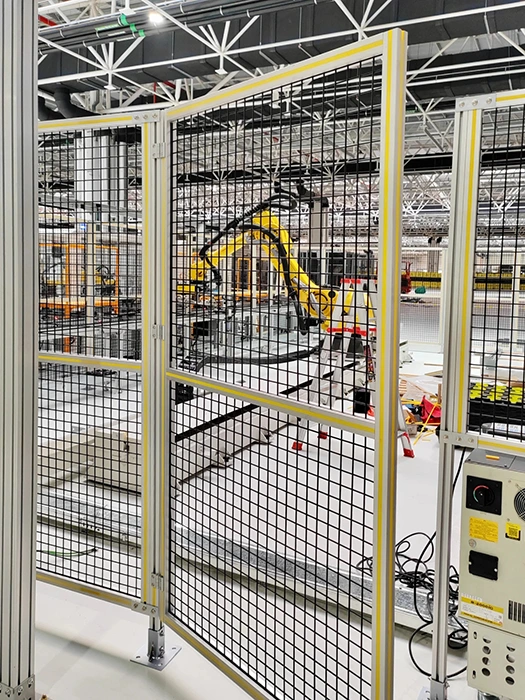
The anchored robot-cell view makes the post-and-panel logic visible: the frame defines the perimeter while the base connection fixes it to the floor. Alfence uses floor connectors with expansion bolts or project-specified fixing hardware; panels and posts are not permanently welded into one irreplaceable cage. The standard 20×100 mm mesh grid can support a closer-to-hazard layout where the completed risk assessment permits it, while PC, acrylic, or metal panels can be selected where visibility or a more enclosed machine enclosure is required.
Where Reconfigurable Alfence Fits
- Automotive robot cell guarding: protect robot workstations and assembly line separation when vehicle platforms or variants change.
- Material-handling robot and AGV path guarding: redraw conveyor, shuttle-car, and AGV boundaries without discarding the complete perimeter.
- CNCおよび工作機械保護: use modular panels and planned maintenance doors for retrofit guarding and equipment relocation.
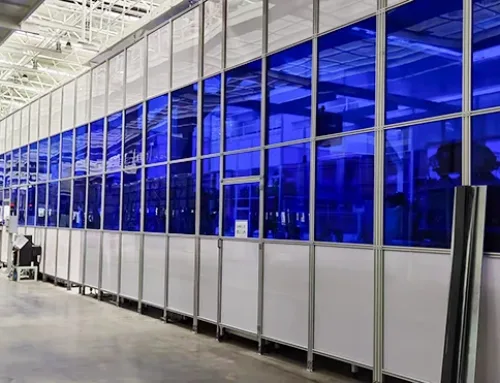
- Welding cell guarding: combine welded wire mesh with PC, polycarbonate, acrylic, or tinted panels when the process calls for visibility or arc-flash screening; panel heat resistance is referenced at ≤60 °C, so process conditions must be checked.
- Indoor plant and cleanroom guarding: use powder-coated aluminum for a lightweight, corrosion-resistant, visually consistent boundary in suitable indoor or light-corrosion environments.
Alfence is intended for indoor, light-to-moderate isolation and frequent retrofit work. It is not a default substitute for an impact-rated steel machine guard, a fall-protection industrial guardrail, or an outdoor security fence. The project team must confirm hazard energy, traffic exposure, clearances, access control, and applicable EN ISO 14120 / EN ISO 13857 requirements.
What the Re-tooling Decision Should Be Based On
Specify the machine envelope, operator and maintenance routes, AGV or conveyor movement, required safety distance, panel type, door opening, interlock interface, floor condition, and expected future change points. Alfence then gives the engineering team a reusable bill of posts, panels, connectors, doors, and floor fittings rather than a one-off welded steel cage. Aluminum extrusion is formed after heating the aluminum bar to about 480 °C and pressing it with approximately 3000 tonnes; the finished profile is shot-blasted and powder-coated, with a cited cure cycle of 185 °C for 15 minutes. These process facts explain the repeatable modular components, but they do not replace a project-specific structural or risk assessment.
Make the Next Model Change a Layout Task, Not a Fence Replacement
When model changeovers, annual variants, and incremental automation are expected, a reconfigurable modular safety fence protects the value of the guarding system. Reposition the perimeter, reuse the panels and posts, and keep machine guarding aligned with the new production line instead of writing off welded steel. Share the cell drawing and changeover constraints with SGF for an Alfence configuration review.