JA
JA  EN
EN  DE
DE  RU
RU  PT
PT  ES
ES  IT
IT 

Your robotic cell’s CAD model is finalized. The PLC is programmed. But the safety fencing on your BOM is still a generic line item—a potential source of costly on-site fabrication, integration headaches, and project delays. The wrong choice doesn’t just create a barrier; it creates a bottleneck.
For automation system integrators, selecting the right ロボット安全フェンス is less about sourcing steel and more about managing risk. A poorly chosen system can derail a project during the most critical phase: commissioning. When your reputation and profitability hinge on delivering a turnkey solution on time, the physical guard becomes a pivotal component of your electrical and control system. This guide breaks down how to choose a fencing system that acts not as a passive barrier, but as an active, integrated part of your automation project.
Beyond the Perimeter: Fencing as a Structural Asset, Not a Liability
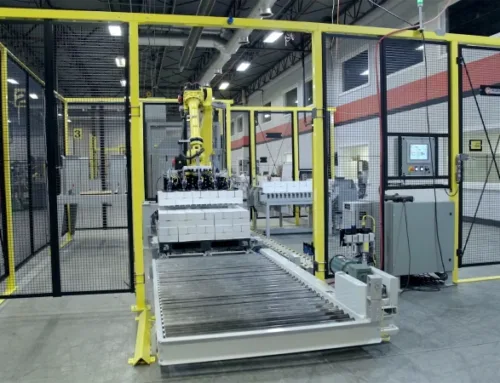
In a dynamic manufacturing environment, the area around a ロボットワークセル is a high-traffic zone. Forklifts, maintenance carts, and personnel are in constant motion. A lightweight or poorly constructed fence is a point of failure waiting to happen. An accidental impact can not only halt production for hours but also damage multi-million dollar robotic arms or CNC machines.
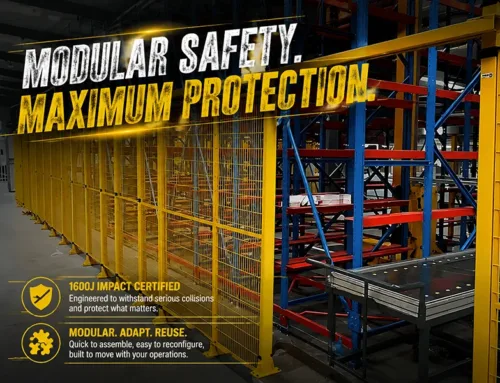
The foundation of a robust system lies in its materials and construction. Look for systems built from high-strength Q235 carbon steel with substantial post dimensions, such as 60 x 60mm (approx. 2.36″ x 2.36″), and a significant wall thickness of at least 2.0mm. The post must be anchored securely with heavy-duty expansion bolts to a solid concrete floor. This isn’t just about meeting a standard; it’s about withstanding the predictable chaos of a factory floor.

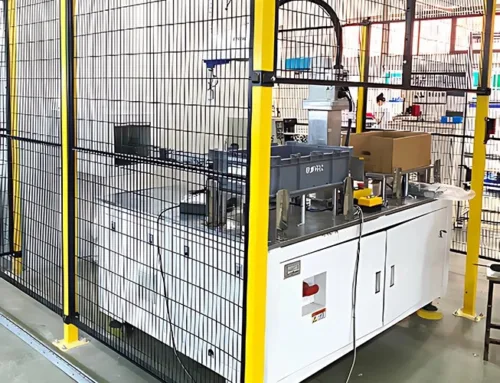
Equally important is the panel construction. A 額装パネル, where the wire mesh is fully welded inside a rigid steel tube frame (e.g., 20 x 30mm), provides vastly superior 衝撃抵抗性 compared to simple unframed mesh. This TUV-certified structural integrity means the fence doesn’t just define a boundary; it actively protects the high-value assets within it.

The Layout Challenge: Conforming to Your Automation, Not the Other Way Around
No two automation cells are identical. Your layout is dictated by robot reach, conveyor paths, and material flow—not by a fencing manufacturer’s standard panel widths. A truly modular system should adapt to your precise CAD drawings, not force you to compromise your design.
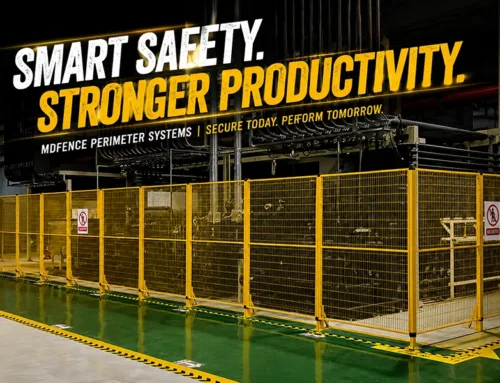
This requires a system with a wide range of standard panel sizes, the ability to supply custom-width panels without exorbitant costs, and components to accommodate non-90-degree angles. Whether you are enclosing a single pedestal robot or an entire 184-foot automated assembly line with multiple access points, the system’s flexibility is paramount. The ability to specify exact heights, panel types (mesh, clear polycarbonate, or solid steel), and configurations from a single supplier simplifies your BOM and procurement process immensely.

The Integration Game-Changer: From Dumb Barrier to Smart Safety Component
Here lies the single most critical factor for a system integrator: seamless integration with your safety control circuit. Your client has specified Omron, Pilz, or Pizzato safety interlock switches. The last thing your team needs is to spend valuable hours on-site, drilling into posts and fabricating custom brackets to mount these switches, hoping for correct alignment.
This is where a “smart” fencing system distinguishes itself. The crucial feature to demand is a pre-engineered セーフティ・インターロック・キャリア. This is not just a piece of metal; it’s a purpose-built mounting solution designed to accept specific, industry-standard interlock switches (like the Omron D4NL series). It ensures perfect alignment and secure mounting every time.
- Before: Your electrical engineers are delayed on-site, cutting and drilling the fence posts, trying to align the actuator and the switch body. This adds hours, or even days, to the commissioning schedule and looks unprofessional.
- Why it Works: A dedicated lock carrier system provides pre-drilled, perfectly positioned mounting points. The fence becomes a plug-and-play component of your safety PLC’s I/O.
- After: The interlock is mounted in minutes. Your safety circuit is verified quickly, the commissioning process stays on track, and you deliver a clean, professionally integrated system to your client. This single feature transforms the fence from a project risk into a project accelerator.

Access is Everything: Choosing the Right Gateway for Your Workflow
A robot cell is useless if you can’t get people, parts, and tooling in and out efficiently. The door system must match the operational needs of the cell. A one-size-fits-all approach doesn’t work.
- Hinged Doors: The standard for personnel access. Ensure they are robust and can be easily integrated with safety interlocks.
- Sliding Doors: Essential for wide openings where the swing path of a hinged door would obstruct a walkway or another piece of equipment. A top-hung track system ensures smooth operation and no floor obstruction.
- Folding Doors: The ideal solution for extra-wide access points where there’s no space for a sliding door to retract into.
A well-designed 機械警備システム will offer all these options as standard, modular components that use the same post-and-panel system, ensuring consistent strength and aesthetics across the entire installation.

Conclusion: Choose a Partner, Not Just a Product
Choosing the right ロボット安全フェンス is a strategic decision that directly impacts your project’s bottom line. Look beyond the price per foot and evaluate the system on its total integration cost. The right system is built on a foundation of high-strength materials, offers the flexibility to match your exact layout, and, most importantly, is engineered from the ground up to integrate seamlessly with the safety controls you use every day. It’s a system that saves you time, de-risks your commissioning phase, and helps you deliver the robust, reliable automation solutions your clients expect.
Frequently Asked Questions for Automation Integrators
1. How does your system handle integration with our specified safety PLCs and interlock switches from brands like Omron, Pilz, or Rockwell?
Our system is designed for seamless integration. We offer a range of pre-engineered セーフティ・インターロック・キャリア specifically designed as installation carriers for popular safety switches, including the Omron D4NL and Pizzato FS series. These carriers eliminate the need for on-site drilling and fabrication, ensuring perfect alignment and turning the fence door into a plug-and-play node in your safety circuit.
2. Our robotic cell has a complex footprint with non-standard angles. Can your system be customized to our CAD layout?
Absolutely. Modularity is at the core of our system. We can provide a complete solution based on your exact CAD drawings, including custom-width panels, angled connectors, and posts customized to specific heights (e.g., up to 8 feet / 2.44m). We deliver a system that conforms to your design, not the other way around.
3. What is the certified impact resistance of the panels and posts?
Our system is TUV certified for high impact resistance, meeting or exceeding standards like ISO 14120. The strength comes from using 60x60mm posts made of Q235 carbon steel and fully framed panels. This ensures the system can withstand significant impacts from industrial equipment, protecting your client’s assets and personnel.
4. How quickly can a typical system be installed to avoid delaying our commissioning schedule?
The modular, no-weld design significantly speeds up installation. Because components like interlock carriers are pre-engineered, on-site fabrication is minimized. A standard cell can typically be assembled by a small team in a fraction of the time required for systems that need field modification. The process primarily involves anchoring posts and fastening panels with standardized hardware.
5. Beyond standard mesh, what other panel options are available for applications like welding cells or clean environments?
We offer a variety of panel infills to suit specific applications. For welding cells where spark and flash containment is necessary, we provide solid steel sheet panels. For areas requiring high visibility without sacrificing protection, we offer impact-resistant polycarbonate (PC) or acrylic panels. All plastic panels meet stringent fire safety standards like UL94V0 and EN1598.