JA
JA  EN
EN  DE
DE  RU
RU  PT
PT  ES
ES  IT
IT 

|
Stop guessing your ISO safety distances. In high-speed automotive assembly and robotic welding cells, a standard 2000mm fence isn’t always compliant. If your risk assessment highlights “reach-over” hazards for KUKA or FANUC arms, you need a calculated physical barrier, not a generic catalog item. We engineer compliant perimeters that integrate seamlessly with your PLC logic. |
Decoding ISO 14120 & 13857: It’s Not Just About “Tall Fences”
For system integrators building automated production lines, the height of your 機械安全フェンス is not an arbitrary choice—it is a mathematical necessity derived from ISO 13857 safety distance calculations.
The critical metric here is the “Reach-Over” distance. If you are guarding a robotic welding station where the hazard zone (the maximum reach of the manipulator arm) is high, a standard 2000mm (approx. 6.5 ft) fence may fail an audit if the horizontal safety distance is insufficient. The standard assumes a tall operator can reach over a protective structure.

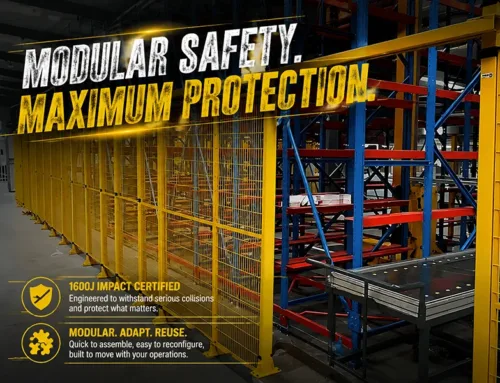
Figure 1: Mdfence Standard Post specifications, customizable up to 2440mm for high-risk zones.
The Mdfence Solution: We don’t force a one-size-fits-all approach. While our standard posts are 2000mm, we frequently manufacture 2440mm (8 ft) systems for automotive clients. This additional height often negates the need to push the fence line further out, saving valuable floor space in tight assembly layouts.
Structural Integrity for High-Impact Zones
Height is useless without stability. In an environment with forklifts and AGVs moving heavy chassis parts, the fence must withstand accidental impacts. A flimsy wire mesh might stop a hand, but it won’t stop a pallet jack.
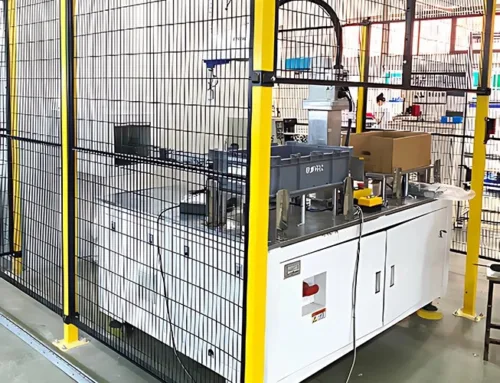
Our system utilizes Q235炭素鋼 with a 60x60mm post profile and a 2.0mm wall thickness. The framed panels (20x30mm tube frame) ensure that even at heights of 2.4 meters, the mesh remains rigid and does not “belly” or vibrate, maintaining the required safety distance (S) at all times.

Figure 2: Framed Panel construction provides the rigidity required for TUV-certified impact resistance.
Integrating Interlocks: The “Hidden” Height Variable
One of the biggest friction points for system integrators is mounting safety switches. Whether you are using Omron D4NL or Pizzato sensors, retrofitting brackets onto a finished fence post is time-consuming and risks damaging the powder coating, leading to corrosion.
Furthermore, the mounting height of the セーフティ・インターロック・キャリア must be ergonomic for operators while remaining tamper-resistant.

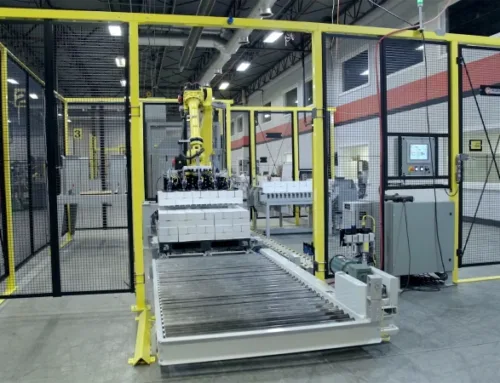
Figure 3: Pre-engineered lock carriers allow for rapid integration of third-party safety switches without on-site drilling.
Mdfence provides pre-engineered mounting kits (e.g., KKCK-LCK-B-D4NL-SET). This turns your ロボット安全フェンス from a passive barrier into an active component of your machine’s safety circuit, drastically reducing installation hours during line commissioning.
Access Management in Restricted Spaces
In automotive tier-1 supplier facilities, space is at a premium. A standard hinged door requires a swing radius that might interfere with an adjacent AGV path or conveyor belt.
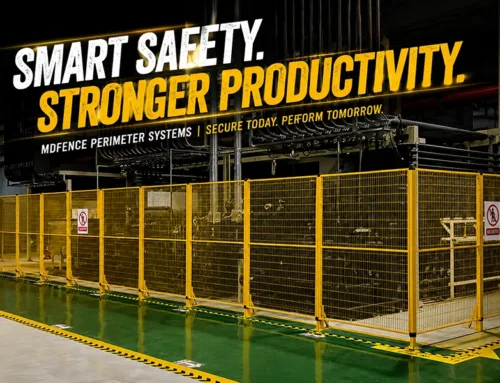
To maintain ISO compliance without blocking logistics routes, we utilize suspended sliding door systems. These doors maintain the full height protection of the fence line while requiring zero swing clearance. For larger openings required for bringing in heavy dies or machinery maintenance, we offer trackless folding systems that can span up to 4800mm.

Figure 4: Sliding door configurations maximize floor space in tight automotive assembly cells.
よくある質問
Q1: What is the minimum height for a robot cell fence under ISO standards?
While 1400mm is a baseline, high-risk robotic applications typically require a minimum of 2000mm to prevent reach-over. The exact height depends on the distance from the hazard zone (refer to ISO 13857 tables).
Q2: Can Mdfence integrate with our existing Siemens PLC safety loops?
Yes. Our セーフティ・インターロック・キャリア kits are compatible with major safety switch brands like Siemens, Euchner, and Omron, allowing seamless integration into your E-stop architecture.
Q3: We have welding sparks. Is wire mesh appropriate?
For direct welding cells, we recommend replacing standard mesh panels with polycarbonate or solid steel sheet panels in the lower sections to contain sparks and protect personnel from UV flash, while maintaining mesh above for visibility.
Q4: How do you handle floor unevenness in older automotive plants?
Our posts feature adjustable mounting capabilities. The base plates are anchored with M10 expansion bolts, and the panel connections allow for slight vertical tolerances to ensure the fence line remains level.
Q5: What is the impact rating of your fencing?
私たちの 産業用周辺警備 systems are TUV certified for high impact resistance, designed to withstand the kinetic energy typical of incidental contact in heavy manufacturing environments.