JA
JA  EN
EN  DE
DE  RU
RU  PT
PT  ES
ES  IT
IT 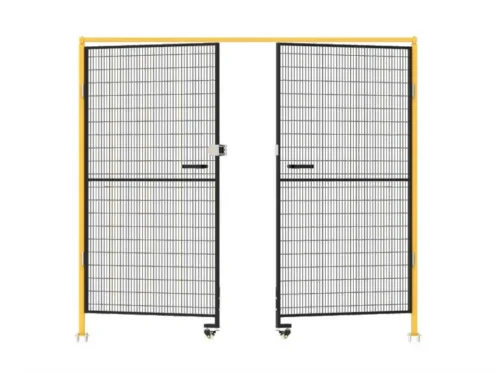

|
In a high-speed automotive welding station, cycle times are measured in seconds. If a KUKA robot’s pneumatic gripper drops a 150 lbs cast-iron engine block at full swing, or if a runaway AGV veers off its path, cheap frameless wire mesh will fold like a hammock. T-slot aluminum profiles will shatter, sending brittle shrapnel directly into the operator aisle. You don’t just need a visual perimeter; you need engineered kinetic stopping power that prevents catastrophic line shutdowns. |
The Reality of High-Speed Automotive Robotics
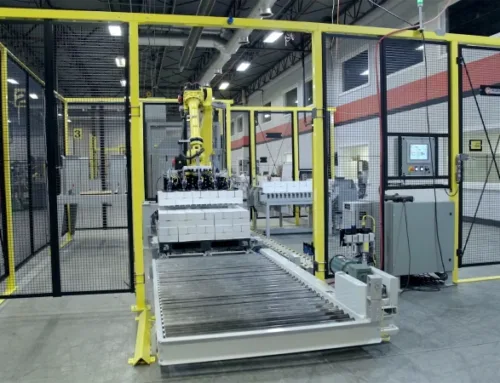
System integrators face a brutal truth when designing ロボット安全フェンスシステム: the physical barrier must account for worst-case scenarios. When a 6-axis robot is manipulating heavy automotive assemblies, the centrifugal force generated during a fault can easily exceed standard commercial limits. Many integrators rely on generic fencing that hasn’t been dynamically tested. The result? A minor forklift bump or a dropped workpiece bends the frame, misaligns the safety interlock switches, and triggers phantom Safety Torque Off (STO) signals to the PLC. Every minute of that unplanned downtime bleeds thousands of dollars from the plant’s OEE (Overall Equipment Effectiveness).
The Physics of Stopping Power: Q235 Steel vs. Kinetic Energy
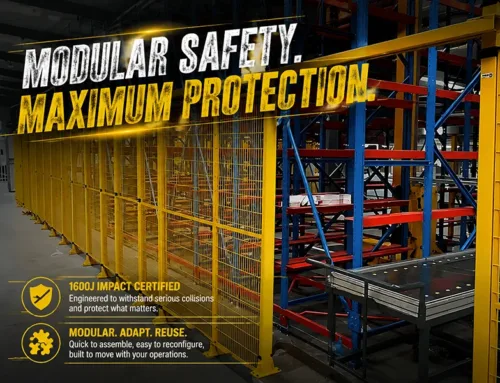
So, can 機械用ガードフェンスパネル truly handle impacts in the 1600J to 2000J range? Yes, but it requires a fundamental shift from rigid brittleness to controlled plastic deformation. Our Mdfence system is TUV certified to withstand 1600 Joules—equivalent to stopping a 220 lbs object moving at 12.4 mph dead in its tracks. To push these boundaries toward extreme impact resistance, the secret lies in the anchoring and the skeletal structure.

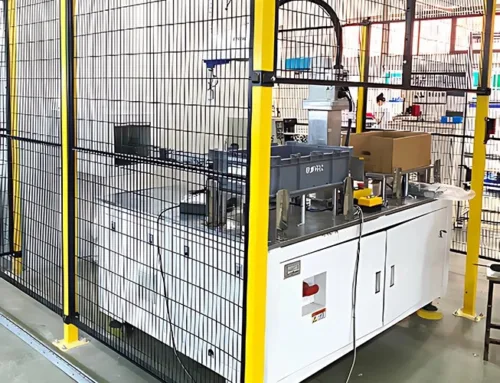
Unlike aluminum, which has a low modulus of elasticity and snaps under sudden heavy loads, our 60x60x2.0mm posts are extruded from Q235 cold-rolled carbon steel. When a massive impact occurs, the fully welded 20x30mm tubular frame of the panel acts as a load-sharing beam. The kinetic energy is transferred through the heavy-duty connection clips down to the post base, which is anchored into the polished concrete using four M10x70mm wedge expansion bolts. The steel bends—acting like an automotive crumple zone—absorbing the energy rather than fracturing. This means the dangerous projectile stays inside the work cell, and your operators walk away without a scratch.
Beyond the Impact: STO Integration and Slashing MTTR
Stopping the physical object is only half the battle; stopping the machine logic is the other. In a fully automated CNC machining center, the physical 工業用安全フェンス must seamlessly integrate with the active safety circuit. If a panel is compromised, maintenance needs access immediately, but safety protocols demand strict LOTO (Lockout/Tagout) compliance.

We eliminate the nightmare of on-site hot work. Instead of maintenance crews dragging welding torches onto the factory floor—risking fire hazards and halting adjacent production lines—our modular system uses standardized fasteners. We provide pre-engineered installation carriers specifically designed for industry-standard interlocks like Omron D4NL or Pizzato. Because our framed panels maintain absolute rigidity, the actuator key aligns perfectly with the switch body every single time. If a forklift destroys a panel, a single technician with an Allen wrench can swap it out in under 10 minutes, drastically reducing your Mean Time To Repair (MTTR) and getting the assembly line back to green light status.
Designing for AGVs: Wide Clearances Without Sagging
Modern automotive plants rely heavily on AGVs and AMRs for material handling. Creating safe tunnels and entry points for these vehicles requires massive openings that standard 安全柵機械ガード simply cannot support without sagging over time.

For areas requiring wide forklift or AGV access, our double sliding door systems are engineered with heavy-duty bearing rails. Spanning up to 14 feet (4300mm) wide, these doors utilize the same 20x30mm framed mesh architecture. This guarantees that even across wide spans, the door will not warp under its own weight, ensuring that your 産業用周辺警備 remains completely aligned with floor tracks and optical sensors.
Frequently Asked Questions (FAQs)
1. How does 1600J impact resistance translate to real-world automotive plant scenarios?
A 1600J rating means the fence can safely intercept a 220 lbs (100kg) object traveling at roughly 12.4 mph (20 km/h). In an automotive setting, this provides critical protection against ejected workpieces from a CNC spindle or a heavy component dropped by a robotic arm during a high-speed transfer.
2. Can we mount Omron or Pizzato safety interlocks directly to these panels without drilling?
Yes. We provide pre-engineered lock carriers (e.g., KKCK-LCK-B-D4NL-SET) that match the exact hole patterns of major switch brands. This eliminates on-site drilling, prevents metal shavings from contaminating the area, and protects the anti-corrosion powder coating.
3. If an AGV or forklift damages a panel, how long does it take to replace?
Because the system is 100% modular and uses bolt-on connection clips, a damaged panel can be swapped out by a single maintenance technician in about 10 minutes using standard hand tools. No welding or hot work permits are required.
4. Do these panels meet OSHA and ISO 14120 standards for robotic work cells?
Absolutely. The system is designed in accordance with ISO 14120 general requirements and ISO 13857 safety distance standards. The 20x100mm mesh prevents fingers from reaching hazardous areas, allowing the fence to be installed as close as 4.7 inches (120mm) to the danger zone.
5. Why is Q235 steel better than T-slot aluminum for heavy machinery guarding?
T-slot aluminum has a lower elasticity modulus; under severe impact, it tends to fracture or suffer permanent brittle failure, creating dangerous shrapnel. Q235 cold-rolled carbon steel undergoes plastic deformation, safely absorbing and dissipating the kinetic energy without breaking apart.