JA
JA  EN
EN  DE
DE  RU
RU  PT
PT  ES
ES  IT
IT 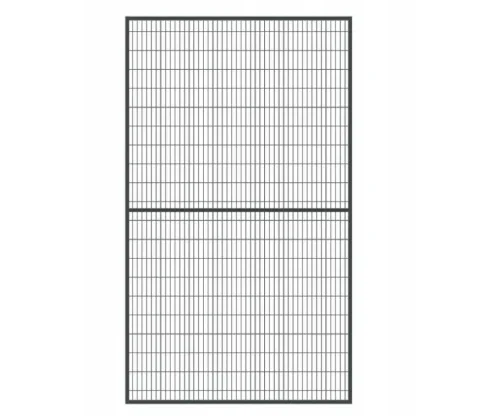

In high-speed automotive assembly lines and dense robotics layouts, a gray or uniformly painted perimeter is a collision waiting to happen. When forklifts and AGVs navigate tight aisles carrying heavy dies or engine blocks, a barrier that blends into the background means bent frames, shattered safety light curtains, and massive OEE drops. You need a physical barrier that screams “danger zone” to traffic, yet remains optically transparent for EHS managers and operators monitoring the KUKA or FANUC robots inside.
The Optical Physics of Safety in Automated Production Lines
The “Visual Wall” Problem in CNC and Welding Cells
In a typical automotive welding station or CNC machining center, operators need to constantly monitor the equipment for weld spatter buildup, tool wear, or part misalignments. Traditional 安全フェンス工業 setups often use galvanized silver or all-yellow mesh. While yellow is a standard safety color, a massive wall of yellow wire mesh creates severe optical glare under bright 5000K LED factory lighting. This forces operators to strain their eyes or, worse, open the interlocked doors just to see what’s happening inside the cell, triggering unnecessary machine stops and killing your cycle times.
The Solution: High-Contrast Color Engineering
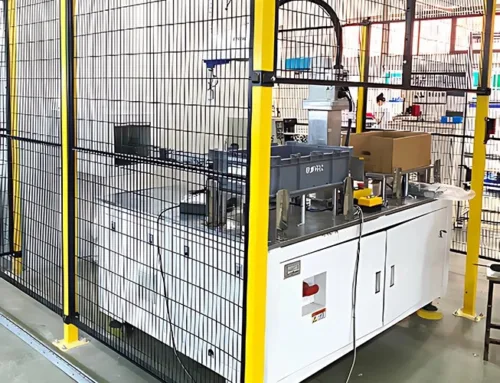
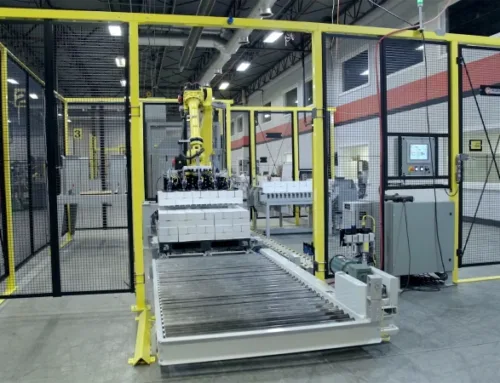
To solve this, our ロボット安全フェンスシステム utilize a dual-color high-visibility strategy based on optical absorption. The structural perimeter—the posts—are coated in highly visible RAL 1023 Safety Yellow, while the mesh panels are coated in RAL 9005 Deep Black.

The 2.36 x 2.36 inches (60x60mm) Q235 carbon steel posts act as an unmissable visual warning for forklift drivers and AGV navigation sensors. Anchored to the concrete with heavy-duty M10 expansion bolts, these yellow posts clearly define the traffic routes and the boundaries of the dedicated manufacturing lines.

Conversely, the black wire mesh absorbs the ambient light rather than reflecting it. When an operator stands outside the cell, the black mesh effectively “disappears” from their focal point, providing a crystal-clear line of sight to the servo motors and robotic arms inside. This allows for continuous quality inspection without breaching the safety zone.
Structural Integrity Meets ISO Compliance
Containing High-Speed Hazards
Visibility means nothing if the barrier cannot withstand a catastrophic event. In high-speed mechanical assembly machines, the risk of a part ejection—such as a 220 lbs (100kg) aluminum casting flying out of a lathe—is a reality. Cheap, frameless wire mesh acts like a trampoline, stretching and eventually giving way under impact.
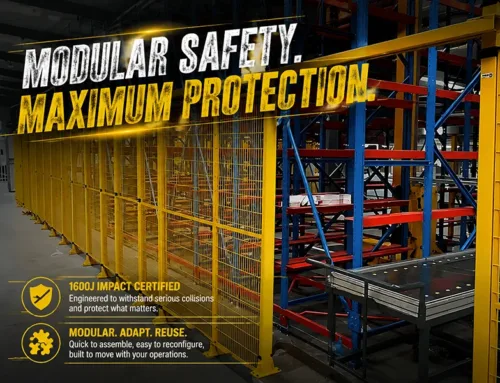
私たちの 機械用ガードフェンスパネル are engineered with a fully welded 0.78 x 1.18 inches (20x30mm) tubular steel frame. The flat-welding process ensures there are no sharp burrs to snag operator uniforms. More importantly, this framed architecture distributes kinetic energy across the entire panel and transfers it to the heavy-duty posts, allowing the system to absorb up to 1600 Joules of impact energy. Furthermore, the 20x100mm narrow mesh spacing strictly complies with ISO 13857 finger-safe distance requirements, allowing you to install the barrier as close as 4.72 inches (120mm) to the hazard, saving valuable floor space in cramped automotive plants.
Seamless Access for Material Handling
Accommodating Heavy Dies and Forklifts
Automotive assembly systems require frequent material replenishment. A standard single door is useless when you need to load a massive stamping die or drive a forklift into the cell for maintenance.

For wide access points, our double sliding door systems are the industry standard. They glide smoothly on heavy-duty bearing rails without consuming aisle space when opened. Because the door panels utilize the same framed Q235 steel construction, they do not sag over time. This rigidity is critical for system integrators because a sagging door will cause sensitive PLe/SIL3 safety interlock switches (like Omron or Pizzato) to misalign, resulting in phantom machine faults and frustrating downtime.
Workflow Transformation: Traditional vs. Modular Guarding
When reconfiguring robotics layouts for a new vehicle model, traditional welded fences end up in the scrap bin. Here is how our modular system changes the engineering workflow:
| Operational Phase | Traditional Welded / Frameless Mesh | Mdfence Modular System |
|---|---|---|
| インストール | Requires hot work permits, welding on the factory floor, and touch-up painting that peels off. | Cold assembly using standard hex wrenches. Pre-drilled clips attach to posts in minutes. |
| Daily Operation | Yellow mesh causes severe glare. Doors sag, causing safety interlocks to fail and stopping the PLC. | Black mesh provides high visibility of the process. Rigid framed doors keep safety switches perfectly aligned. |
| 再構成 | Must be cut with grinders and thrown away. Zero asset recovery. | Unbolt panels and move them to the new CNC line. 95% asset reuse rate. |
よくある質問
1. Why is the mesh black instead of safety yellow?
Black absorbs light, eliminating the glare caused by factory LED lighting. This allows operators and machine vision systems to clearly see through the 安全柵機械ガード to monitor the robotic cell without opening the doors.
2. Can this fencing withstand a forklift collision?
The system is certified to withstand a 1600 Joules impact. The Q235 carbon steel posts will plastically deform to absorb the kinetic energy rather than snapping, preventing the fence from becoming dangerous shrapnel.
3. How does the system integrate with our existing PLC and safety interlocks?
We provide pre-engineered mounting plates (lock carriers) specifically designed for standard safety switches like Omron D4NL or Pizzato. This guarantees perfect alignment and seamless integration into your automated production line’s STO (Safe Torque Off) circuit.
4. Does the powder coating resist automotive machining fluids?
Yes. The electrostatic powder coating passes stringent ISO 9227 salt spray tests, making it highly resistant to CNC coolants, hydraulic oils, and industrial cleaning solvents used in metalworking environments.
5. What is the safety distance required for the 20x100mm mesh?
Because the 20mm slot prevents fingers from reaching through, ISO 13857 standards allow this specific mesh profile to be installed as close as 4.72 inches (120mm) from the hazard, saving critical floor space compared to standard 50x50mm mesh.