JA
JA  EN
EN  DE
DE  RU
RU  PT
PT  ES
ES  IT
IT 

In high-speed automotive assembly and robotic integration, every square inch of floor space directly impacts your plant’s throughput. Miscalculating the safety distance for your six-axis robotic work cells doesn’t just risk OSHA compliance—it forces you to push your perimeter outward, eating up critical AGV (Automated Guided Vehicle) pathways and limiting the number of CNC or welding stations you can deploy on the floor. Stop guessing with generic chain-link barriers and start engineering your floor plan with precision.
[How do you calculate the safety distance for a robot fence?]
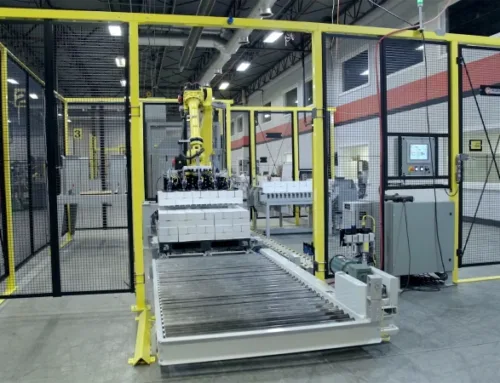
Calculating the precise safety distance for a robotic work cell is governed by strict international standards, primarily ISO 13857 そして ANSI/RIA R15.06. The formula isn’t just about drawing a line around the maximum reach of your KUKA or FANUC arm; it is fundamentally dictated by the physical properties of the 工業用安全柵 you install—specifically, the size of the mesh openings and the system’s ability to withstand impact.
The Mesh Size vs. Reach Distance Dilemma
The Assembly Line Pain Point (Before): Many system integrators default to standard 2×2 inch (50x50mm) wire mesh or local fabrication for their automated production lines. Because a 2-inch opening easily allows an operator’s arm to pass through, ISO standards dictate that the hazard reach distance must be extended to at least 33.5 inches (850mm). This forces the perimeter guard far away from the machine base, creating a massive footprint that chokes material handling areas and narrows forklift aisles.
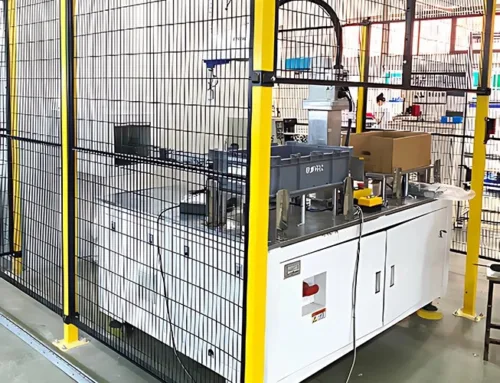
Our Engineering Logic (Why it works): We engineered our 機械用ガードフェンスパネル with a highly specific 20x100mm (0.78″ x 3.9″) framed mesh configuration. This narrow vertical slot acts as an anti-climb and “finger-safe” barrier. Because the 20mm width restricts penetration to just the fingertips, the ISO 13857 calculation allows the physical barrier to be moved significantly closer to the hazard zone.

The Plant Floor Benefit (After): By utilizing the 20x100mm mesh, you can legally and safely install the fence as close as 4.7 inches (120mm) from the moving mechanical assembly. For a 150-foot automated automotive welding line, shrinking the perimeter inward by over two feet on both sides reclaims hundreds of square feet of premium factory real estate, allowing for an additional CNC machining center or a wider AMR route.
Accounting for High-Speed Ejections and Heavy Impacts
The Integration Pain Point (Before): Safety distance calculations are void if the barrier collapses under pressure. T-slot aluminum profiles or frameless mesh systems often buckle or permanently deform when an end-of-arm tooling (EOAT) drops a heavy automotive component, or when a forklift accidentally bumps the perimeter during material loading. A breached cell means immediate production halt and mandatory safety audits.
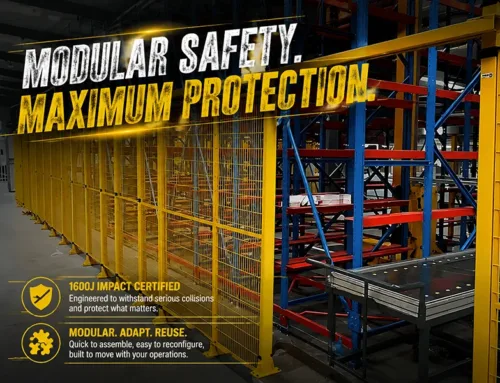
Our Engineering Logic (Why it works): 真 ロボット安全フェンスシステム must operate as kinetic energy absorbers. Our system utilizes Q235 cold-rolled carbon steel. The 60x60mm (2.36″x2.36″) posts, combined with 20x30mm fully welded tubular panel frames, distribute point loads across the entire structure. Anchored to the concrete via heavy-duty M10 expansion bolts, the system is TUV-certified to withstand a 1600 Joule impact—equivalent to halting a 220 lb (100 kg) object traveling at 12.4 mph (20 km/h).

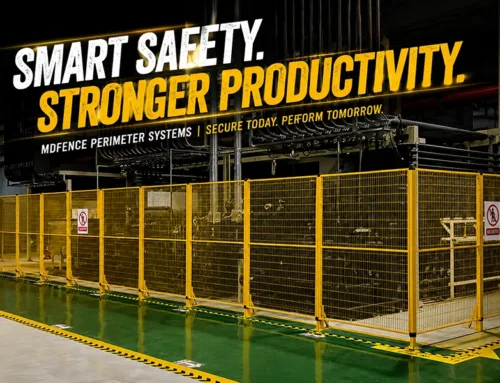
The Plant Floor Benefit (After): When the inevitable bump occurs, the steel undergoes controlled plastic deformation rather than catastrophic brittle failure. Your robotic cell remains secure, the equipment inside is protected from external forklift damage, and your manufacturing line maintains its uptime without requiring emergency maintenance overhauls.
Maintaining Safety Distance at Access Points
The Automation Pain Point (Before): The most vulnerable point in any safety distance calculation is the entry gate. When integrators use custom-welded doors for wide entry points (like those needed for loading heavy engine blocks), gravity causes the hinges to sag over time. This misalignment causes the Omron or Pizzato safety interlock switches to lose contact, triggering random Safety Torque Off (STO) signals to the PLC and shutting down the high-speed assembly line for no apparent reason.
Our Engineering Logic (Why it works): To maintain structural integrity across wide spans, we utilize modular sliding door systems with top-mounted bearing rails or heavy-duty folding doors. More importantly, we provide pre-engineered installation carriers (like the KKCK-LCK-B-D4NL-SET) specifically designed for third-party electronic safety interlocks. The rigid 20x30mm frame ensures the door geometry never warps.

The Plant Floor Benefit (After): Your safety circuit remains perfectly aligned regardless of how many times the door is cycled by operators. You eliminate “ghost trips” on your PLC, ensuring seamless integration with your control equipment and maximizing your Overall Equipment Effectiveness (OEE).
Real-World Matrix: The Impact of Proper Guarding Specification
| Specification Element | Standard Commercial Mesh (50x50mm) | Mdfence System (20x100mm) |
|---|---|---|
| Required ISO 13857 Distance | 850mm (33.5 inches) | 120mm (4.7 inches) |
| Impact Resistance (Forklift/Robotics) | Low (Prone to elastic failure) | 1600 Joules (Q235 Carbon Steel) |
| PLC Interlock Integration | Requires on-site drilling & hot work | Pre-engineered mounting plates (No hot work) |
Frequently Asked Questions (FAQs)
1. Does ISO 13857 dictate the exact distance I must place my robot fence?
ISO 13857 provides a matrix based on the height of the hazard and the size of the openings in your physical barrier. Using a tighter mesh (like 20x100mm) limits reach to fingertips, legally allowing you to place the fence much closer to the robotic arm than a wide mesh would permit.
2. Can I integrate Omron or Pizzato safety interlocks directly into these panels?
Yes. We provide pre-engineered lock carriers (e.g., KKCK-LCK-B-D4NL-SET) that mount directly to the 60x60mm steel posts and tubular frames without any on-site drilling, ensuring perfect alignment for your PLC safety circuits.
3. How does the 1600J impact rating protect my automated production line?
The 1600 Joule rating ensures that if a forklift bumps the perimeter, or an automated arm drops a heavy component, the Q235 steel structure will absorb the kinetic energy through plastic deformation rather than breaking, preventing damage to expensive internal machinery and keeping operators safe.
4. If my robotic layout changes next year, do I have to scrap the fence?
No. The system is 100% modular, utilizing bolt-on fixing rings rather than permanent welds. You can easily unbolt the panels, move the posts, and reconfigure the perimeter around your new CNC or assembly layout without losing your asset investment.
5. How do you handle conveyor belts passing through the safety perimeter?
We engineer custom tunnel guards that integrate directly into the mesh panels. These tunnels extend the reach distance outward specifically at the conveyor opening, ensuring materials can pass through while preventing operators from reaching inside, fully complying with automated material handling safety standards.