JA
JA  EN
EN  DE
DE  RU
RU  PT
PT  ES
ES  IT
IT 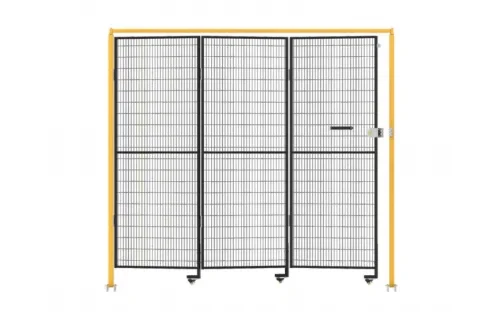

|
Quoting a new robotic welding cell or a high-speed CNC machining center? The true cost of your safety perimeter isn’t just the raw steel. It is the engineering hours wasted drilling holes for safety interlocks, the valuable plant footprint lost to non-compliant mesh sizes, and the delayed commissioning when a forklift taps a flimsy panel and shuts down the entire PLC safety circuit. Let’s break down the real cost per meter for automotive automation integrators. |
How Much Does Industrial Robot Safety Fencing Cost Per Meter? The Integrator’s Reality
When system integrators bid on automated production lines, the baseline material cost for 工業用安全フェンス typically ranges between $60 to $120 per linear meter, depending on height (e.g., standard 78.7 inches or 2000mm) and door configurations. However, evaluating the cost strictly by the meter is a trap.
The Pain Point (Before): You buy cheap, frameless wire mesh from a local fabricator for $40 a meter. During installation, your technicians have to apply for hot work permits, grind down burrs, and manually drill the freshly powder-coated posts to mount Omron D4NL or Pizzato safety switches. Because the mesh is a standard 2″x2″ (50x50mm), ISO 13857 standards mandate a reach distance of up to 33.5 inches (850mm). You are forced to push the perimeter out, eating up premium floor space and narrowing the AGV (Automated Guided Vehicle) pathways. When an AGV inevitably clips the weak fence, the elastic deformation misaligns the door interlock. The machine triggers a false emergency stop, plummeting the line’s OEE (Overall Equipment Effectiveness).

The Engineering Logic: Why Mdfence Changes the Cost Equation (Why it works)
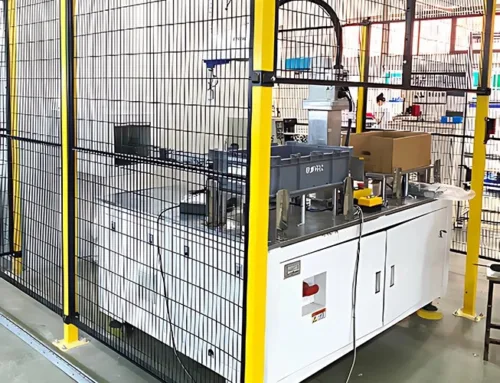
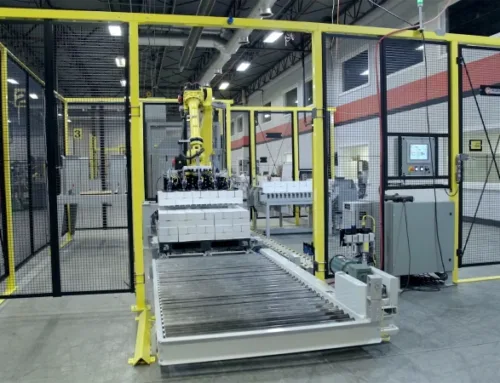
Mdfence is engineered specifically for the rigorous demands of ロボット安全フェンス. The system neutralizes hidden integration costs through physics and modularity:
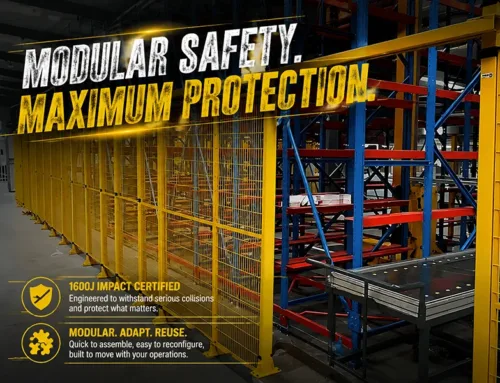
- Structural Integrity (Q235 Carbon Steel): Unlike brittle aluminum profiles that snap or cheap mesh that sags, our 60x60x2.0mm posts and fully welded bases are anchored with four M10x70mm expansion bolts. The system is TUV certified to withstand a 1600 Joules impact—equivalent to stopping a 220 lbs (100kg) object moving at 12.4 mph (20 km/h) dead in its tracks.
- The “Finger-Safe” Mesh Premium: We utilize a narrow 0.78″ x 3.93″ (20x100mm) mesh profile. Under ISO 13857, this restricts penetration to the fingertips, allowing you to legally position the fence just 4.7 inches (120mm) away from the hazard.
- Pre-Engineered PLC Integration: We provide standardized lock carriers (e.g., KKCK-LCK-B-D4NL-SET). Your technicians simply bolt the safety interlocks directly to the pre-drilled plates. Zero site drilling, zero rust points, and instant alignment for your safety torque off (STO) circuits.

The Real-World ROI for Automotive Assembly (After)
When you deploy Mdfence 機械警備システム, the upfront per-meter cost is instantly offset by installation speed and spatial efficiency. By shrinking the safety distance from 850mm to 120mm, you reclaim roughly 7.5 square feet of premium floor space per linear meter of fencing. On a 50-meter automotive assembly line, that is enough reclaimed space to add an entirely new testing station or widen the logistics corridor for dual AGV passing.
Furthermore, the framed panel architecture (20x30mm tubular borders) ensures extreme out-of-plane stiffness. If a forklift damages a panel, the MTTR (Mean Time To Repair) drops to exactly 10 minutes. A single technician uses a hex key to unbolt the four fixing rings, swaps the panel, and the robotic cell is back online. No welding, no painting, no extended downtime.

Cost Breakdown: Traditional vs. Modular Mdfence
| Cost Factor | Traditional Welded / Frameless Mesh | Mdfence Modular System |
| Installation Labor | High (Requires welding, grinding, and field painting). | Low (Cold assembly, 40% faster, bolts together). |
| Footprint Efficiency | Poor. 50x50mm mesh requires large safety distances (up to 33.5″). | Excellent. 20x100mm mesh allows installation as close as 4.7″ (120mm). |
| インターロック統合 | Manual drilling required; risks misalignment and false stops. | Pre-engineered lock carriers for Omron/Pizzato; perfect alignment. |
| 資産の再利用性 | 0% (Must be cut and scrapped if cell layout changes). | 95%+ (Unbolt and reconfigure for new production lines). |
Frequently Asked Questions (Automotive & Robotics Integration)
Q1: What is the baseline cost per meter for the Mdfence system?
A: While exact pricing depends on the layout complexity and door configurations, standard runs typically range between $60 to $120 per linear meter. The true savings emerge from the 40% reduction in installation labor and the elimination of custom integration brackets.
Q2: How does the 20x100mm mesh size affect my robotic cell footprint?
A: According to ISO 13857, our 20x100mm (0.78″ x 3.93″) finger-safe mesh allows you to position the physical barrier just 120mm (4.7 inches) from the hazard zone. This drastically reduces the total square footage required for the cell compared to standard 50x50mm mesh.
Q3: Can we directly mount our specified Omron or Pizzato safety interlocks?
A: Yes. We supply pre-engineered lock carriers (e.g., KKCK-LCK-B-D4NL-SET) specifically designed to match the hole patterns of standard Omron and Pizzato switches, ensuring seamless PLC integration without site drilling.
Q4: What happens if an AGV or forklift collides with the perimeter?
A: The Mdfence system utilizes Q235 carbon steel and is TUV certified to absorb up to 1600 Joules of impact energy. The framed panel architecture distributes the load, preventing catastrophic failure. If a panel is compromised, it can be unbolted and replaced in under 10 minutes, minimizing MTTR.
Q5: Do you provide 3D CAD models for our layout engineering?
A: Absolutely. We provide complete STP files for all posts, panels, and door assemblies, allowing your engineering team to validate ISO 13857 reach distances and clash detection directly in your digital twin or facility layout software before procurement.