JA
JA  EN
EN  DE
DE  RU
RU  PT
PT  ES
ES  IT
IT

|
In high-speed automotive assembly, stopping a conveyor belt to feed a part into a robotic cell is a crime against OEE (Overall Equipment Effectiveness). You need continuous material flow, but an open hole in your perimeter is an immediate OSHA violation. Here is the engineering logic on how to design compliant “Tunnel Guards” and safe pass-throughs using modular guarding systems. |
The “Open Hole” Fallacy in Automated Cells
For system integrators and plant managers, the most common friction point occurs where the intralogistics system (conveyors, AGV paths) intersects with the 安全フェンス工業 perimeter.
Simply cutting a hole in the mesh to let a pallet pass through is not a solution; it’s a liability. According to ISO 13857 (Safety of machinery — Safety distances), the size of the opening dictates how far the fence must be from the hazard. If you cut a large opening for an engine block, an operator can easily reach through and touch the robotic arm. To maintain a compact footprint without sacrificing safety, you must employ Tunnel Guarding geometry.

The 20x30mm framed structure allows for rigid modifications and tunnel attachments without losing structural integrity.
Solution 1: The Geometry of Tunnel Guards
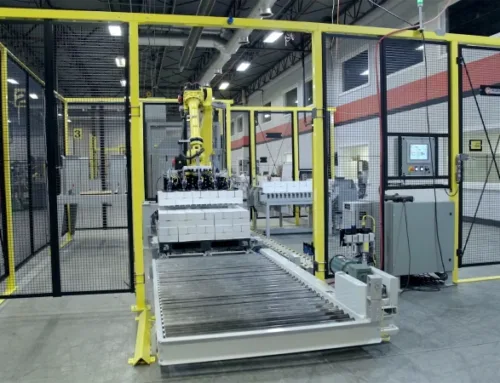
A “Tunnel Guard” extends the physical barrier outward or inward from the opening, making it physically impossible for an operator to reach the hazard zone even while the conveyor is moving.
- Mesh Size Matters: Using Mdfence’s 20x100mm mesh (Anti-climb/Finger-safe) allows you to position the tunnel much closer to the conveyor belt compared to standard 50x50mm mesh. The narrower the slot, the shorter the required safety distance (Sr).
- Structural Rigidity: Unlike “Anping” wire mesh which is flimsy and deforms under vibration, our Q235 Framed Panels (20x30mm tube frame) provide a solid mounting point for tunnel extensions. You can bolt the tunnel structure directly to the main fence frame without welding.
- No Electronics Required: This is a passive safety measure. It does not require muting sensors, PLCs, or maintenance. It is fail-safe by design.
Solution 2: Active Muting for Pallet Entry
When a tunnel is not feasible due to space constraints (e.g., in a tight AGV corridor), you must rely on Safety Light Curtains with Muting functions. However, the effectiveness of these sensors depends entirely on the stability of their mounting.
Mdfence systems are designed for this specific integration. We provide specialized 80x80mm posts with internal cable routing or universal mounting plates compatible with brands like Keyence, SICK, or Omron.

Integration ready: Standardized brackets for interlocks and sensors ensure alignment is maintained despite machine vibration.
Solution 3: The “Air-Lock” Logic for AGVs
For larger material handling, such as forklifts or large AGVs entering a robotic welding cell, a double-gate system (Air-Lock) is often required to prevent “tailgating” by personnel.
私たちの Double Sliding Door systems are engineered for high-cycle usage. Unlike standard hinge doors that sag over time causing sensor misalignment, our sliding doors run on heavy-duty tracks with ball bearings. This ensures that the interlock switch (e.g., Omron D4NL) engages perfectly every single time, preventing nuisance trips that stop your production line.

Wide-span double sliding doors facilitate AGV access while maintaining a rigid perimeter.
Summary: Why Modular Framing Wins
In the automotive industry, change is the only constant. A welded “blacksmith” fence cannot be adapted when you change from producing sedan engines to SUV chassis. Mdfence’s modular connection system allows you to unbolt a panel, install a new tunnel guard frame, and re-certify the line in hours, not days.
Frequently Asked Questions (Automotive & Automation)
Q1: Can we cut the Mdfence mesh on-site to fit a conveyor profile?
Yes. Because every vertical wire is welded to the horizontal wire, the mesh retains its integrity even when cut. However, for structural longevity, we recommend using our U-profile edging kits to cover the cut edges, preventing snag hazards for cables or operators.
Q2: How does your system handle vibration from heavy stamping presses?
Standard fences often loosen at the bolts due to harmonic vibration. Mdfence uses M10x70 expansion bolts for ground anchoring and nylon-insert lock nuts on all panel clamps, ensuring the perimeter remains rigid even near high-vibration stamping or CNC machinery.
Q3: Does the black mesh interfere with light curtains?
No. The RAL 9005 black mesh is designed to absorb light and reduce glare, improving visibility for human operators. It does not reflect laser or infrared signals, making it safe to use alongside optical safety devices.
Q4: What is the minimum distance for a tunnel guard using 20x100mm mesh?
With 20mm slot width, the ISO 13857 reach distance calculation allows the guard to be placed as close as 120mm to the hazard in many configurations, significantly saving floor space compared to 50x50mm mesh which requires greater standoff distances.
Q5: Can I mount an Emergency Stop button directly on the post?
Absolutely. Our 60x60mm Q235 steel posts are robust enough to be drilled and tapped for mounting control boxes, E-Stops, and stack lights without compromising the structural rating of the fence.