JA
JA  EN
EN  DE
DE  RU
RU  PT
PT  ES
ES  IT
IT 

|
Calculating the exact robot safety fence distance from a robot arm isn’t just a compliance checkbox—it’s the difference between a fully optimized factory floor and wasting thousands of dollars on dead space. If your current mesh size forces you to push your perimeter guarding 33.5 inches (850mm) away from the hazard zone, you are bleeding valuable real estate that could be used for AGV paths or extra material handling conveyors. Stop letting generic fencing dictate your robotics layout. |
The Floor Space Dilemma: Mesh Size vs. Reach-Over Distance
The Layout Pain (Before): When integrating high-speed mechanical assembly machines or 6-axis welding robots, EHS managers and system integrators often default to standard 2×2 inch (50x50mm) chainlink or cheap wire mesh. Because human fingers and hands can easily pass through these large gaps, ISO 13857 and OSHA regulations dictate that the physical barrier must be installed at a significantly larger safety distance from the robot’s maximum reach (including the end-effector). This often forces the 安全フェンス工業 perimeter to sit up to 33.5 inches (850mm) away from the hazard. In a tight automotive manufacturing cell, this bloated footprint kills your layout efficiency, creating bottlenecks for forklifts and AGVs.
The Engineering Logic (Why it works): Our systems utilize a specialized 20x100mm (0.78″ x 3.93″) “finger-safe” slotted mesh profile. Built on a fully welded 20x30mm tubular steel frame, this specific geometry physically restricts anything larger than a fingertip from penetrating the barrier.

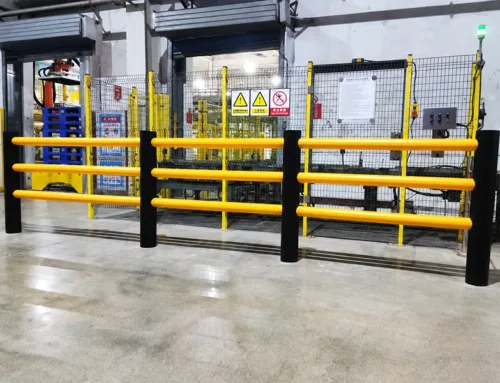
Standard framed panel featuring the 20x100mm finger-safe mesh design.
The Realized Benefit (After): By restricting access at the mesh level, ISO standards allow you to legally and safely shrink the robot safety fence distance from the robot arm down to just 4.7 inches (120mm). For a typical 160-foot (50-meter) automated production line, reclaiming that 2.3 feet (700mm) of perimeter depth translates to over 370 square feet of recovered, high-value manufacturing space. You can now fit an extra CNC machining center or widen your logistics corridors without expanding your building.
Surviving Catastrophic Tooling Failures: Impact Resistance
The Hazard Pain (Before): Distance calculations assume the robot stays within its programmed parameters. But what happens during a high-speed spindle crash, or if a robotic gripper drops a 220 lb (100kg) engine block? Flimsy, frameless wire mesh buckles and collapses upon impact. Once the barrier is compromised, the robot arm can reach outside the safe zone, leading to immediate OSHA shutdowns and catastrophic downtime.
The Engineering Logic (Why it works): エムドフェンス 機械警備システム are engineered around Q235 cold-rolled carbon steel. Instead of brittle aluminum, the 60x60mm posts and heavy-duty expansion bolts absorb and dissipate kinetic energy. The system is TUV certified to withstand 1600 Joules of impact—equivalent to intercepting a 220 lb object moving at 12.4 mph (20 km/h).

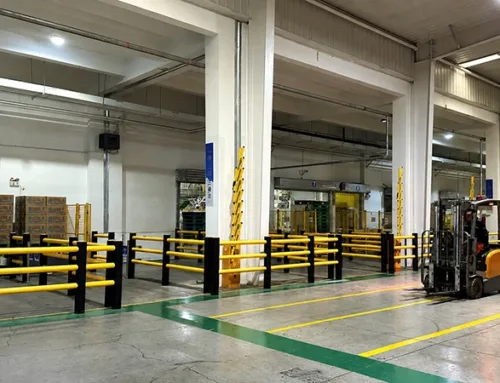
60x60mm Q235 carbon steel post anchored with M10x70mm expansion bolts for maximum kinetic absorption.
The Realized Benefit (After): In the event of part ejection or an accidental forklift bump, the steel yields plastically rather than fracturing into dangerous shrapnel. The perimeter holds its ground, your EHS audit passes without a hitch, and you avoid the staggering costs of halting a dedicated manufacturing line.
Eliminating Nuisance Trips: Safe Torque Off (STO) Integration
The Integration Pain (Before): The access door is the Achilles’ heel of any robot cell. Integrators often spend hours on-site drilling into painted posts to mount third-party safety interlocks (like Omron D4NL or Pizzato). This hot work creates metal shavings that rust instantly. Worse, over a few months of heavy use, wide doors sag. The lock tongues misalign, triggering false “door open” signals to the PLC. The robot cell faults out unexpectedly, causing you to lose thousands of dollars in assembly production per minute.
The Engineering Logic (Why it works): 私たちの ロボット安全フェンスシステム treat doors as active safety components. We utilize heavy-duty caster wheels for wide spans and rigid door frame beams that connect the top of the posts, ensuring perfect parallelism. Furthermore, we provide pre-engineered “lock carriers”—standardized mounting plates that perfectly align with major electronic interlock brands without a single drill hole required on-site.

Double sliding doors for large robot cells, maintaining perfect alignment for safety interlocks.
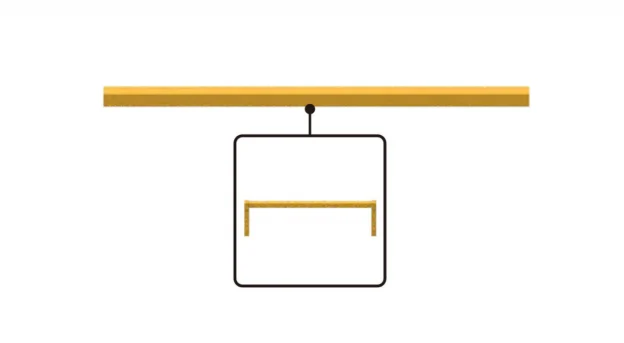
Top door frame beam ensuring structural rigidity and preventing door sag over millions of cycles.
The Realized Benefit (After): Plug-and-play integration means your automation setup is commissioned 40% faster. The doors glide smoothly, the STO interlocks align flawlessly every single time, and your Overall Equipment Effectiveness (OEE) remains at peak levels without frustrating nuisance stops.
Workflow & Distance Matrix: Traditional vs. Modular Fencing
| Parameter | Standard Wire Mesh / Welded Fence | Mdfence Modular System |
|---|---|---|
| Required Safety Distance (ISO 13857) | Up to 850mm (33.5″) due to large 50x50mm mesh gaps allowing arm reach-through. | As close as 120mm (4.7″) using 20x100mm finger-safe slotted mesh. |
| Installation & Modification | Requires hot work (welding, grinding). Zero asset recovery if layout changes. | Cold assembly with bolts. 95% asset recovery for rapid robotic cell reconfiguration. |
| インターロック統合 | Manual drilling on-site, leading to rust and misalignment over time. | Pre-engineered mounting plates for Omron/Pizzato; zero sagging. |
Frequently Asked Questions (FAQs)
1. How do I calculate the exact robot safety fence distance from the robot arm?
The exact distance is calculated based on ISO 13857 standards, which account for the fence’s mesh size, the height of the hazard, and the robot’s maximum reach (including the end-effector and any carried parts). Using a 20x100mm mesh allows you to reduce this distance to as little as 120mm (4.7 inches), whereas larger mesh sizes require distances up to 850mm (33.5 inches).
2. Can we install the fencing closer if we use safety light curtains?
While safety light curtains are excellent for frequent access points (like manual loading stations), physical perimeter guarding is still required around the rest of the robotic cell to contain potential part ejections and prevent unauthorized bypass. Light curtains stop the machine, but they cannot stop a flying CNC part or dropped payload.
3. Does the 20x100mm mesh comply with OSHA machine guarding requirements?
Yes. The 20x100mm design is specifically engineered to be “finger-safe,” exceeding standard OSHA requirements and fully complying with ISO 14120 and ANSI/RIA R15.06 standards for robotic safety environments.
4. How do we handle maintenance access for operators using a teach pendant?
For maintenance and teaching, we integrate interlocked hinged or sliding doors. When the door is opened, the Safe Torque Off (STO) circuit is triggered. Operators can then safely enter the cell with the teach pendant while the robot operates in a severely restricted, safe-speed manual mode.
5. What happens if an AGV or forklift hits the perimeter guarding?
Our Q235 carbon steel systems are TUV certified to withstand up to 1600 Joules of impact. Instead of shattering, the tubular frame and posts plastically deform to absorb the kinetic energy, protecting the expensive automation equipment inside and preventing the fence from collapsing into the robot’s path.