JA
JA  EN
EN  DE
DE  RU
RU  PT
PT  ES
ES  IT
IT 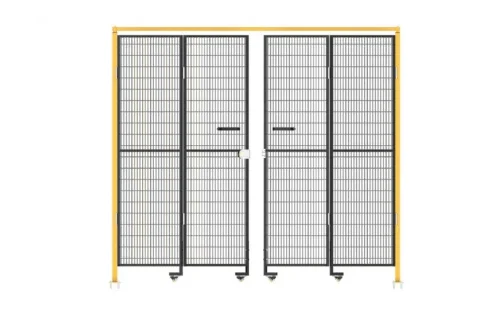
![[Industrial Safety Fencing]](https://safetyfencesystems.com/wp-content/uploads/2025/11/Industrial-Safety-Fencing-14.webp) |
Your robot cell integration project is on a tight deadline. The last thing you need is a safety guard that fails the end-customer’s EHS audit or requires on-site welding and hot work permits. The real question isn’t just ‘how long will it last,’ but ‘will it adapt and stay compliant through the life of the production line?’ |
When specifying a 機械防護 system, the question “How long will it last?” seems straightforward. But for an automation engineer or system integrator, a simple answer in years is misleading. The true lifespan of an industrial safety fence isn’t just a measure of its resistance to rust; it’s a function of its **Material Durability** against the harsh realities of the factory floor and its **System Adaptability** to the inevitable changes in production layouts.
A fence that lasts 20 years but has to be scrapped after the first line modification has a functional lifespan of zero. A truly long-lasting system endures both physical wear and operational evolution. Let’s break down the engineering that separates a temporary barrier from a long-term safety asset.
Beyond Rust-Proofing: The Physics of Industrial Durability
The factory floor is a hostile environment. Coolant mists, cleaning solvents, and the occasional bump from a forklift are daily occurrences. A fence’s longevity begins with its core materials and construction, designed to withstand this reality without compromising safety.
Material Science: Q235 Carbon Steel vs. Brittle Alternatives
The structural backbone of the Mdfence system—from the 60x60mm posts to the 20x30mm panel frames—is built from Q235炭素鋼. The choice is deliberate. Unlike brittle cast iron or easily deformed aluminum, Q235 steel has excellent plasticity. In the event of a severe impact, such as a forklift collision, it is engineered to bend and absorb energy. This plastic deformation prevents it from shattering into dangerous projectiles, which could cause a secondary, more catastrophic accident. It’s the difference between a dented barrier and shrapnel.
![[Industrial Safety Fencing]](https://safetyfencesystems.com/wp-content/uploads/2025/11/Industrial-Safety-Fencing-1.webp)
Surface Engineering: A Powder Coating That Endures
A common failure point for lesser fences is corrosion, especially at weld joints. Our system employs an electrostatic パウダーコーティング process that creates a tough, uniform, and chemically resistant shell. This finish is validated through ISO 9227 salt spray testing, ensuring it withstands corrosive industrial fluids and cleaning agents. This means the vibrant RAL 1023 Safety Yellow on the posts and the non-glare RAL 9005 black on the mesh won’t flake or bubble, even in a CNC machining center shrouded in coolant mist. It passes the visual inspection of the most stringent EHS manager, year after year.
Structural Integrity: The Power of a Framed Panel
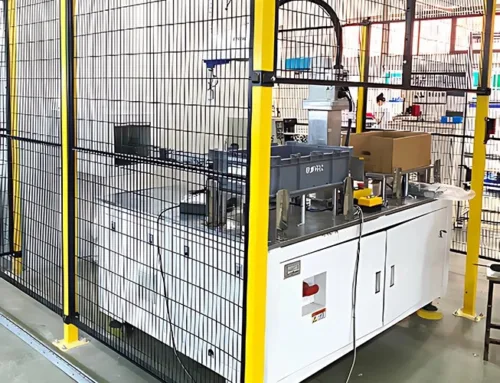
Many budget options use simple “frameless” wire mesh, which relies on bent wires for rigidity. This design is prone to sagging and deformation, even from a worker leaning against it. Mdfence utilizes a full 20x30mm steel tube frame for every mesh panel. The wire mesh is welded directly to the inside of this frame, creating a single, rigid unit. This architecture provides immense out-of-plane stiffness, ensuring the panel remains flat and secure, which is critical for maintaining the precise alignment of door-mounted safety interlocks and preventing nuisance trips.
![[Industrial Safety Fencing]](https://safetyfencesystems.com/wp-content/uploads/2025/11/Industrial-Safety-Fencing-2.webp)
The True Lifespan Killer: When Your Production Line Outgrows Your Fence
The most expensive safety fence is the one you have to throw away. Traditional welded barriers have an asset value that drops to zero the moment your facility needs to re-tool, relocate a robot, or add a new conveyor line. This is where modularity becomes the single most important factor in a fence’s long-term value.
Designed for Change: The Modular, Bolt-Together Advantage
Every component of the Mdfence system is designed for mechanical assembly. Panels connect to posts using high-strength steel brackets and M8 bolts. This completely eliminates the need for on-site welding, cutting, or grinding. There are no hot work permits, no fire watches, and no production downtime for installation or modification.
When a production layout changes, the system is simply unbolted, reconfigured, and re-secured. With a 95% asset reusability rate, the fence becomes a movable capital asset, not a sunk construction cost. The initial investment is preserved through countless layout iterations, making the total cost of ownership significantly lower than that of a “cheaper” welded solution.
![[Industrial Safety Fencing]](https://safetyfencesystems.com/wp-content/uploads/2025/11/Industrial-Safety-Fencing-15.webp)
A System’s Life is Measured in Uptime: The Integration Factor
A safety fence doesn’t just exist in physical space; it’s a critical node in your machine’s safety circuit. Its ability to reliably integrate with safety components defines its true performance lifespan.
Plug-and-Play Safety: Pre-Engineered Interlock Mounting
A common headache for integrators is fabricating custom brackets to mount the specified safety interlock switches, whether it’s an Omron D4NL, a Pizzato, or a Schmersal. This field modification is time-consuming, looks unprofessional, and often requires drilling into the post, compromising the protective powder coating and inviting corrosion.
We’ve engineered a range of pre-drilled セーフティ・インターロック・キャリア plates. These components provide a standardized, robust mounting solution for the industry’s most common safety switches. This turns a complex integration task into a simple bolt-on procedure, saving hours of on-site labor and ensuring perfect alignment every time.
![[Industrial Safety Fencing]](https://safetyfencesystems.com/wp-content/uploads/2025/11/Industrial-Safety-Fencing-12.webp)
Eliminating Nuisance Trips: The Importance of Door Stability
A sagging door is a primary cause of intermittent machine stoppages. When a door droops, its interlock key can fall out of alignment with the switch body, triggering a false “door open” signal to the PLC. This erodes OEE and leads to frustrating troubleshooting. Our hinged and sliding door systems are built with the same structural rigidity as our panels, often incorporating support casters for wider gates, to ensure they remain true and aligned through thousands of cycles. This robust design ensures the safety system works reliably, contributing to a longer, more productive life for the entire automated cell.
![[Industrial Safety Fencing]](https://safetyfencesystems.com/wp-content/uploads/2025/11/Industrial-Safety-Fencing-3.webp)
Conclusion: A Fence That Lasts as Long as Your Automation
So, how long does an Mdfence industrial safety fence last? It’s engineered to last the entire operational life of your automated equipment. It physically withstands the industrial environment thanks to robust materials and coatings. More importantly, it adapts to the evolving needs of your facility through its inherent modularity and integrates seamlessly with your control systems. It’s not just a fence; it’s a permanent, adaptable safety infrastructure for your facility.
Frequently Asked Questions for Automation Professionals
1. How does your system’s 1600 Joule impact rating translate to a real-world scenario in a robot cell?
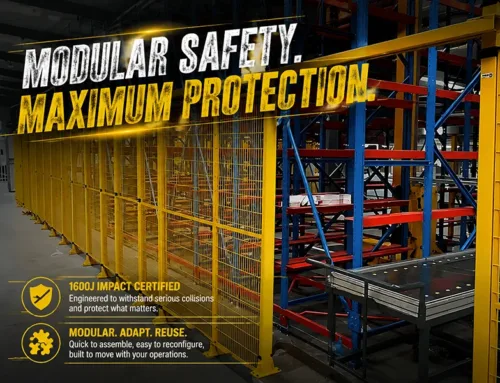
A 1600 Joule rating is equivalent to the system stopping a 100 kg (220 lbs) object traveling at 20 km/h (12.4 mph) without penetration or structural failure. In a robot cell, this means it can contain a dropped workpiece or a robot arm in an over-travel or fault condition, preventing it from becoming a high-velocity projectile and damaging surrounding equipment or injuring personnel.
2. Can I get CAD/STP files for your components to drop into my master layout in SolidWorks or AutoCAD?
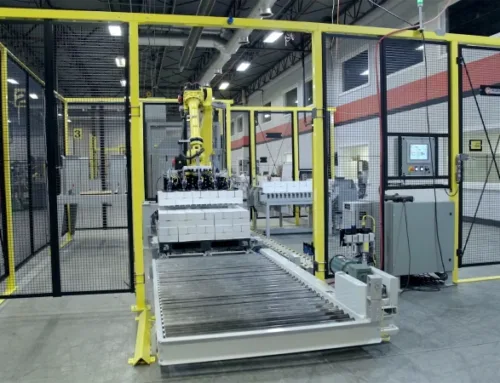
Absolutely. We provide a complete library of 3D STP files for all our standard components—posts, panels, doors, and accessories. This allows your design team to integrate our ロボット安全フェンス directly into your master assembly, check for clearances, and generate an accurate Bill of Materials (BOM) right from the design stage, eliminating guesswork and on-site surprises.
3. We have to run a conveyor through the fence. How do you handle openings without compromising safety?
We offer customized tunnel guards and panel cutouts. These openings are designed strictly according to the safe distance calculations in ISO 13857. The size of the opening is engineered to be large enough for your product or pallet to pass through, but small enough to prevent a person from reaching the hazard zone, ensuring full compliance during safety audits.
4. What is the typical lead time for a standard yellow/black system? Our project timelines are tight.
We maintain a significant inventory of our standard components (RAL 1023 yellow posts, RAL 9005 black panels, and common door sizes). For standard configurations, we can often ship within a few days to meet the urgent demands of integration projects. For highly customized solutions, we work with you to establish a timeline that aligns with your project schedule.
5. How does the cost of Mdfence compare to a custom-welded solution or a T-slot aluminum extrusion system?
While the initial material cost may be higher than a simple welded fence, the total installed cost is often lower due to a 40-70% reduction in installation time and the elimination of hot work labor. Compared to T-slot aluminum, our steel system offers superior impact resistance at a significantly lower price point. Most importantly, the 100% reusability of our modular system provides a far greater return on investment over the life of the equipment.