JA
JA  EN
EN  DE
DE  RU
RU  PT
PT  ES
ES  IT
IT 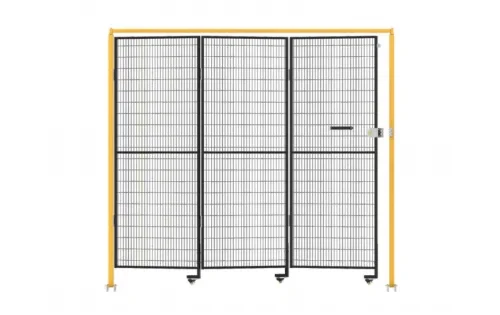

|
In automated automotive assembly and robotics integration, floor space is your most expensive asset. Specifying the wrong mesh size doesn’t just violate ISO standards—it forces your safety perimeter outward, choking AGV pathways and wasting premium square footage. Discover how precision-engineered mesh dimensions instantly reclaim your layout footprint while ensuring zero-compromise compliance for your turnkey solutions. |
The Hidden Footprint Cost in Robotics Layouts
When designing a dedicated manufacturing line or an automotive welding station, system integrators often default to generic 2″x2″ (50x50mm) wire mesh. The problem: Under ISO 13857 reach distance standards, a 50x50mm opening allows a worker’s hand and arm to pass right through. To maintain compliance, you are legally required to install the 機械警備システム up to 33.5 inches (850mm) away from the pinch point or robot end-effector.
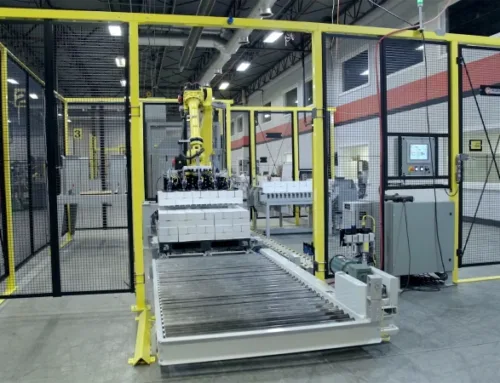
Our Logic (Why it works): The Mdfence system utilizes a highly specific 20x100mm (approx. 0.79″ x 3.94″) “finger-safe” standard mesh size. This narrow vertical slot physically restricts penetration to just the fingertips. Because the hazard cannot be reached, ISO 13857 allows this specific mesh to be installed at a dramatically reduced safety distance.

The Actual Benefit: You can legally position the perimeter just 4.72 inches (120mm) from the hazard. For a 150-foot automated production line, shrinking the perimeter by over 2 feet on each side reclaims massive floor space. This allows you to squeeze an extra CNC machining center into the layout, widen the aisles for warehouse AGVs, and deliver a tighter, more efficient turnkey solution to your end-user.
Structural Integrity: Surviving the 1600J Impact
The Pain Point: High-speed mechanical assembly machines and heavy-duty 6-axis robots (like KUKA or FANUC) handle massive payloads. If a gripper fails and ejects a 220 lb (100kg) aluminum engine block, or if a forklift miscalculates a turn, generic frameless mesh will stretch, detach, and collapse, sending shrapnel into the control equipment area.
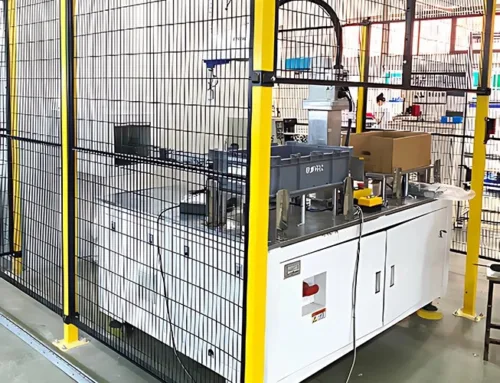
Our Logic (Why it works): We don’t just rely on the wire. The 工業用安全フェンス features a 20x30x1.5mm tubular steel frame. The 3.0mm or 4.0mm Q235 carbon steel wire is flat-welded directly to this frame, eliminating weak points. The energy is transferred from the mesh, through the frame, into the 60x60mm posts, and down to the expansion bolts anchored in the concrete.
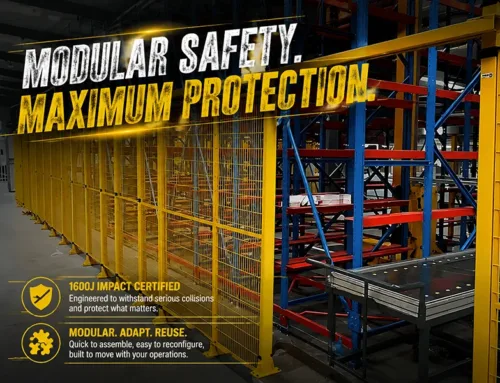
The Actual Benefit: The system is TUV-certified to absorb up to 1600 Joules of kinetic energy. It acts like an automotive crumple zone—plastically deforming instead of shattering. The physical barrier holds, protecting your expensive electro-optical elements and preventing catastrophic line shutdowns.
シームレスな安全インターロックの統合
The Pain Point: Integrating safety torque off (STO) circuits is a nightmare when your installation crew has to field-drill holes into painted posts to mount Omron D4NL or Pizzato switches. Drilling creates metal shavings that damage nearby pneumatics, voids the powder-coating warranty leading to rust, and often results in misaligned doors. A sagging door means the actuator key misses the switch, causing nuisance E-stops and ruining the line’s Overall Equipment Effectiveness (OEE).

Our Logic (Why it works): The Mdfence system is engineered as an active machine safety node. We provide pre-engineered lock carriers (e.g., KKCK-LCK-B-D4NL-SET) that map perfectly to industry-standard interlocks. Combined with our heavy-duty caster wheels and overhead door frame beams, the door geometry remains rigidly parallel.
The Actual Benefit: Plug-and-play integration. Your electrical engineers spend zero time fabricating custom brackets. The interlock keys align with sub-millimeter precision every single time, eliminating false machine trips and ensuring the ロボット安全フェンス communicates flawlessly with your PLC.
Cold Assembly: Slashing MTTR in Dynamic Facilities
The Pain Point: When a forklift inevitably damages a perimeter section, traditional welded fences require hot work permits. Welding sparks are a massive hazard around automotive painting lines or vision systems. The line must be shut down for hours, driving up the Mean Time To Repair (MTTR).

Our Logic (Why it works): Our modular clip-and-bolt design completely eliminates on-site welding. The framed panels lock into the 60x60mm posts using high-strength steel connection clips and M8x16 hex screws.
The Actual Benefit: A single maintenance technician can swap out a damaged panel in under 10 minutes using just an Allen wrench—a true cold assembly process. Furthermore, when the automotive layout needs to be reconfigured for a new vehicle model next year, the system offers a 95% asset reusability rate.
| シナリオ | Generic 50x50mm Mesh & Welded Fences | Mdfence 20x100mm Modular System |
|---|---|---|
| Layout Footprint | Requires 850mm (33.5″) reach distance, wasting space. | Allows 120mm (4.72″) reach distance, saving ~30 sq ft per cell. |
| Safety Integration | Field drilling required; leads to door sag and false PLC trips. | Pre-engineered lock carriers for Omron/Pizzato; zero misalignment. |
| Maintenance (MTTR) | Hot work permits, cutting, welding; takes hours. | Cold assembly; swap panels in 10 minutes with hand tools. |
Frequently Asked Questions (FAQs)
1. What is the standard mesh size for machine safety fencing to comply with ISO 13857?
While 50x50mm is common, a 20x100mm mesh size is the optimal standard for tight layouts. It restricts reach to just the fingertips, allowing you to legally position the fence as close as 120mm (4.72 inches) from the hazardous machine components.
2. Can the 20x100mm framed panels withstand impacts from heavy robotics?
Yes. The combination of Q235 carbon steel, 20x30mm tubular frames, and 60x60mm posts allows the system to absorb up to 1600 Joules of impact energy, effectively containing ejected workpieces from 6-axis robots.
3. How does this system integrate with warehouse AGV pathways?
Because the 20x100mm mesh drastically reduces the required safety distance, it prevents the perimeter from encroaching into AGV aisles. For material entry points, we utilize sliding doors or ISO-compliant tunnel guards.
4. Do I need to drill holes to mount safety interlock switches?
No. Our system features pre-engineered lock carriers designed specifically for industry-standard switches like Omron D4NL and Pizzato, eliminating field drilling and ensuring perfect alignment with your STO circuits.
5. Is welding required to assemble or repair the fencing on the production line?
Absolutely not. The entire system uses a modular clip-and-bolt design. This cold assembly process requires no hot work permits, allowing for rapid installation and minimizing MTTR during repairs.