JA
JA  EN
EN  DE
DE  RU
RU  PT
PT  ES
ES  IT
IT 
 |
A forklift just breached your robot cell guard. The line is down. Is your maintenance team grabbing an angle grinder and a fire extinguisher for a 4-hour hot-work repair, or a single hex wrench for a 10-minute panel swap? The difference isn’t just downtime; it’s a fundamental flaw in how most safety fencing is designed. |
The Hidden Cost of “Permanent” Guards: Why Welded Fencing Cripples OEE
In automation-driven environments, every second of uptime counts. Yet, traditional welded-in-place or low-cost “disposable” machine guards treat damage as a catastrophic event. When an AGV misaligns or a robot arm has a pathing error, the resulting fence damage triggers a cascade of costly, inefficient procedures:
- Extended Downtime: The entire work cell must be shut down. The repair involves cutting, grinding, welding, and repainting—a process that can take hours, if not an entire shift. For an automotive line, this can translate to tens of thousands of dollars in lost production.
- On-Site Fabrication Hazards: Cutting and welding (hot work) introduce significant fire hazards, requiring permits, fire watches, and fume extraction. The process creates a mess of metal filings and paint fumes, contaminating the area around sensitive equipment like CNC machines or electronic assembly stations.
- Zero Asset Value: Once a production line is reconfigured, welded guards are not assets; they are scrap metal. They must be destructively removed and disposed of, representing a 100% loss on the initial investment.
Engineered for Reality: The Logic of Modular Panel Replacement
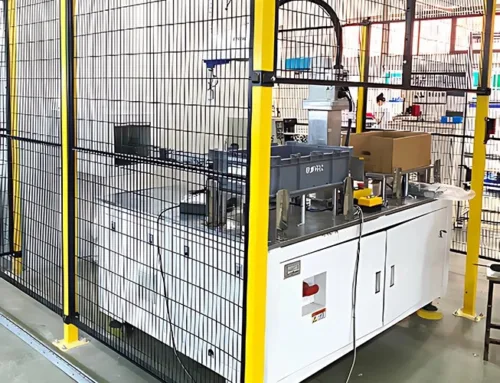
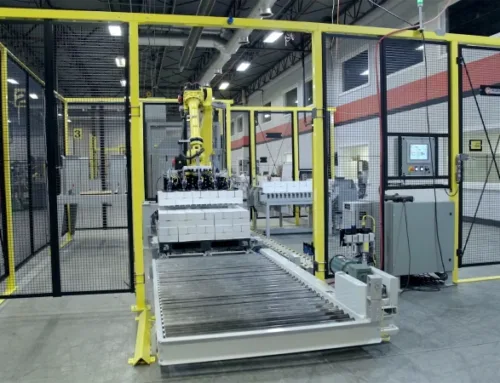
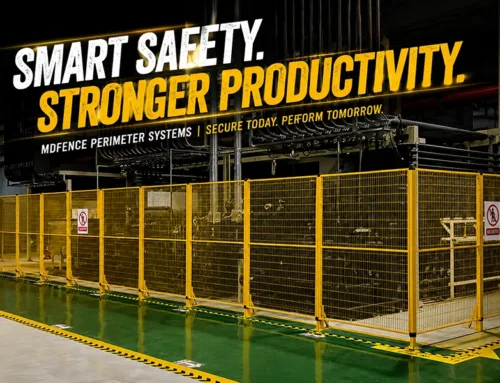
A modern ロボット安全フェンス system anticipates the realities of a dynamic factory floor. Instead of being a permanent, unchangeable barrier, Mdfence is an engineered asset designed for rapid maintenance and reconfiguration. The ability to replace a panel in minutes is not an accident; it’s the result of a deliberate design philosophy rooted in superior materials and intelligent assembly.
The Foundation: High-Integrity Framed Panels
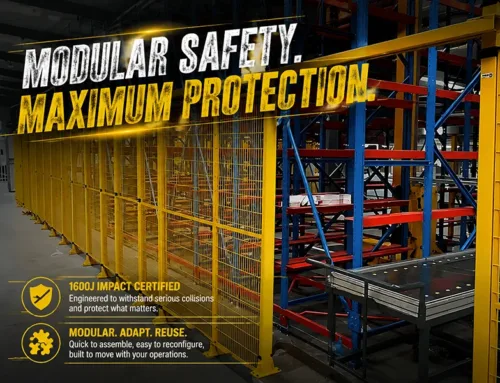
Unlike flimsy, frameless mesh that deforms on impact, our standard panels are built with a full 20 x 30mm tubular steel frame. This frame, constructed from high-tensile Q235 carbon steel, does more than just hold the wire mesh; it creates a rigid, load-bearing structure. When an impact occurs, the force is distributed across the entire frame, preventing the catastrophic buckling and tearing common with cheaper alternatives. This structural integrity is what makes a simple replacement possible.
The Mechanism: Bolt-On Assembly, Not Destructive Welding
The core of our rapid replacement capability lies in the connection system. Panels are secured to 60 x 60mm steel posts using high-strength steel fixing rings and M8 bolts. This is a purely mechanical, “cold assembly” process.
To replace a panel, a maintenance technician simply needs to:
- Follow LOTO (Lockout/Tagout) procedures to safely power down the cell.
- Use a standard hex wrench to loosen the bolts on the fixing rings holding the damaged panel.
- Slide the damaged panel out.
- Slide the new panel in and tighten the bolts.
There is no cutting, no sparks, no fumes, and no need for specialized labor. What was a multi-hour production halt becomes a routine, 10-minute maintenance task, directly boosting your Mean Time To Repair (MTTR) and protecting your Overall Equipment Effectiveness (OEE).

From Replacement to Reconfiguration: A True Industrial Asset
The same modular principle that makes replacement easy transforms your safety guarding from a sunk cost into a flexible, long-term asset. When your production needs evolve and you need to relocate a robot, expand a work cell, or change a conveyor line, the entire Mdfence system can be unbolted, moved, and reassembled in the new configuration. Every panel, post, and door is 100% reusable.
This is a critical advantage for system integrators working on turnkey projects and for plant managers planning for future growth. The ability to adapt the physical guarding to new layouts without scrapping the initial investment delivers a significantly lower total cost of ownership and a much higher ROI.

Stop accepting downtime as a consequence of minor impacts. Investing in a modular 機械用ガードフェンスパネル system is an investment in operational resilience. It ensures that when the inevitable happens, your response is measured in minutes, not hours, keeping your automated lines running and your production targets on track.
よくある質問
1. How long does it actually take to replace a single damaged Mdfence panel?
For a trained maintenance person with the correct tools (a single hex wrench), the process of unbolting the four fixing rings, swapping the panel, and re-securing it typically takes between 10 to 15 minutes. This is a dramatic reduction from the 2-4 hours required for cutting and re-welding a traditional guard.
2. If we add a new robot, can we reuse our existing Mdfence guarding?
Absolutely. This is a core benefit of the modular design. You can disassemble your existing configuration and reassemble the panels, posts, and doors to fit the new layout. If the new layout is larger, you simply order the additional standard components needed to expand the cell.
3. Are replacement panels and hardware (like fixing rings and bolts) readily available?
Yes, we maintain a stock of all standard components, including various panel sizes, posts, fixing rings, and bolts. This ensures that you can quickly source replacement parts to minimize any potential downtime.
4. What tools are required for a panel replacement?
The only primary tool required is a standard metric hex wrench (Allen key) to fit the M8 bolts on the fixing rings. For the initial installation, you would also need a hammer drill and socket wrench to set the M10 expansion bolts into the concrete floor, but these are not needed for a simple panel swap.
5. Does replacing a panel compromise the system’s overall strength or safety compliance?
No. As long as you are replacing a damaged panel with an identical, genuine Mdfence panel and securing it correctly with the standard hardware, the system’s structural integrity and compliance with standards like ISO 14120 are fully maintained. The bolt-on system is engineered and tested to provide the specified impact resistance.