JA
JA  EN
EN  DE
DE  RU
RU  PT
PT  ES
ES  IT
IT 
 |
Your robot cell passed the PLC logic test, but will it pass the client’s physical EHS audit? A flimsy guard can derail your project handover. Don’t let a failed impact test be the reason for costly delays and penalty clauses. |
Robot Safety Fencing Systems: The Real-World Impact Test Your Project Must Pass
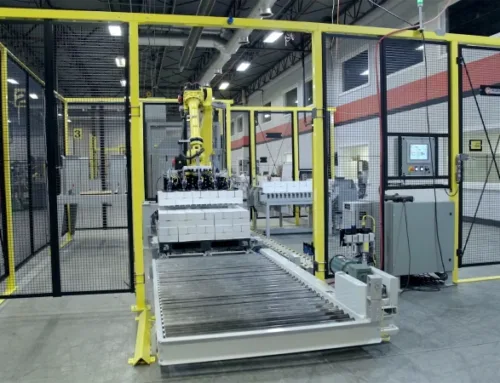
For an automation system integrator, the final acceptance test is the moment of truth. The robot arm moves flawlessly, the cycle time is perfect, and the PLC logic is sound. But then, the end-client’s EHS manager walks the floor. They grab the top of your ロボット安全フェンス and give it a firm shake. They scrutinize the spec sheet, looking for one number: the impact rating. This is the real-world impact test, and passing it separates a successful project handover from a costly, delayed one.
Too often, guarding specified to simply “check a box” fails this test. Locally welded angle-iron frames or frameless “chain-link style” mesh might seem cost-effective initially, but they introduce significant project risks. They require on-site hot work permits, create weld spatter hazards, and, most critically, lack the engineered rigidity to contain a real-world incident—like a 50 lb end-of-arm-tooling (EOAT) dropped during a fault condition. This failure doesn’t just damage equipment; it destroys client confidence and project timelines.
Why Generic Fencing Fails Under Pressure: The Physics of Failure
When a heavy object strikes a guard, the system’s response is dictated by its material science and structural design. Most low-cost solutions fail in predictable ways:
- The “Hammock Effect”: Frameless mesh panels, held only by tension, deform easily upon impact. They behave like a hammock, absorbing little energy and often detaching from their posts, creating a larger opening for hazards to escape.
- Brittle Fracture: On-site welds, especially on coated materials, can create weak, brittle points. Instead of bending to absorb energy, these joints can fracture, turning the guard itself into a projectile.
- Weak Connections: Flimsy brackets or drilled-through-post connections compromise the structural integrity of the entire system, creating a weak link that will fail long before the materials themselves.
From Material to System: Engineering for a Certified 1600 Joule Impact
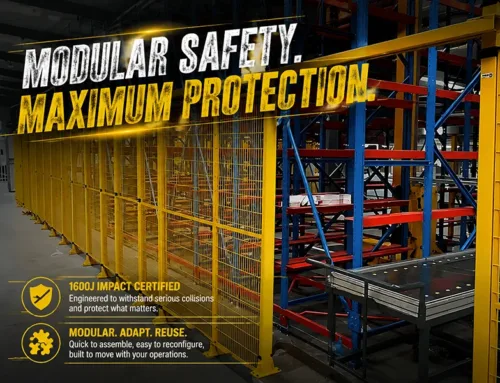
A truly robust 機械防護 system is not merely assembled; it is engineered. The ability to withstand a significant impact is a calculated outcome of deliberate design choices. A certified 1600 Joule rating—equivalent to stopping a 220 lb (100 kg) mass moving at 12.5 mph (20 km/h)—is achieved through a unified system approach.
The Foundation: Q235 Carbon Steel’s Ductility
The core of our system is high-tensile Q235 carbon steel. Unlike brittle cast iron or easily deformed aluminum, Q235 steel exhibits excellent ductility. When faced with an impact exceeding its design load, it undergoes plastic deformation—it will bend and absorb the energy, much like a car’s crumple zone. This prevents shattering and the creation of secondary projectiles, ensuring the hazard remains contained.
The Backbone: Full-Frame Welded Panels
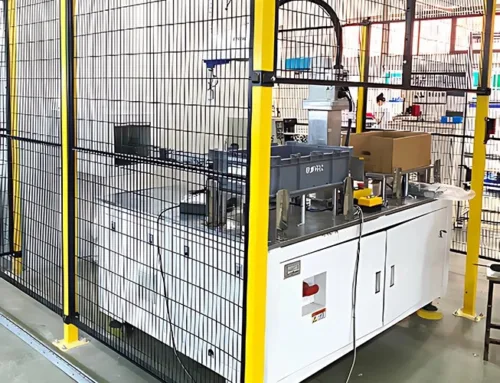
Our standard panels are not simply mesh sheets. Each panel features a 20x30mm tubular steel frame, with the wire mesh fully welded to the interior. This frame acts as a rigid backbone, distributing the force of a point impact across the entire structure. This prevents the “hammock effect” and ensures the panel maintains its shape and position, even under significant load.

The Anchor: Robust Posts and Non-Invasive Connections
The system’s strength is transferred to the ground through heavy-duty 60x60mm steel posts, anchored by M10 expansion bolts. Crucially, panels are attached to these posts via high-strength steel clamps. This method avoids drilling holes into the posts, a practice that can compromise structural integrity and create rust points. The result is a continuous load path from the panel, through the clamp, down the post, and into the concrete floor.

Strength That Accelerates Your Project Timeline
An engineered, impact-rated system delivers value far beyond the initial safety audit. Its inherent structural integrity directly translates into faster, cleaner, and more reliable project commissioning.
Eliminate On-Site Hot Work and Delays
Because the Mdfence system is entirely modular and bolt-together, all on-site welding, cutting, and grinding are eliminated. This means no more waiting for hot work permits, no fire watch requirements, and no risk of weld spatter damaging nearby equipment or finished surfaces. A two-person team can assemble a standard robot cell in hours, not days, using only basic hand tools.
Achieve Flawless Safety Interlock Integration
One of the most common points of failure in a safety circuit is a misaligned door interlock switch. A sagging, flimsy door can cause nuisance trips, leading to frustrating downtime and troubleshooting. The structural rigidity of our framed door panels and heavy-duty posts ensures that doors never sag. Combined with our pre-engineered mounting plates for common safety switches (like Omron D4NL or Pizzato), you get perfect alignment from day one, ensuring your safety PLC gets a reliable signal every time.

Comparative Analysis: Your Guarding Options
When planning your next robot cell, consider the total project impact of your guarding choice.
| 特徴 | Mdfence System | Local Welded Guarding | T-Slot Aluminum Guarding |
|---|---|---|---|
| 影響度評価 | Certified ≥ 1600 Joules | Unknown / Not Tested | Low to Moderate; Prone to deformation |
| 組み立て方法 | Bolt-together (Cold Assembly) | Welding/Grinding (Hot Work) | Bolt-together |
| インストール速度 | Fast (e.g., 50m/day/2 people) | Slow; requires skilled labor | Moderate; many small components |
| インターロック統合 | Pre-engineered mounting plates | Requires on-site fabrication | Requires special T-nuts/brackets |
| Reconfigurability | 100% Reusable | 0% (Destructive removal) | Highly reusable |
| Project Risk | Low (Predictable & Compliant) | High (Unpredictable & Non-compliant) | Moderate (Vibration/loosening risk) |
のいずれかを選択する。 robot safety fencing system is more than a line item—it’s a reflection of your integration quality. By specifying an engineered, impact-tested system, you are not just buying steel; you are buying project certainty. You are ensuring that when the EHS manager performs their “test,” your work stands strong, leading to a faster sign-off, a satisfied client, and a stronger reputation for your company.
システム・インテグレーターによくある質問
1. What is the typical lead time for a standard 10ft x 10ft robot cell configuration?
Standard components (yellow posts, black mesh panels, and common door sizes) are typically in stock and can be shipped within a few business days, allowing you to meet tight project deadlines.
2. Do you provide 3D CAD models (e.g., STP files) for integration into our master layout?
Yes. We provide a complete library of 3D models for all our components. This allows your engineering team to easily integrate the fencing system into your design software, check for clearances, and generate an accurate Bill of Materials (BOM) from the start.
3. Is the Mdfence system compliant with North American safety standards like ANSI/RIA R15.06?
Absolutely. The system is designed and tested to meet or exceed the requirements of global machinery safety standards, including ISO 14120 and ANSI/RIA R15.06, ensuring it will pass the compliance requirements of your most demanding end-clients.
4. How does the system accommodate conveyors or other equipment pass-throughs?
We offer customized tunnel guards and panel cutouts that are fabricated in our factory. These openings are designed to comply with the safe distance requirements of ISO 13857, allowing materials to pass through while preventing personnel access.
5. We have a high-payload robot with a heavy EOAT. How do we determine the required impact energy rating?
This is a critical part of the risk assessment. Our technical experts can work with you to analyze your application’s specific risks—considering factors like robot speed, payload, and potential failure modes—to recommend a guarding solution that provides a verified safety margin.