JA
JA  EN
EN  DE
DE  RU
RU  PT
PT  ES
ES  IT
IT 

|
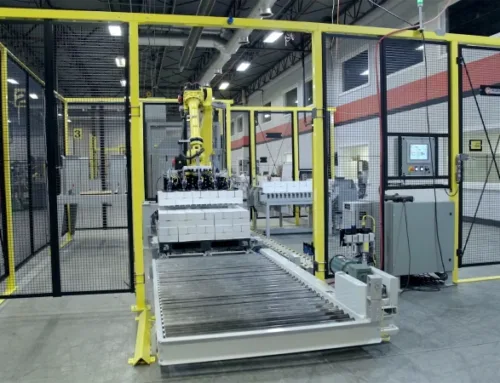
Your client’s factory floor is shrinking, but their automation demands are growing. Every square inch you save on the safety footprint is a win for production flow and your project’s bottom line. Stop letting bulky, non-compliant guarding dictate your robot cell layout. |
Save Space with Safety Fence Industrial
As an automation system integrator, you live in a world of tight tolerances and even tighter deadlines. The CAD model for the new robot cell is perfect, the PLC logic is simulated, and the end-of-arm tooling is ready. But then you get to the client’s site. The floor space is more congested than the drawings suggested, and the legacy 機械警備システム you quoted suddenly looks like a space-hogging liability. The choice you make for the physical barrier can either streamline your project or become the single biggest bottleneck to commissioning and final payment.
The Footprint Problem: Reclaiming Square Footage from Safety Standards
The most common mistake is defaulting to generic fencing with large 2″ x 2″ (50x50mm) wire mesh. To comply with safety standards like ISO 13857 and ANSI/RIA R15.06, this type of barrier must be installed far from the nearest hazard point—often 200mm or more. This creates a massive, unusable “dead zone” around every machine. For a compact work cell, that wasted space can kill a project, obstructing forklift paths and preventing the future installation of another piece of equipment.

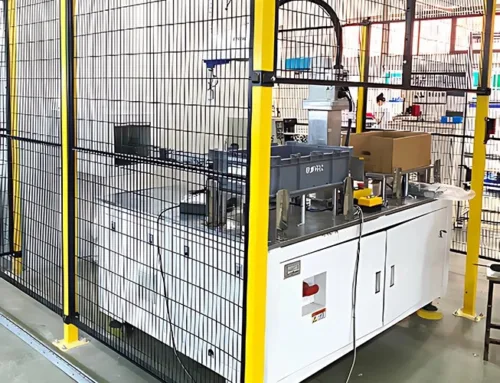
The Mdfence Logic: Our system is engineered around a core principle: smarter design saves space. We utilize a 20x100mm (approx. 0.8″ x 4″) mesh opening. This “finger-safe” design is too narrow for an operator’s hand to pass through, fundamentally changing the risk assessment calculation. It allows you to legally and safely place the ロボット安全フェンス as close as 120mm (~4.7 inches) to the danger zone. For a typical 164 ft (50-meter) automated line, reducing the safety distance by just 20 inches can reclaim over 270 sq. ft. of valuable production floor. That’s space your client can use for another pallet, a QA station, or improved workflow—a tangible benefit you deliver.
From Hot Work to “Cold Assembly”: Slashing On-Site Installation Time
Your team’s time on-site is your most valuable resource. The traditional approach of welding a custom cage is a project manager’s nightmare. It requires hot work permits, fire watches, and disrupts the client’s ongoing operations with smoke and grinding noise. If a last-minute layout change occurs, it means cutting, re-welding, and repainting—a costly and unprofessional delay. This turns a supposedly permanent asset into a disposable liability.

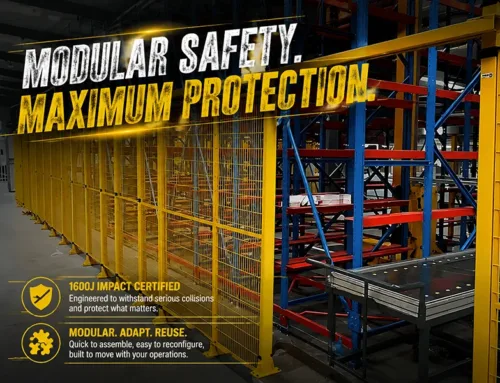
The Mdfence Logic: We’ve eliminated on-site fabrication. The Mdfence system is a completely modular, bolt-together solution. Built from high-tensile Q235 carbon steel, every component—posts, framed panels, and high-strength fasteners—is pre-fabricated and powder-coated for durability. Installation is a “cold assembly” process requiring only standard hand tools. A two-person team can deploy over 150 feet of fencing in a single day, often over a weekend, with zero disruption to your client’s production. This speed and efficiency directly translate to lower labor costs and a faster path to project completion.
Seamless Integration, Not On-Site Improvisation
The final hurdle is often the most frustrating: integrating safety components. Your client has specified an Omron D4NL or a Pizzato safety interlock switch. With a generic fence, this means your technicians are forced to become on-site fabricators—drilling and tapping into freshly powder-coated posts, creating potential rust points, and struggling to align the switch correctly. When a poorly supported gate sags over time, it causes nuisance trips in the safety circuit, leading to angry calls from the client about unplanned downtime.

The Mdfence Logic: 私たちの 安全フェンス工業 system is designed *for* integration. We provide a range of pre-engineered lock carriers and mounting plates specifically designed for industry-standard interlock switches. There is no drilling, no improvisation. It’s a clean, professional, plug-and-play solution. Our rigid, framed door panels are engineered to prevent sagging, ensuring precise alignment and reliable operation of the safety circuit for years. This attention to detail is what separates a truly professional integration from a makeshift one, and it’s what makes you look good during the final EHS audit.
Frequently Asked Questions for Automation Integrators
1. How does your fencing system help me meet ANSI/RIA R15.06 standards for robotic cells?
Our system directly supports compliance in several ways. The 20x100mm mesh helps satisfy the safety distance requirements of ISO 13857 (referenced by ANSI standards). Its certified 1600 Joule impact resistance ensures it can contain projectiles as calculated in your risk assessment. Finally, our pre-engineered mounting options for safety interlocks ensure a reliable and compliant integration into your PLe/SIL3 safety circuits.
2. I have a conveyor passing through the robot cell. How do you handle that?
We provide custom-sized tunnel guards or pass-through openings. These are designed to fit your specific conveyor dimensions while strictly adhering to ISO 13857 standards, ensuring materials can pass through but personnel cannot reach the hazard zone.
3. My client specified a Pizzato safety switch. Do I need to drill and tap your posts to mount it?
Absolutely not. We offer pre-engineered “Safety Interlock Carriers” or mounting plates designed for the exact hole patterns of common switches from Pizzato, Omron, Schmersal, and others. This eliminates on-site fabrication and ensures a perfect fit every time.
4. The client’s layout might change in a year. Is the system reusable?
Yes, 100%. The modular, bolt-together design means the entire system can be disassembled, moved, and reconfigured without any cutting or welding. This turns the safety guarding from a one-time construction expense into a long-term, reusable asset for your client.
5. How does the Q235 steel construction compare to a T-slot aluminum extrusion fence?
While aluminum offers modularity, Q235 carbon steel provides far superior impact resistance at a more cost-effective price point. In an industrial environment with forklift traffic and heavy machinery, the toughness of steel ensures greater durability and asset protection. Our system provides the modularity of aluminum with the industrial strength of steel.