JA
JA  EN
EN  DE
DE  RU
RU  PT
PT  ES
ES  IT
IT 

Your client just approved the final CAD layout for a new robot work cell. Now the challenge is finding a machine guarding system that doesn’t require a week of on-site cutting, welding, and custom fabrication just to mount the specified safety interlocks. Project timelines are tight, and your integration budget can’t afford surprises.
When you’re sourcing 工業用安全柵 kits, the real question isn’t just “where to buy,” but “where to find a system that won’t blow up my project’s timeline and budget.” For system integrators, a fencing kit should be a predictable, bolt-on solution, not the start of a custom fabrication project. The market is flooded with options, but most fall short when it comes to the crucial details of real-world automation projects: complex layouts, tight footprints, and seamless safety circuit integration.
This guide breaks down what to look for in a modular safety fence supplier, ensuring the kit you buy is an asset to your integration process, not a liability.
Beyond the Steel: Why a “Kit” is More Than Just Posts and Panels
A true modular fencing kit for automation environments is an engineered system, not just a pile of components. The value isn’t in the raw steel; it’s in the design intelligence that eliminates guesswork and on-site rework.
The Foundation: Industrial-Grade Components
Any professional 機械用ガードフェンス starts with robust materials. Your Bill of Materials (BOM) should specify components built for harsh industrial environments, not light-duty partitions.
- Posts: Look for heavy-gauge Q235 carbon steel posts, typically 60 x 60mm (approx. 2.36″ x 2.36″), with a substantial wall thickness (1.5mm to 2.0mm). The baseplate design is critical; a wide, stable base secured with M10 expansion bolts ensures rigidity against accidental impact.
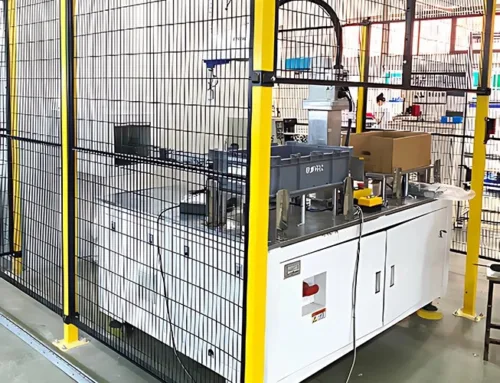
- Panels: A fully 額装パネル is non-negotiable for high-risk areas. A 20 x 30mm steel tube frame prevents the mesh from buckling and provides superior impact resistance, a feature validated by certifications like TUV. The welding quality, especially flattened welds with no sharp burrs, is a key indicator of a premium, safety-conscious product.

A robust 60x60mm post with a stable, bolt-down base is the starting point for any serious machine guarding system.

Framed panels provide the structural integrity needed to withstand impacts in an industrial setting.
The Integrator’s Edge: Pre-Engineered Solutions for Real-World Problems
This is where most suppliers fail and where savvy integrators find their competitive advantage. A superior fencing “kit” anticipates your integration challenges and provides off-the-shelf solutions.
Access Designed for Automation: Modular Door Systems
Your client’s workflow dictates access needs. A one-size-fits-all door is a recipe for inefficiency. A truly modular system offers a complete portfolio of door solutions that can be configured to match the specific layout and operational requirements of the robot cell or production line.
- Hinged Doors: The standard for personnel access. Look for kits that offer single and double-door configurations with options for caster wheels on wider gates to prevent sagging.
- Sliding Doors: Essential for areas with limited swing clearance, such as along conveyor lines or between closely packed machinery. A top-hung track system ensures smooth operation without creating a trip hazard on the floor.
- Folding Doors: The ideal solution for extra-wide openings where a sliding door’s track path is obstructed. They provide maximum access with a minimal footprint when open.

Single Hinged Door

Single Sliding Door

Multi-Panel Folding Door
The Critical Component: Seamless Safety Interlock Integration
Here lies the biggest time-sink in most guarding installations. Your client specifies a particular safety switch—an Omron D4NL or a Pizzato FS series, for example. The last thing you need is your installation team spending hours on-site drilling, tapping, and fabricating custom brackets to mount it.
A premier supplier will have already solved this problem. They offer a pre-engineered **セーフティインターロックキャリア**. This isn’t just a piece of metal; it’s a specifically designed mounting plate and hardware set that allows for the precise, secure, bolt-on installation of industry-standard safety switches.
This transforms the fence from a passive barrier into an active, integral part of the machine’s E-stop circuit. It saves immense amounts of integration time and eliminates the risk of improper mounting that could lead to safety system failure. When you source your kit, ask this critical question: “Do you provide a pre-engineered, bolt-on mounting solution for my specified brand of safety interlock?”
From CAD to Reality: Finding a Supplier Who Speaks Your Language
The best suppliers act as partners, not just vendors. They understand that you’re working from detailed CAD drawings and need a solution that matches the design precisely, down to the last millimeter.
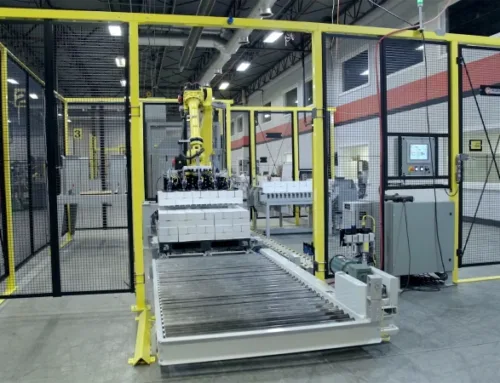
Look for a supplier who can demonstrate a history of delivering on complex, custom layouts. Case studies are invaluable here. Can they show you a project like a multi-station automated assembly line with specific heights, non-standard angles, and multiple door types?

A reliable supplier can turn a complex CAD drawing like this into a perfectly fitting, ready-to-assemble kit.
A supplier like Mdfence, which provides solutions directly from customer drawings, ensures that the kit arriving on-site is not a “close enough” approximation but an exact match. This eliminates the need for on-the-fly modifications, reduces installation time from days to hours, and guarantees the final installation is as clean and professional as your initial design.
Ultimately, buying a ロボット安全フェンス kit is a strategic decision. By choosing a supplier that provides a complete, intelligently engineered system—from robust core components to pre-designed interlock carriers—you de-risk your project, protect your margins, and deliver a safer, more compliant solution to your client.
システム・インテグレーターによくある質問
1. Can your fencing kits accommodate non-standard angles, like a 45-degree corner in my layout?
Yes. A truly modular system includes specialized post connectors or can be configured to create clean, secure corners at any angle required by your CAD layout, eliminating the need for custom welding on-site.
2. My client’s risk assessment requires polycarbonate panels in one area for visibility and solid steel panels near a welding station. Can one kit include different panel types?
Absolutely. A flexible system allows you to mix and match panel types within the same fence line. You can specify standard wire mesh panels for general guarding, clear PC panels for observation points, and solid steel panels to contain sparks or debris, all using the same standard posts and fixing hardware.
3. How quickly can a custom layout based on my drawings be kitted and shipped?
While lead times vary, a supplier specializing in automation solutions understands project urgency. Because they use standardized modular components, they can typically configure, pick, and pack a custom kit much faster than a traditional fabricator. Always ask for a specific lead time based on your project drawings.
4. What documentation is provided to ensure compliance with safety standards like ISO 14120 or ANSI/RIA R15.06?
A reputable manufacturer should provide documentation confirming their system’s compliance with key international safety standards. This may include TUV certification for impact resistance and technical data sheets specifying materials and performance, which are crucial for your project’s final safety validation and handover package.
5. The floor in the facility is uneven. Does your system have a way to adjust for this during installation?
Yes, this is a common on-site issue. Look for systems that offer leveling shims or adjustable base plates. Additionally, the fixing method for panels often allows for minor vertical adjustments, ensuring a clean, level fence line even on imperfect concrete floors.