JA
JA  EN
EN  DE
DE  RU
RU  PT
PT  ES
ES  IT
IT 

|
In a heavy metalworking environment, a safety guard isn’t just a visual boundary—it’s a kinetic shield. When a 5-axis CNC spindle crashes or a forklift clips a corner in a tight aisle, standard wire mesh fails. You need 工業用安全フェンス engineered with Q235 carbon steel frames and TUV-certified impact resistance to keep your machining cells running and your operators safe from flying debris. |
The Physics of the Crash: Why Standard Mesh Fails in Metal Plants
In the metal fabrication and automotive manufacturing sectors, the “hazard zone” is vastly different from a textile warehouse. Here, we are dealing with high-velocity projectiles—broken tool bits, metal swarf, or even rejected workpieces ejected from a lathe. Furthermore, the logistical traffic involves heavy forklifts moving steel coils or engine blocks through narrow gangways.
Many facilities make the mistake of installing generic perimeter fencing. When impacted, these frameless grids deform, snapping welds and creating sharp, hazardous edges. This is why 機械安全フェンス for metal plants must be structurally distinct.
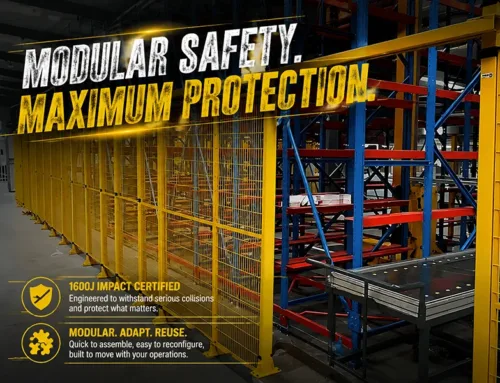
The Mdfence solution relies on a rigid skeleton. We utilize Q235炭素鋼 for our posts (60x60mm) and, crucially, for the panel frames (20x30mm). This isn’t just wire welded to wire; it is a steel tube structure that absorbs and distributes kinetic energy. The system is anchored using heavy-duty M10 x 70mm エキスパンションボルト, ensuring that when a collision occurs, the barrier holds its ground.

Figure 1: Cross-section of the Q235 Carbon Steel post and expansion bolt anchoring system designed for high impact resistance.
Framed Panels: The First Line of Defense Against Projectiles
In CNC machining centers and robotic welding cells, the risk isn’t just unauthorized entry; it’s containment. A “runaway” robot or a mechanical failure generates significant force. Our 額装パネル design is specifically engineered for this 衝撃抵抗性.
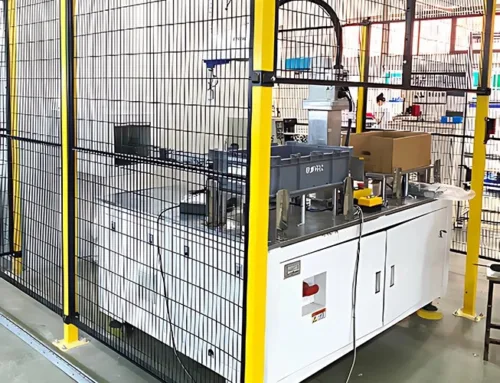
Unlike “crinkle wire” fences that act like a net, our framed panels utilize a flat welding technique where the 3mm or 4mm steel wire is fully welded to the 20x30mm tube frame. This creates a rigid barrier that meets ISO 14120 standards. If a heavy part strikes the screen, the frame transfers the load to the posts rather than tearing the mesh. This structural integrity is critical for maintaining the safety distance (ISO 13857) even after a minor incident, preventing the need for immediate, production-stopping repairs.

Figure 2: The assembly of framed panels to posts creates a unified, rigid structure capable of withstanding industrial impacts.
Integrating Safety Logic in Robotic Cells
Modern metal plants are increasingly automated. Whether it’s a robotic welding arm or an automated press brake, the physical barrier must communicate with the machine’s logic controller. A simple padlock is insufficient for a Tier-1 automotive supplier.
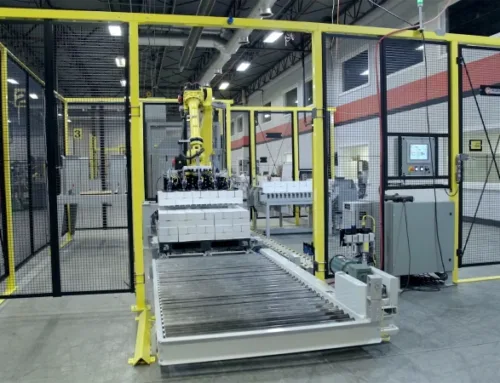
私たちの ロボット安全フェンス system is designed as an “active” component. We provide specialized セーフティ・インターロック・キャリア kits (e.g., KKCK-LCK-B-D4NL-SET) that seamlessly mount third-party switches like Omron or Pizzato directly to the door frame. This ensures that if an operator opens the gate to clear a jam or check a finish, the machine enters an immediate emergency stop (E-Stop) condition.
This integration eliminates the need for your maintenance team to fabricate custom brackets on-site, reducing installation time and ensuring the interlock is rigid and tamper-proof.

Figure 3: Complex robotic cell layout design integrating safety fencing with machine control zones.
Access Solutions for Heavy Logistics
In metalworking, material handling is heavy. You aren’t moving cardboard boxes; you are moving pallets of castings or raw bar stock via forklift or AGV. Standard hinged doors can be a liability if they swing out into a forklift aisle, creating a collision hazard.
For these scenarios, we deploy robust sliding door systems. Our double sliding doors can provide an opening width of up to 4300mm (approx. 14 feet), sufficient for large forklifts carrying wide loads. The doors hang on heavy-duty tracks with bearing rails, ensuring smooth operation even in dusty environments.

Figure 4: Wide double sliding door system allowing safe forklift access into heavy machining zones.
Surviving the Environment: Oil, Coolant, and Chips
Metal plants are harsh. Coolant mist settles on surfaces, and sharp metal chips accumulate at the base of equipment. A standard painted fence will chip, rust, and degrade quickly.
Mdfence components undergo a rigorous パウダーコーティング process conforming to GB/T9286-1998 standards, verified by ISO9227 salt spray testing. This ensures long-term corrosion resistance. Additionally, our specialized post base protective covers serve a dual purpose: they hide the anchor bolts for a clean look and, more importantly, prevent metal swarf from accumulating in the bolt threads, making cleaning easier and preventing corrosion at the anchor point.

Figure 5: Post base protective covers prevent swarf accumulation and protect anchor bolts from corrosion.
よくある質問
1. Can this fencing withstand a direct impact from a forklift?
While the system is TUV-certified for high 衝撃抵抗性 (up to specific Joule ratings suitable for machine guarding), no fence is indestructible against a full-speed forklift. However, the Q235 steel construction and framed panels are designed to deform elastically and absorb significant energy, protecting the expensive machinery behind it and preventing catastrophic failure compared to standard wire mesh.
2. We have welding robots; do you offer protection against arc flash?
Yes. For welding cells, we recommend replacing the standard wire mesh with solid steel sheet panels or integrating dark polycarbonate/acrylic viewing windows that filter UV radiation. This contains sparks and protects passersby from “welder’s flash.”
3. How do we handle maintenance access for large CNC machines?
For large equipment requiring overhead crane access or removal of large parts, we can install removable fence sections or large folding doors (up to 4800mm wide) that allow full exposure of the machine bay during maintenance shutdowns.
4. Is the system compatible with our existing Lockout/Tagout (LOTO) procedures?
Absolutely. Our door systems are compatible with a wide range of locking mechanisms, from simple hasps for padlocks (supporting LOTO) to sophisticated trapped-key interlock systems utilized in high-risk automotive manufacturing environments.
5. What happens if a panel is damaged by a thrown part?
The modular design allows for rapid replacement. Because the panels are attached via bolted fixing rings rather than welded permanently to the posts, you can swap out a single damaged 額装パネル in minutes without cutting or welding on the plant floor.