JA
JA  EN
EN  DE
DE  RU
RU  PT
PT  ES
ES  IT
IT 

|
Stop waiting for hot work permits. In high-speed automotive assembly and robotics integration, a static welded barrier is a liability, not an asset. Discover why top-tier System Integrators are switching to modular, bolt-on 工業用安全フェンス that matches the strength of custom fabrication without the rigid footprint. |
The Engineering Reality: Rigidity vs. Agility in Automation Cells
For decades, the standard in heavy industry—specifically in stamping plants, body shops, and casting foundries—was simple: if you need a guard, you call a fabricator to weld 2-inch angle iron on site. While this creates a formidable barrier, it introduces a critical bottleneck in modern “Design for Automation” workflows.
The debate of Safety fencing machine guarding: Bolt-on vs. welded isn’t just about tensile strength; it’s about the Total Cost of Ownership (TCO) during the lifecycle of a production line. When a robotic arm’s reach envelope is recalibrated or a conveyor path shifts by 6 inches, a welded fence requires cutting torches, grinders, fire watches, and significant downtime.
Structural Integrity: The “Framed” Compromise
A common misconception among Plant Managers is that “modular” means “flimsy.” This might be true for cheap perimeter fencing, but not for engineered 機械警備システム designed for robotics.
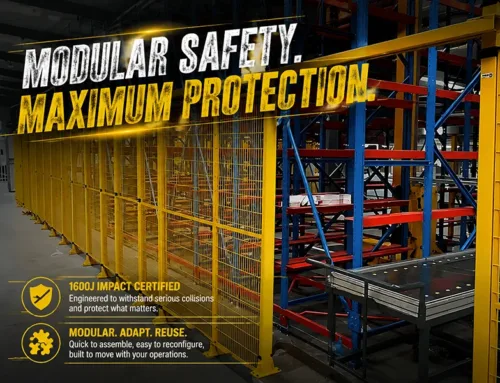
The Mdfence system bridges this gap by utilizing Q235炭素鋼 in a fully welded frame construction. Unlike simple wire mesh that can deform under impact, our panels feature a 20x30mm steel tube frame where the mesh is flat-welded at every contact point. This delivers the impact resistance required for ロボット安全フェンス (verified by TUV testing) while maintaining the modularity of a bolt-on system. You get the structural rigidity of a custom weldment with the flexibility of an erector set.

Figure 1: The framed panel design combines the strength of welded tubular steel with modular connectivity.
Installation Velocity and Site Compliance
In greenfield automotive projects or brownfield retrofits, timeline is everything. Relying on on-site welding introduces variables: welder availability, smoke extraction requirements, and painting/curing time.
Our bolt-on system utilizes standard エキスパンションボルト (M10 x 70mm) and pre-engineered base plates. A two-man crew can install 100+ linear feet of fencing in a single shift using only rotary hammers and impact drivers. There is no need for touch-up painting or spark containment. This capability is vital for System Integrators who need to deploy 自動生産ライン under tight penalties for delay.
Maintenance and Crash Recovery
Accidents happen. In a busy logistics corridor, a forklift tine will eventually catch a post.
The Welded Scenario: The damaged section must be cut out. The concrete may be damaged if the post is ripped up. You need to fabricate a new piece, weld it in, and repaint it. The aisle is closed for 24-48 hours.
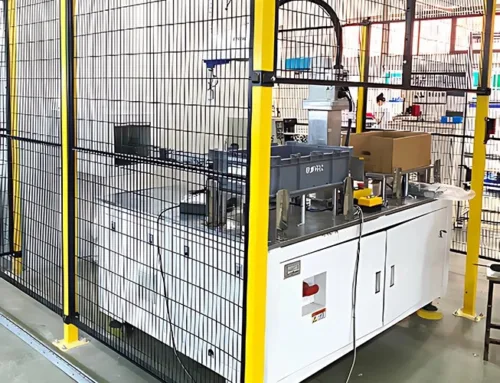
The Bolt-On Scenario: You unbolt the damaged 60x60mm post and the adjacent panels. You retrieve a spare post from stock. You bolt it down. The line is back up and running in 45 minutes. The modular design isolates damage to individual components rather than compromising the entire fence line.

Figure 2: Heavy-duty base plates with expansion bolts allow for rapid replacement without concrete work.
Integration with Safety Logic (PLC & Interlocks)
モダン ロボット安全フェンス is not just a physical barrier; it is part of the machine’s safety circuit. Welded fences often require ad-hoc drilling and tapping to mount safety switches, leading to misalignment and “door open” faults that plague OEE (Overall Equipment Effectiveness).
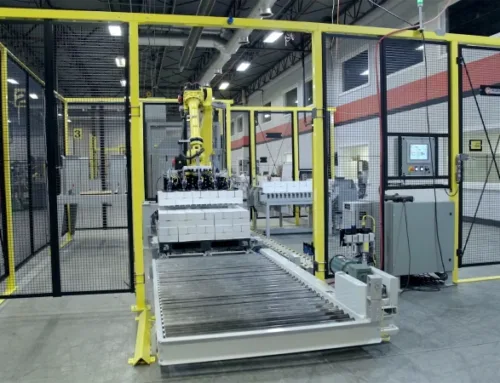
Mdfence systems offer dedicated セーフティ・インターロック・キャリア pre-drilled for industry-standard switches like Omron D4NL or Pizzato. Whether you are using a simple slide bolt or a complex solenoid-locking RFID switch, the mounting is standardized and robust, ensuring the tolerance stack-up is controlled and the safety signal is reliable.

Figure 3: Pre-engineered mounting solutions for safety interlocks eliminate on-site fabrication errors.
よくある質問
1. Can bolt-on fencing withstand the impact of a robotic arm payload?
Yes. Our system uses 60x60mm posts (2.0mm wall thickness) and framed panels that are TUV certified for high impact resistance. It is designed specifically to contain parts or prevent entry into the kinematic range of industrial robots (ISO 10218 compliance).
2. How do we handle welding spatter protection in a bolt-on system?
We replace the standard wire mesh with solid sheet metal or polycarbonate panels within the same modular frame. This effectively contains sparks and welding spatter in automotive body shop applications while maintaining the bolt-on modularity.
3. Can I retrofit this system into an existing layout with non-standard dimensions?
Absolutely. While we have standard widths, our “Cut-to-Size” kits allow installers to modify panel widths on-site using simple hand tools, or we can provide custom-width panels based on your CAD layout to fit tight spaces between conveyors.
4. Does the powder coating withstand harsh industrial fluids?
Yes. Our powder coating meets GB/T9286-1998 adhesion standards and passes ISO9227 salt spray testing. It is resistant to common cutting fluids, coolants, and oils found in CNC and machining environments.
5. How quickly can we access the cell for a changeover?
We offer sliding, hinged, and folding door modules that integrate seamlessly. For large mold changes or forklift access, our trackless sliding doors or large folding doors provide openings up to 15 feet wide without overhead obstructions.