JA
JA  EN
EN  DE
DE  RU
RU  PT
PT  ES
ES  IT
IT 
![[Industrial Safety Fencing]](https://safetyfencesystems.com/wp-content/uploads/2025/11/Industrial-Safety-Fencing-2.webp)
|
When a heavy-duty forklift or a rogue AGV crashes into the perimeter of your robotic welding station, every minute of downtime bleeds capital. Traditional welded barriers require hot work permits, grinding, and hours of lost production just to fix a bent frame. With our modular architecture, you don’t need to tear down the whole line or shut down adjacent CNC machining centers. You can isolate the damage and swap a single framed section in under 10 minutes using nothing but a wrench. Keep your MTTR (Mean Time To Repair) low and your OEE (Overall Equipment Effectiveness) high. |
The Reality of Forklift Strikes in High-Traffic Automation Cells
In a high-speed automotive assembly plant or a turnkey robotics integration facility, the floor is a battlefield. Forklifts carrying 2,000 lbs of engine blocks share tight corridors with automated guided vehicles (AGVs) and 6-axis KUKA or FANUC robots. A collision is not a matter of “if,” but “when.”
The Before Scenario: When a forklift clips a traditional, locally welded iron fence, the damage doesn’t stop at the impact point. Because the entire structure is welded together, a single hit can warp 20 feet of the perimeter. Repairing it means shutting down the robotic work cell, issuing a hot work permit, covering sensitive electro-optical elements to protect them from weld spatter, cutting out the bent section with an angle grinder, welding a new piece, and repainting. This process easily consumes 4 to 6 hours. In an industry where a minute of downtime can cost thousands of dollars, this is an unacceptable bottleneck.
The Modular Advantage: Replacing Just One Section
Yes, if a forklift damages a panel, you can replace のみ that specific section. This is the core engineering logic behind our 機械用ガードフェンスパネル.
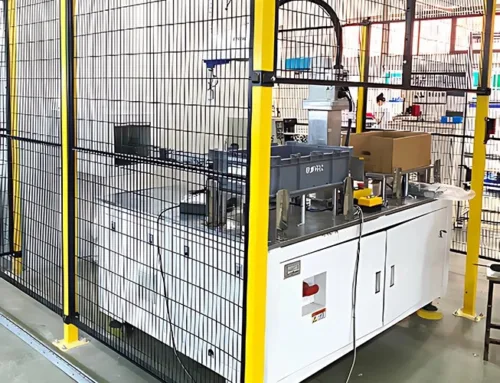
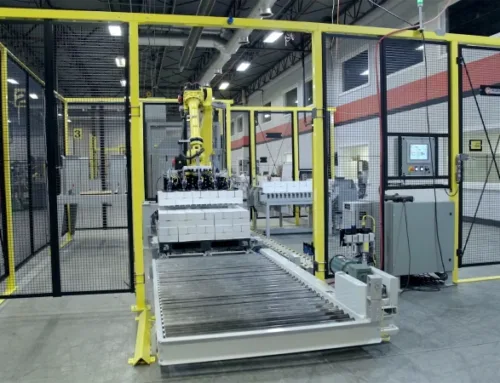
Why it works: Our system is entirely cold-assembled. It relies on a framed mesh architecture (20x30x1.5mm seamless steel tube frames) connected to standardized 60x60mm posts via high-strength steel fixing rings and M8x10 flange bolts. There are no permanent welds between the panels and the posts. If an AGV veers off its path and dents a mesh panel, the kinetic energy is absorbed by that specific frame and the adjacent brackets, localizing the deformation.
![[Industrial Safety Fencing]](https://safetyfencesystems.com/wp-content/uploads/2025/11/Industrial-Safety-Fencing-16.webp)
To restore ISO 14120 compliance, your maintenance crew simply needs to perform a quick LOTO (Lockout/Tagout) procedure, unscrew the four M8 bolts holding the damaged panel, snap a fresh panel into the lower fixing ring’s teeth, and tighten the upper ring. You have a fully restored 工業用安全フェンス perimeter in under 10 minutes. No sparks, no paint fumes, no massive production halts.
Built to Absorb the Hit: 1600 Joules of Impact Resistance
Before you even think about replacing a panel, the barrier must do its primary job: stop the threat from reaching your high-speed mechanical assembly machines or your operators.
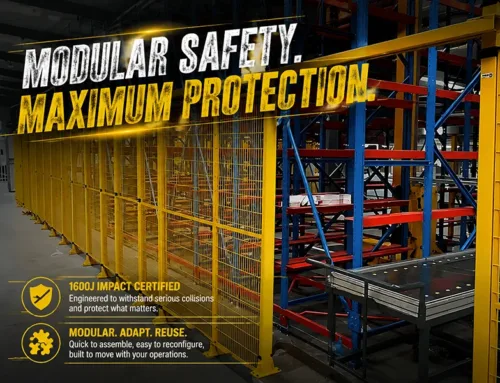
Unlike brittle cast iron or T-slot aluminum profiles that snap under heavy impact, our ロボット安全フェンスシステム are manufactured from Q235 cold-rolled carbon steel. Q235 steel possesses excellent plasticity. When a forklift carrying a heavy load strikes the fence, the system is TUV-certified to withstand up to 1600 Joules of impact energy—equivalent to stopping a 220 lbs (100kg) object moving at roughly 12.4 mph (20km/h).
![[Industrial Safety Fencing]](https://safetyfencesystems.com/wp-content/uploads/2025/11/Industrial-Safety-Fencing-1.webp)
The 60x60mm posts act as cantilever beams, transferring the force down to the heavy-duty base plates anchored by M10x70mm expansion bolts into the concrete. The steel mesh deforms plastically—acting exactly like the crumple zone of an automobile. It sacrifices itself to dissipate the kinetic energy, ensuring the robotic arm inside the cell remains untouched and the forklift driver is safely decelerated.
Workflow Comparison: Damaged Panel Recovery
| Recovery Metric | Traditional Welded Barrier | Mdfence Modular System |
|---|---|---|
| Repair Method | Hot work (Cutting, Grinding, Welding) | Cold assembly (Wrench & Bolts) |
| Collateral Impact | Sparks hazard; requires covering CNC/Robots | Zero debris; safe for cleanroom & optical sensors |
| Average MTTR | 4 to 6 Hours | Under 10 Minutes |
| Asset Recovery | Entire section becomes scrap metal | Only the single damaged panel is discarded |
For system integrators and facility managers, the math is simple. By maintaining a small inventory of flat-packed spare panels in your warehouse, a catastrophic forklift collision is downgraded from a major production crisis to a minor, 10-minute maintenance task.
Frequently Asked Questions (FAQs)
Not necessarily. If the concrete itself isn’t severely fractured, you can remove the nuts from the existing M10x70mm expansion bolts, lift off the bent post, and drop a new post onto the existing anchors. If an anchor is sheared, you can shift the new post slightly along the layout line and drill new holes, adjusting the modular panel connection via the sliding fixing rings.
Yes. Our panels utilize a flat-pack design. You can easily store several standard 20x100mm mesh panels and fixing kits on a single pallet in your maintenance area, ensuring you have immediate stock to address any AGV or forklift damage without waiting for shipping.
No. Because you are replacing the damaged section with an identical, factory-welded OEM part using the standardized M8 bolted connections, the structural integrity and the safety distance calculations (ISO 13857) of the perimeter remain fully compliant with your original risk assessment.
It depends on the severity. However, because our panels feature a rigid 20x30mm tubular frame, the vibration and deformation are highly localized. This prevents the “hammock effect” seen in cheap, frameless wire mesh, drastically reducing the chance of the impact jarring the door frame out of alignment and causing nuisance trips on your Omron or Pizzato interlock switches.
T-slot aluminum has a lower modulus of elasticity and is prone to snapping or permanent, unfixable distortion under heavy point loads. Furthermore, the T-nuts often vibrate loose. Our Q235 carbon steel system absorbs the 1600J impact through plastic deformation (bending without shattering), keeping the hazard contained, and the bolted fixing rings will not shake loose from the impact.