JA
JA  EN
EN  DE
DE  RU
RU  PT
PT  ES
ES  IT
IT 
 |
Your new high-speed robot arm doesn’t care about the flimsy chain-link fence you put around it. When an end-of-arm tool fails or a workpiece is ejected at 500 inches per second, you don’t have a barrier—you have shrapnel. It’s time to move beyond simple demarcation and engineer a solution that can physically contain the kinetic energy of modern automation. |
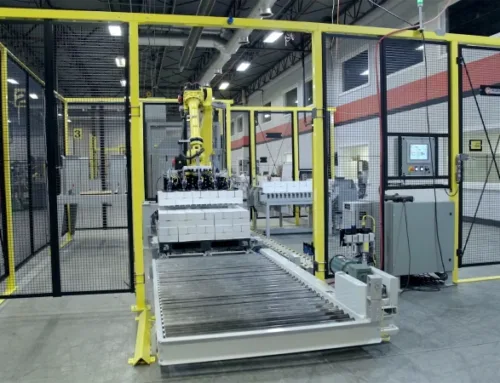
So, you’re commissioning a new robotic cell. The six-axis arm is a marvel of speed and precision, but it also introduces a significant hazard. The question isn’t if you need a barrier, but what kind? Is standard industrial fencing enough for the dynamic forces of a high-speed robot arm? The short answer is no. A barrier for a high-payload, high-velocity robot isn’t just a fence; it’s a critical piece of safety engineering, and the difference between compliant 機械警備システム and a simple perimeter fence can be the difference between a contained incident and a catastrophic failure.
The Physics of Failure: Why Material and Structure Matter
In the world of automation integration, we often see guarding solutions that are fundamentally mismatched to the risk. A lightweight, tack-welded mesh or a T-slot aluminum frame might look the part, but it lacks the structural integrity to handle a real-world impact event. When a robot moving a 100 Lbs component at full extension has an emergency stop or loses its payload, the kinetic energy has to go somewhere.
From Brittle Failure to Controlled Deformation
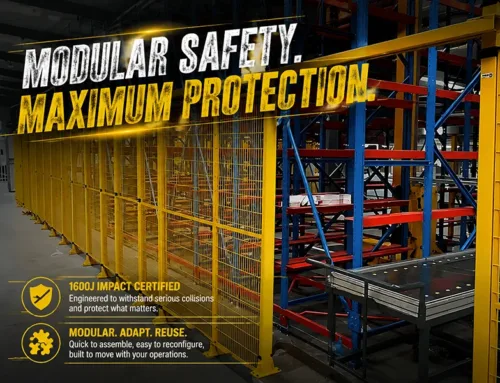
The core problem with cheap or improperly specified guards is brittle failure. Under impact, weak welds snap, and thin-gauge steel can tear, creating secondary projectiles. A proper ロボット安全フェンス system is designed for ductile failure. Our systems are built from high-tensile Q235炭素鋼 with a fully-welded 20x30mm tubular frame around every panel. This architecture does two things:
- Distributes Force: The frame acts like a chassis, spreading the impact load across the entire panel and into the 60x60mm posts.
- Absorbs Energy: Q235 steel is engineered to bend and deform under extreme stress, not shatter. It acts like a car’s crumple zone, absorbing the energy of an impact. With a certified impact resistance of 1600 Joules, our system can absorb the force of a 220 Lbs object moving at 12.4 mph without penetration.

Beyond a Dumb Barrier: Achieving True PLC Integration
For a system integrator, one of the biggest headaches is marrying the physical guard to the machine’s control logic. You’ve installed a high-end Pizzato or Omron D4NL safety interlock, but the door on your guarding is flimsy. After a few hundred cycles, it sags, the switch misaligns, and the line starts experiencing nuisance trips—killing OEE and leading to frustrated calls from your client.
Engineered for Precision and Reliability
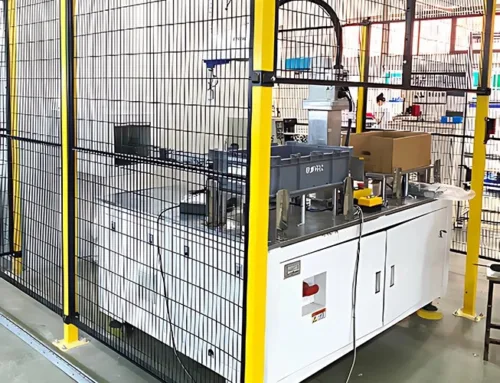
A machine guard must be a reliable component of the safety circuit. This requires a level of structural rigidity that most modular systems lack. Our heavy-duty posts and framed door panels resist sagging, ensuring your interlocks stay perfectly aligned year after year. More importantly, we’ve moved beyond simple physical barriers by offering pre-engineered セーフティ・インターロック・キャリア plates. Instead of your technicians spending hours on-site drilling and tapping custom mounts (and destroying the powder coating in the process), our system provides a standardized, bolt-on solution. This turns the fence from a passive object into an active, integrated part of the PLe/SIL3 safety system, saving you critical integration time and de-risking your project.

Reclaiming Floor Space: The ROI of ISO 13857 Compliance
In modern manufacturing, floor space is money. A common mistake is using guarding with large 50x50mm (2″x2″) mesh openings. According to ISO 13857, to prevent an operator from reaching through and touching a hazard, this type of fence might need a setback distance of 850mm (33.5 inches) or more. This creates a massive, unproductive buffer zone around every machine.
The 120mm Advantage
Our standard panels use a 20x100mm mesh aperture. This “finger-safe” design is too narrow for an operator to reach through, drastically reducing the required safety distance. The standard allows this fence to be placed as close as 120mm (4.7 inches) from the hazard. For a typical 65-foot-long robotic line, switching to this compliant mesh can reclaim over 250 square feet of valuable production floor—enough for another pallet station, a quality control desk, or a wider, safer forklift aisle.
Case Study: A System Integrator’s Challenge
We recently worked with GBM Automation, a system integrator designing a complex, multi-station assembly line. Their end-client had strict EHS requirements and a non-negotiable go-live date. The layout was complex, with multiple conveyor pass-throughs and specific requirements for Omron safety switches.

A welded-on-site solution was too slow and inflexible. A generic T-slot system couldn’t provide the required impact resistance or a reliable mounting solution for the interlocks. By using our modular 安全フェンス工業 system, GBM received a kit of parts based on their exact CAD drawings. The bolt-together assembly eliminated hot work permits and allowed for rapid installation. Our pre-engineered interlock plates meant their control engineers could integrate the safety circuit in record time. The result: the project was delivered ahead of schedule and passed the final EHS audit on the first walkthrough.
Ultimately, guarding a high-speed robot arm is an engineering challenge. It requires a system that respects the laws of physics, integrates seamlessly with control logic, and understands the economic realities of your plant floor. It requires more than just a fence; it requires a complete machine guarding solution.
よくある質問
1. How does your fencing handle integration with different safety interlock brands like Schmersal, Pizzato, or Rockwell?
Our system is designed for agnosticism. We offer a range of pre-engineered mounting plates and lock carriers specifically designed for popular interlock models, including the Omron D4NL, Pizzato FS series, and others. This eliminates the need for on-site drilling or welding, ensuring a clean, compliant, and reliable installation that saves significant integration time.
2. What is the typical installation time for a 100-foot robotic cell compared to a welded solution?
A two-person team using standard hand tools can typically install 100-150 feet of our modular fencing in a single 8-hour shift. A comparable welded solution would require at least 2-3 days, factoring in cutting, fitting, welding, grinding, painting, and the associated hot work permits and fire watch requirements. Our system reduces installation labor by up to 70%.
3. Can the system be modified on-site to accommodate conveyors, cable trays, or light curtains?
Absolutely. The modularity is a key feature. We offer specialized components like tunnel guards for conveyors and dedicated, beefier posts designed to mount light curtains. Panels can be customized in width or height at the factory, or standard panels can be combined to create openings precisely where you need them, ensuring a perfect fit with your existing infrastructure.
4. You mentioned a 1600 Joule impact rating. What does that mean in the context of a high-speed robot?
1600 Joules is the kinetic energy of a 220 Lbs (100 kg) mass traveling at approximately 12.4 mph (20 km/h). This rating, certified by TUV, ensures that the fence can contain a significant impact, such as a dropped payload or an unexpected movement from a medium-to-large industrial robot, preventing the object from exiting the cell and becoming a projectile.
5. Do you provide 3D CAD/STP files for us to use in our plant layout software?
Yes. We understand that accurate planning is critical for system integrators and plant engineers. We provide a complete library of 3D STP files for all our standard components. This allows your design team to import our entire fencing system into your layout software (like AutoCAD or SolidWorks) to check for clearances, plan access points, and generate an exact Bill of Materials before ordering.