JA
JA  EN
EN  DE
DE  RU
RU  PT
PT  ES
ES  IT
IT 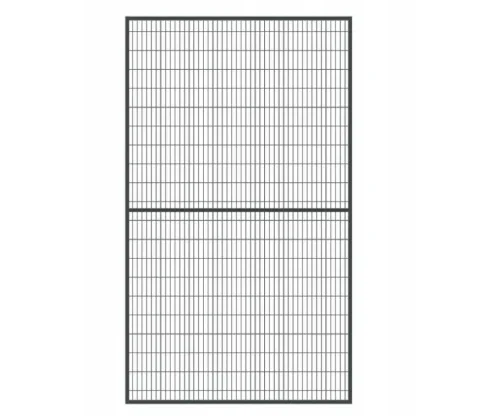
 |
Your new robot cell layout looks perfect in CAD, but a last-minute risk assessment reveals a fatal flaw: your chosen fence mesh requires a 3-foot safety distance, shrinking your forklift aisle to an unusable width. Now you face a costly redesign and a delayed production start. The problem wasn’t the robot or the layout; it was the millimeter-level detail of your fence panel. |
In the world of industrial automation and robotics integration, success is measured in millimeters and milliseconds. A robot’s reach, a conveyor’s speed, an AGV’s path—every element is precisely calculated. Yet, one of the most critical and frequently overlooked details in a ロボット安全フェンス system is the mesh size of its panels. This seemingly minor specification can have a major impact on your factory’s productivity, safety compliance, and even your bottom line.
Choosing the wrong mesh is not just a minor error; it’s a decision that can force expensive layout changes, fail EHS audits, and waste thousands of dollars in valuable floor space. Let’s break down why mesh size is the cornerstone of efficient and compliant machine guarding.
The Physics of Safety: How Mesh Size Dictates Your Factory Layout
The core principle governing the placement of 機械用ガードフェンスパネル is ISO 13857. This international standard defines the safety distances required to prevent personnel from reaching hazardous areas. It’s not a suggestion; it’s a non-negotiable rule that safety engineers and auditors live by.
The standard operates on a simple premise: the larger the opening in a guard, the farther away that guard must be placed from the hazard. This is to account for the potential reach of a human limb.
The Common—and Costly—Mistake: The 50x50mm Mesh Trap
Many facilities opt for generic fencing with a 50x50mm (approx. 2″ x 2″) mesh, often because it’s perceived as a low-cost commodity. However, this decision triggers a cascade of negative consequences based on ISO 13857:
- The Problem: A 50x50mm opening is large enough for a person’s entire hand to pass through.
- The ISO 13857 Mandate: To account for full arm access, the standard mandates a safety distance (Sr) of up to 850mm (nearly 34 inches).
- The Real-World Impact: Your safety fence must be installed almost three feet away from the robot’s maximum reach. For a typical 50-foot-long production line, this decision instantly consumes an additional 150 square feet of high-value production space. That’s space you can no longer use for material staging, maintenance access, or another piece of equipment.
The Strategic Advantage: The 20x100mm “Finger-Safe” Mesh
A purpose-built machine guarding system like Mdfence utilizes a 20x100mm (approx. 0.8″ x 4″) vertical mesh pattern. This design is not arbitrary; it’s engineered specifically to leverage the physics of ISO 13857 to your advantage.

- The Logic: The narrow 20mm opening physically prevents fingers from passing through beyond the knuckle. It’s what we call a “finger-safe” design.
- The ISO 13857 Allowance: Because only the tip of a finger can penetrate the barrier, the standard allows for a dramatically reduced safety distance of just 120mm (about 4.7 inches).
- The Quantifiable Benefit: Compared to the 50x50mm mesh, the 20x100mm panel allows you to place your guarding 730mm (over 28 inches) closer to the machine. On that same 50-foot production line, you instantly reclaim over 115 square feet of floor space. In a high-cost manufacturing hub, this translates directly into thousands of dollars in saved rent annually or provides the critical space needed to avoid a congested and inefficient layout.
Beyond Space Savings: Structural Integrity and Operational Efficiency
While optimizing your layout is a massive win, the benefits of a correctly specified mesh panel extend further into the daily realities of a manufacturing environment.
Visibility and Strength in One Package
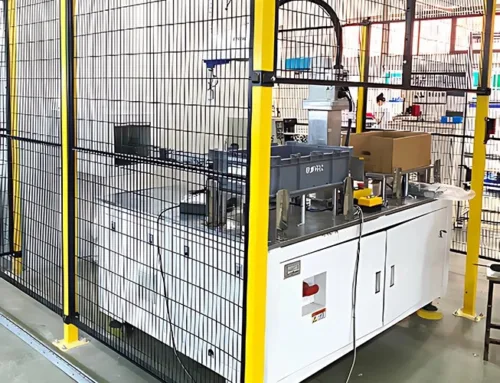
A common concern is that a denser mesh might obstruct the view of the machinery. However, when combined with a black powder-coated finish, the 20x100mm mesh offers superior visibility. The black color absorbs light and reduces glare, making the mesh “disappear” to the human eye, allowing operators to clearly monitor processes inside the cell. Furthermore, Mdfence panels are not simple wire mesh; they are fully welded into a 20x30mm steel tube frame. This architecture provides immense out-of-plane stiffness, ensuring the panel can withstand significant impacts without deforming or failing—a critical feature when dealing with powerful industrial robots.
A Foundation for Seamless Safety Integration
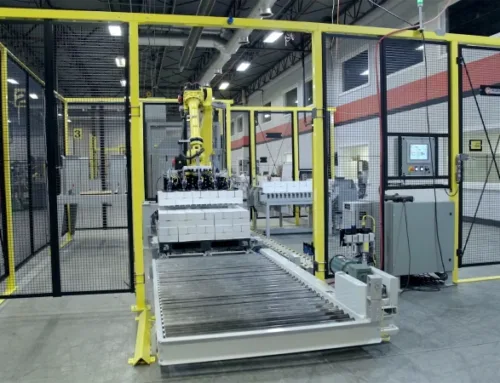
あなたの 工業用安全フェンス is the physical foundation of your entire safety system. The rigid, framed panels provide a stable and reliable mounting surface for critical components like safety interlock switches (e.g., Omron D4NL, Pizzato) and emergency stop buttons. This structural integrity prevents the door sag and misalignment common with flimsy, frameless mesh, which can lead to nuisance trips in the safety circuit and costly, unexplained downtime.
The Verdict: Mesh Size is a Strategic, Not a Commodity, Decision
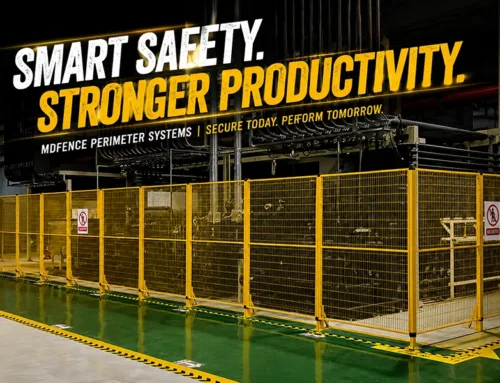
In the high-stakes environment of automation, treating your machine guarding panels as a low-bid item is a recipe for failure. The mesh size is a fundamental engineering choice that directly influences your operational footprint, your compliance with global safety standards, and your ability to run an efficient, uninterrupted production line. By choosing an engineered solution with a “finger-safe” 20x100mm mesh, you are not just buying a fence; you are investing in a more compact, compliant, and productive factory floor.
よくある質問
1. What exactly is ISO 13857 and why does it care so much about mesh size?
ISO 13857 is the international safety standard for “Safety of machinery — Safety distances to prevent hazard zones being reached by upper and lower limbs.” It provides specific, calculated distances based on the size of an opening in a physical guard. A smaller opening (like 20mm) limits access to just a fingertip, allowing the guard to be placed very close to a machine. A larger opening requires a much greater distance to prevent an entire arm from reaching the hazard.
2. Can I use a cheaper 50x50mm mesh? What’s the real trade-off?
You can, but the trade-off is space and flexibility. While the upfront cost of a 50x50mm panel might be lower, it will legally require you to place it much farther from your equipment (up to 850mm vs. 120mm). This consumes valuable floor space, can create inefficient layouts, and may force costly redesigns if you discover the issue late in the project. The “cheaper” panel often becomes far more expensive in terms of lost productivity and space.
3. Does the 20x100mm mesh size significantly impact visibility into the robot cell?
No, quite the opposite. When finished with a standard black powder coating, the denser mesh pattern tends to be less distracting to the human eye than a wider, more open mesh. The black color absorbs ambient light and reduces glare, making the fence appear almost transparent and allowing operators to clearly monitor the process and equipment within the cell.
4. How does mesh size affect the integration of other safety devices like light curtains?
Mesh size is critical for creating a cohesive safety system. In areas where you use a physical gate, the 20x100mm mesh ensures compliance. In adjacent openings for material pass-through, you might use a light curtain. The rigid frame of a high-quality panel system provides a stable structure to mount these light curtains, ensuring they remain perfectly aligned. Using the correct mesh for fixed panels prevents anyone from simply reaching around the light curtain and bypassing it.
5. Is the 20x100mm mesh strong enough to contain a part ejected by a robot?
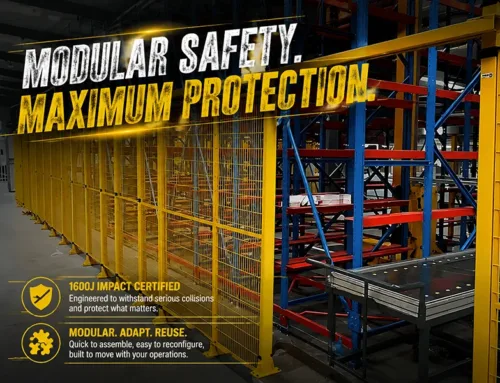
Yes, when it’s part of an engineered, framed panel system. The strength comes not just from the 3.0mm or 4.0mm wire, but from the complete structure. The wire is welded to a robust 20x30mm tubular steel frame. This design is certified to withstand significant impact forces (e.g., 1600 Joules), ensuring it can contain a dropped workpiece or resist accidental contact from equipment, preventing a hazardous situation from escalating.