JA
JA  EN
EN  DE
DE  RU
RU  PT
PT  ES
ES  IT
IT Machine guarding for faster robot-cell delivery
ロボットセル用機械ガード:アルフェンスが溶接フェンスの遅延をセル納入から排除する方法
When a robot cell is ready for integration but its perimeter fence is still waiting on cutting, welding, grinding, and coating, guarding becomes the delivery bottleneck. Alfence uses a bolt-assembled modular safety fence so integrators can install and adjust machine guarding in parallel with robot and equipment work—without adding welding or painting to the critical path.
Why welded steel fencing can hold up a cell
For an automation integrator under delivery pressure, a traditional welded steel fence is more than a perimeter product. It can require shop or site cutting, welding, grinding, and coating in sequence. The work depends on welding and finishing labor, is difficult to parallelize, and often remains unfinished while the robot cell is already waiting for commissioning.
| Delivery requirement | Alfence machine guarding response |
|---|---|
| Reduce site-dependent work | Bolt-assembled post-and-panel system avoids on-site welding, grinding, and painting. |
| Build before the robot arrives | Standardized posts, prefabricated steel wire mesh panels, and standard doors can be prepared and stocked ahead of cell commissioning. |
| Adapt to the final cell layout | Removable, reconfigurable panels and T-slot aluminum posts support late layout changes without rebuilding a welded frame. |
| Keep the guarding practical for automation | 40×40 mm or 45×45 mm posts, 20×100 mm mesh, floor-mounted expansion bolts, and access-door options support robot cell and conveyor layouts. |
| Protect the project schedule | Guarding installation can proceed in parallel with robot-body delivery and equipment integration instead of waiting for a fabrication sequence to finish. |
Alfence structure and site evidence
Standardized components can be prepared before commissioning
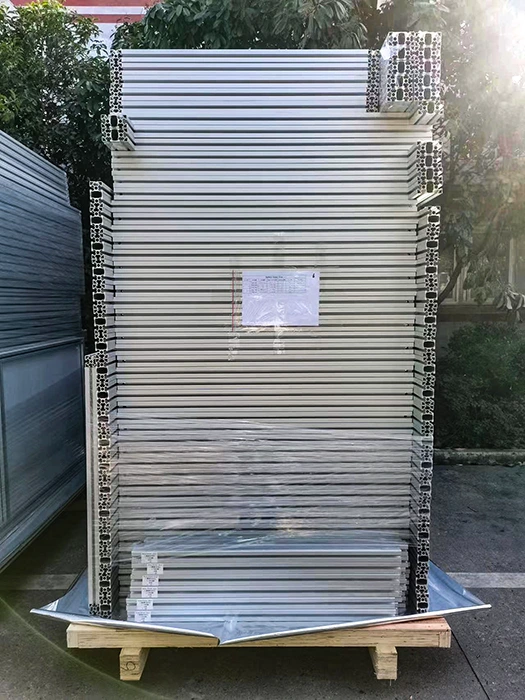
Alfence combines 40×40 mm or 45×45 mm T-slot aluminum posts, prefabricated welded wire mesh panels, and standard safety doors in a modular frame. Posts are available from 0 to 2200 mm in length; typical panel heights include 1000, 1800, and 2000 mm, with panel widths from 200 to 1200 mm. The component approach lets an integrator plan machine guarding as a repeatable installation package rather than a one-off welding job.
Robot-cell access remains part of the guarding layout
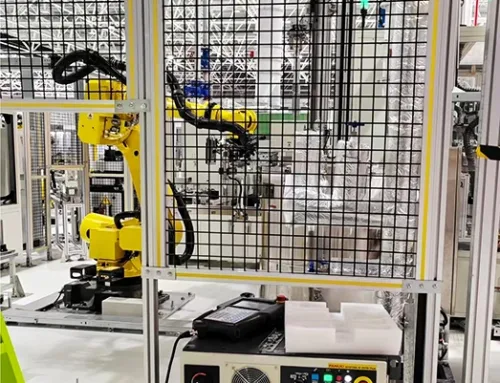
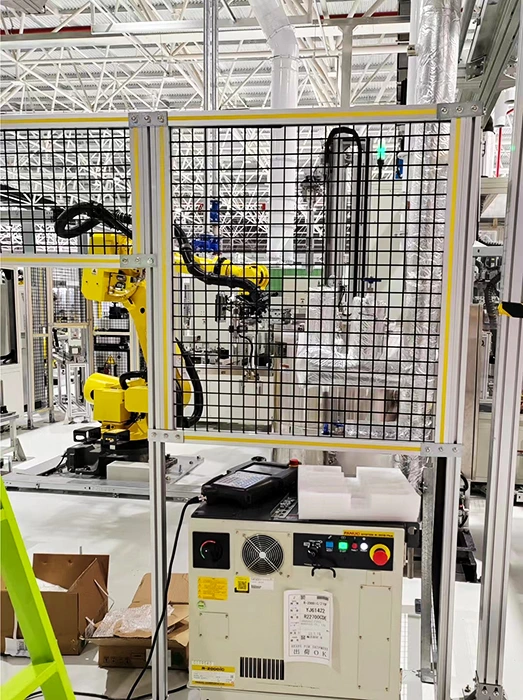
On a working robot cell, guarding has to separate the hazard while preserving access for setup and maintenance. The documented Alfence options include hinged, sliding, or folding safety doors, magnetic handles, caster wheels, safety interlock switches, and light curtains. The photographed mesh enclosure shows multiple hinged access gates, control panels, and a yellow robot inside—evidence of the access and control relationship an integrator must resolve during installation.
Machine guarding can follow the line instead of delaying it
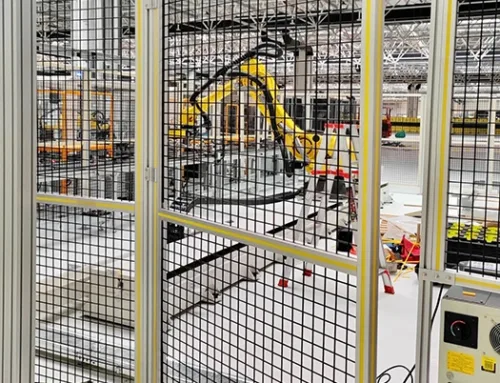
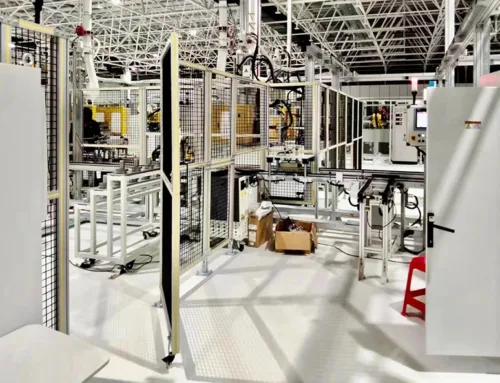
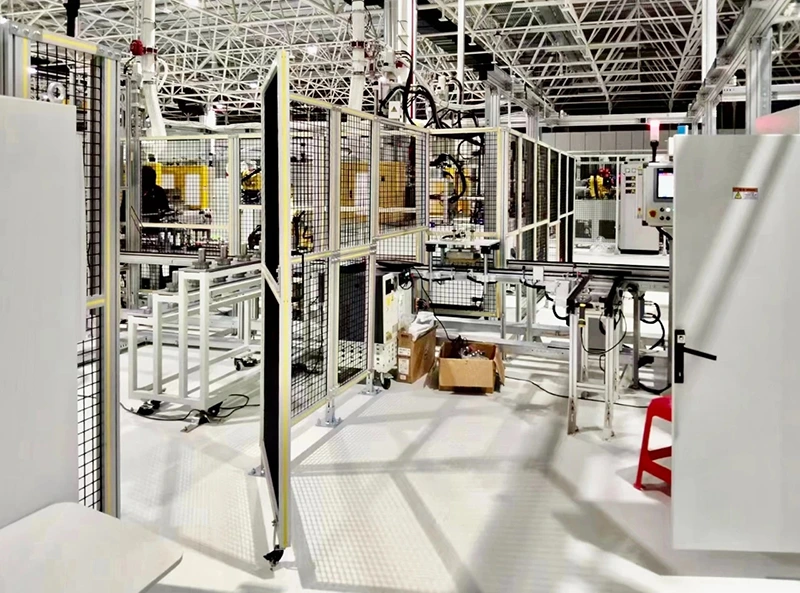
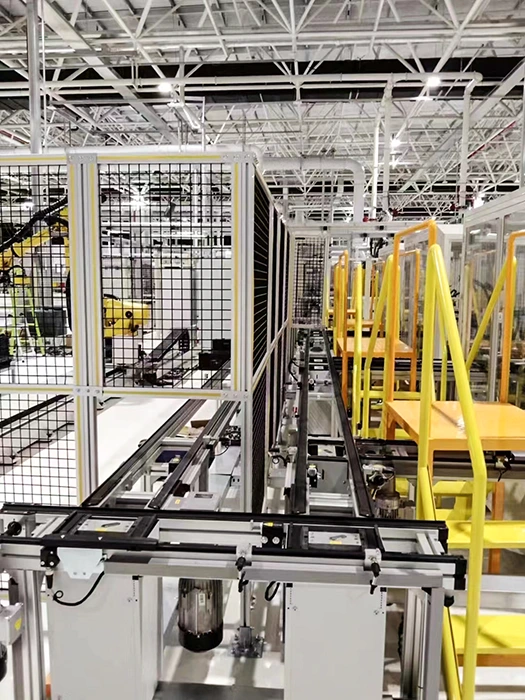
For conveyor and assembly-line separation, the same post-and-panel principle can be extended across a longer perimeter. The installation image shows welded wire mesh panels, a conveyor transfer line, and a yellow access platform in one production area. Alfence supports floor mounting with expansion bolts and can maintain a closer-to-hazard layout where the 20×100 mm mesh is selected to support an approximately 120 mm safety distance, subject to the project risk assessment and applicable EN ISO 13857 requirements.
Where this machine guarding approach fits
- Robot cell guarding and welding cell guarding where the perimeter must be installed alongside automation equipment.
- CNC machine guarding and machine tool guarding for indoor plant installations and retrofit guarding.
- Conveyor guarding, AGV path guarding, shuttle-car protection, and material-handling robot guarding.
- Palletizer guarding, packaging line guarding, and assembly line separation where reconfiguration is expected.
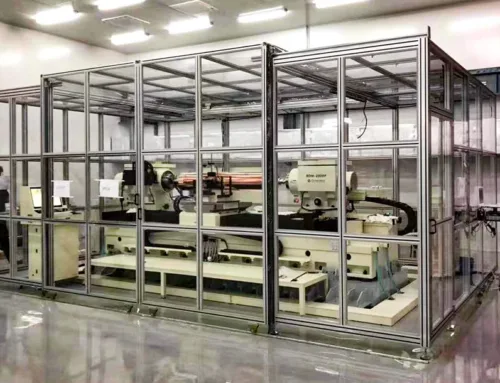
- Automated warehouse guarding, ASRS or high-bay storage guarding, and cleanroom guarding with an appropriate panel choice.
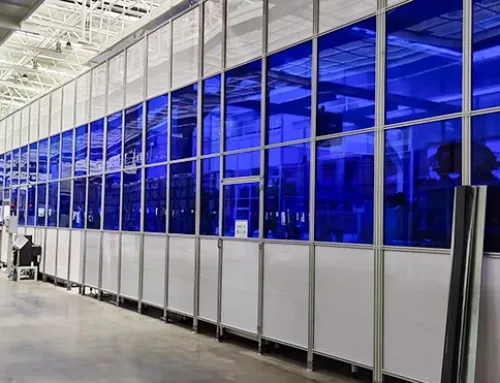
Alfence is intended for indoor machine and perimeter guarding; outdoor use requires the project-specific corrosion treatment. Where the risk assessment calls for it, the system can be specified with transparent polycarbonate or acrylic panels, tinted or red arc-flash panels, safety interlocks, and light curtains.
Turn guarding into a parallel work package
For a fast robot-cell delivery, confirm the perimeter, access points, hazard distance, door type, and floor fixing early. Then standardize the component list—posts, panels, connectors, end caps, doors, and safety devices—so material preparation and machine integration can proceed in parallel. Alfence’s reusable, reconfigurable components also support later line changes without repurchasing an entire welded steel fence.
Need machine guarding without a fencing bottleneck?
Send the cell perimeter, required access doors, target height, and delivery date. SGF can help map the Alfence modular safety fence into a practical installation package for your robot cell, conveyor, CNC, or automation line.