
 JA
JA  EN
EN  DE
DE  RU
RU  PT
PT  ES
ES  IT
IT 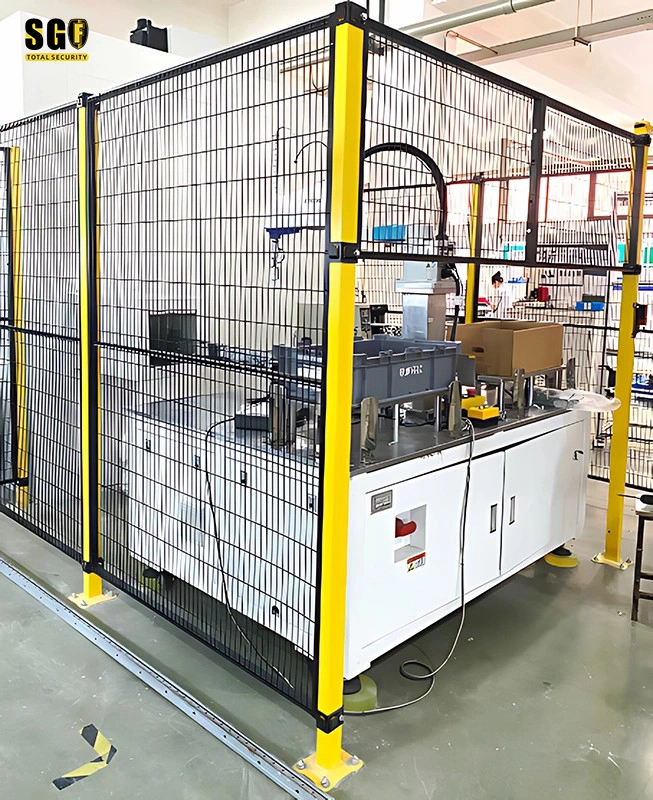
Machine guarding systems for robotics, conveyors, palletizing cells and automated production lines
Machine Guarding Systems for Robotics and Conveyor Automation
MDFence is a modular machine guarding system built around Q235 carbon steel posts, framed wire mesh panels and access-controlled gate options. It helps manufacturers create compact, audit-ready protection around robot cells, conveyor zones, automated assembly lines and restricted machine areas without relying on site welding or disposable barriers.
When generic fencing becomes a project risk
Factories do not buy guarding just to mark a boundary. They buy it to control real risk: unauthorized entry into active machinery, thrown parts, layout conflicts, failed audits, difficult lock integration and wasted floor space. Light partitions and improvised welded barriers often look acceptable on day one, then create problems during commissioning, maintenance or export acceptance.
- Large mesh openings can force longer safety distance and consume valuable machine-side space
- Frameless panels can deflect, loosen or age poorly in high-cycle industrial use
- Field welding slows installation and makes later reconfiguration expensive
- Weak gate design can cause sag, poor alignment and unstable interlock performance
- Non-standard layouts around conveyors, palletizers and transfer points are hard to solve with off-the-shelf barriers
What makes MDFence a true machine guarding system
The system uses Q235 carbon steel for the load-bearing structure and framed mesh construction to improve rigidity. Common documented configurations include 60×60 mm posts, 20x30x1.5 mm panel frames and 3.0 mm or 4.0 mm wire. This is paired with modular clamp-based assembly and expansion-anchor fixing, creating a practical guarding platform for facilities that need both physical protection and layout flexibility.
Product documentation also repeatedly references impact performance at or above 1600 J. In practical terms, that supports guarding projects where flying parts, accidental contact, unstable handling or surrounding equipment movement must be treated as serious engineering issues rather than cosmetic concerns.
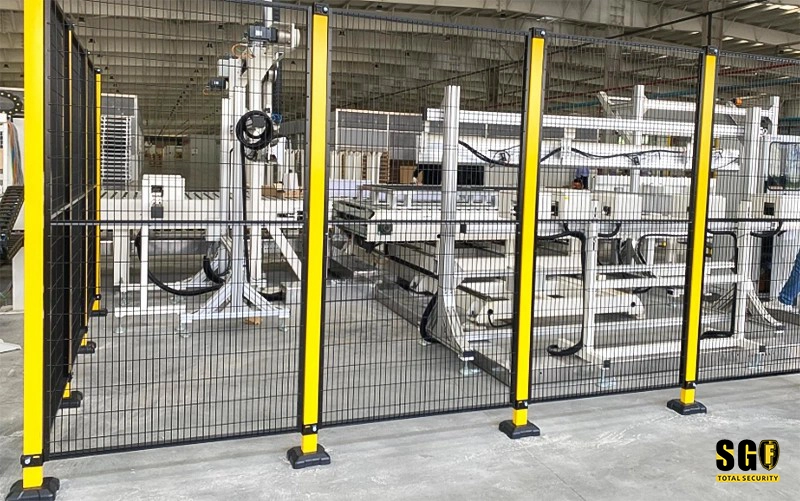
Built for dense automation layouts
MDFence is especially suitable for factories where equipment density matters. The dominant 20×100 mm mesh format is widely used for finger-safe machine guarding applications and supports compact guarding layouts around robotic stations, transfer modules and machine perimeters. For manufacturers trying to keep access aisles clear while protecting operators from reach-in risk, that dimensional logic matters more than brochure language.
Robot cells
Protect six-axis robots, handling stations and test cells while preserving visibility for monitoring and troubleshooting.
Conveyor guarding
Manage long linear runs, pass-through openings and side protection on automated transfer and packaging lines.
Palletizing and end-of-line automation
Combine perimeter panels with controlled gate access for discharge, service and operator intervention zones.
Warehouse and ASRS protection
Apply modular fencing, double gates and optional lower shielding around high-bay storage, stacker and logistics equipment.
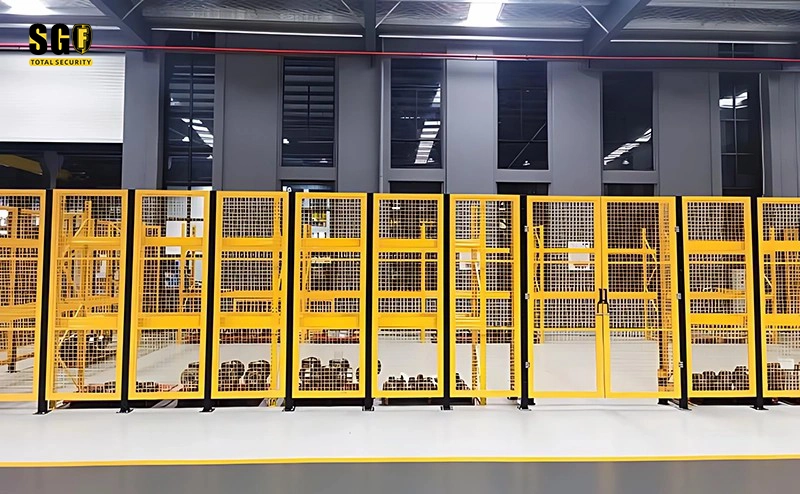
Door options matched to access behavior
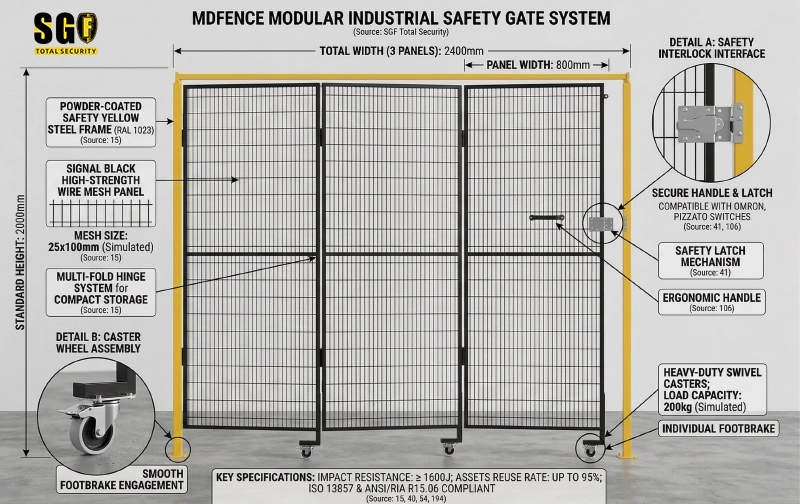
Different machine zones need different opening logic. MDFence supports single hinge, double hinge, sliding, folding, double sliding and telescopic style solutions documented across the product materials. That matters when an access point must balance opening width, traffic frequency, surrounding obstructions and safety-device integration.
Hinged safety doors
Good for routine operator or maintenance access, especially where door opening space is available and interlock positioning must stay straightforward.
Sliding gates
Useful where aisle clearance is tight or where side movement is easier to control than a swinging leaf.
Folding gate systems
Well suited to wider openings in compact layouts, including automation cells where large access is required but floor swing space is limited.
Interlock-ready structure
Rigid posts, framed doors and hardware interfaces help maintain stable alignment for safety switches and controlled restart logic.
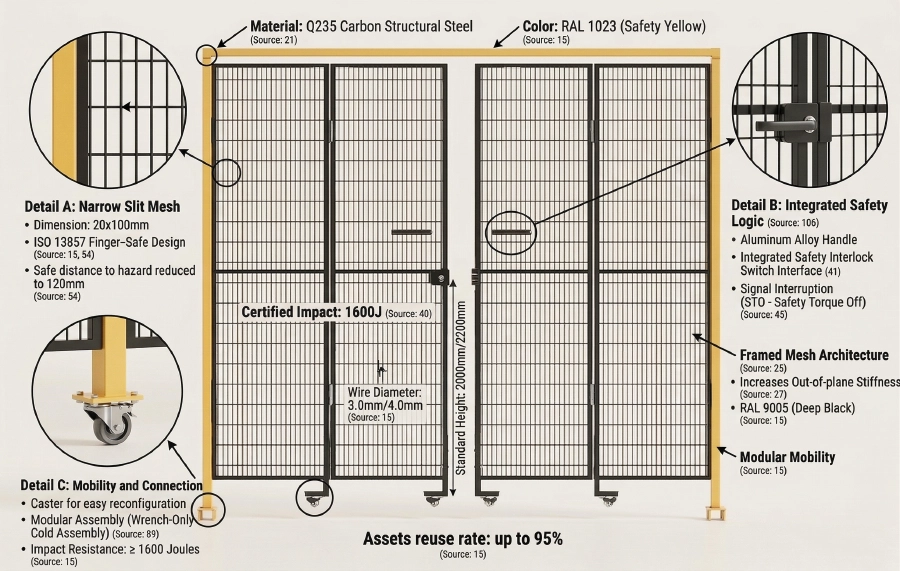
Technical data for specification and comparison
| Product category | Modular steel machine guarding system |
|---|---|
| 主な素材 | Q235炭素鋼 |
| Common post formats | 60×60 mm and 40×60 mm square tube; documented light curtain posts in 80×80 mm |
| Typical heights | 1200 mm, 2000 mm and 2200 mm; project-specific custom heights are also documented |
| Panel frame | 20x30x1.5 mm framed steel mesh panel |
| 線径 | 3.0 mm or 4.0 mm |
| Primary mesh opening | 20×100 mm |
| Surface finish | Electrostatic powder coating |
| Common color scheme | RAL 1023 yellow posts with RAL 9005 black mesh panels |
| Floor fixing | Expansion anchors, commonly M10x70 or M10x80 |
| Accessory compatibility | Gate systems, support wheels, header frames, lower panels, light curtain posts and safety lock integration |
| Referenced standards | ISO 14120, ISO 13857, ISO 9227 and ISO 9001 related product documentation |
Why manufacturers use this system over welded barriers
Welded barriers can look strong, but they are slow to install, difficult to revise and expensive to move after one production change. MDFence is designed as a reusable guarding asset. Panels, posts and gates can be planned around the line, anchored in place and later reconfigured when machines move or access logic changes. That improves lifecycle value for machine builders, factories and multi-line integrators.
- Cold assembly avoids on-site hot work and supports cleaner installation inside active plants
- Framed mesh construction improves structural confidence compared with low-cost frameless alternatives
- Black mesh improves line visibility while yellow posts maintain strong visual warning
- Modular components support repeatable guarding packages across multiple machines or projects
- Gate and hardware flexibility helps match the guarding system to actual maintenance and operator behavior
Specification support for export and compliance-driven projects
For export-oriented OEMs and turnkey automation lines, guarding performance is rarely judged by appearance alone. The system must support the logic of risk assessment, safety distance, controlled access and repeatable installation quality. MDFence gives engineering teams a steel-based platform that aligns better with those requirements than ad hoc partitions or site-built enclosures.
This is particularly valuable in projects that combine robots, conveyors, end-effectors, transfer stations and maintenance doors in one guarded area. Instead of treating each opening as a workaround, the guarding package can be structured as part of the machine solution from the beginning.
Need a machine guarding package for your automation line?
Send your equipment layout, required gate openings, pass-through points and preferred safety hardware. We can help define an MDFence solution for robot cells, conveyors, palletizers, ASRS zones and restricted industrial work areas.

