
 JA
JA  EN
EN  DE
DE  RU
RU  PT
PT  ES
ES  IT
IT MDFence Robot Cell Safety Fence with Header-Reinforced Hinged Doors for GBIM Automation & Robotics LTD
For GBIM Automation & Robotics LTD, SGF developed a drawing-driven MDFence machine guarding solution built for robot-integrated equipment cells, controlled service access, and export delivery. The solution combined rigid Q235 steel fence modules, 20×100 mm framed mesh panels, header-reinforced hinged doors, and Omron-ready interlock mounting support so the customer could align guarding performance with automation safety logic and installation efficiency.
Layout drawings aligned
Mesh opening confirmed
Steel and wire strength basis
GBIM Automation & Robotics LTD operates in industrial automation and robotics with decades of engineering experience, which means enclosure proposals cannot stay at the level of generic perimeter fencing. The project required a practical machine guarding package that could match multiple drawing sets, maintain operator visibility, support controlled access, and fit the safety expectations of integrated equipment deliveries.
Based on the technical exchange recorded in the project file, SGF translated four customer drawings into a consistent MDFence modular architecture. The agreed direction focused on all-metal separation fencing for equipment protection, reinforced hinged door structures with top header beams, compatibility with Omron D4NL-4EFG-B and D4DS-K3 safety locking logic through a dedicated mounting carrier, and packing methods suitable for overseas project execution.
The challenge was not simply to place mesh around machines. GBIM needed a guarding system that could adapt to multiple robot-related equipment layouts while keeping door stability, interlock readiness, visibility, and export practicality under control. Without reinforced door geometry and a clear hardware interface strategy, large access doors can sag, interlock installation becomes inconsistent, and field integration delays can affect commissioning schedules.
1. Layout translation from four equipment drawings into one guarding logic
The technical solution started from four customer drawings and converted them into repeatable fence units built around posts, framed mesh panels, and controlled access points. This approach reduced variation in field installation while still respecting the geometry of each equipment zone. For an automation integrator, that matters because consistent fence logic simplifies purchasing, assembly sequencing, spare parts planning, and later expansion.

2. Header-reinforced hinged doors for reliable service access
One of the clearest agreements in the source document was the addition of a top header beam on hinged door adjacent posts. That structural decision improved door-area stiffness compared with a no-beam arrangement and gave the opening a more reliable support condition. The design also included a ground support wheel for the hinged door so the moving leaf could maintain alignment over time, especially where door width, frequent use, or site floor variation would otherwise accelerate sagging.
For daily operations, this means access points stay easier to close, latch, and integrate with stop-start safety logic. Instead of treating the door as an afterthought, the solution made the opening assembly a controlled engineering component inside the guarding package.

3. Omron-ready interlock interface without cross-border hardware risk
The project discussion referenced Omron safety lock components, specifically the D4NL-4EFG-B switch body and D4DS-K3 key concept. SGF’s recommendation was commercially practical: the customer could source the electrical lock hardware locally for warranty and service convenience, while SGF supplied the matching mechanical carrier and interface arrangement on the door structure. This split strategy reduced unnecessary cross-border risk yet preserved a clean safety integration path.
That is a strong fit for international automation projects because the mechanical guarding supplier and the local electrical safety ecosystem do not have to work against each other. The result is better maintainability, faster replacement planning, and cleaner compliance handoff during installation.
4. Material and mesh decisions matched to industrial machine guarding use
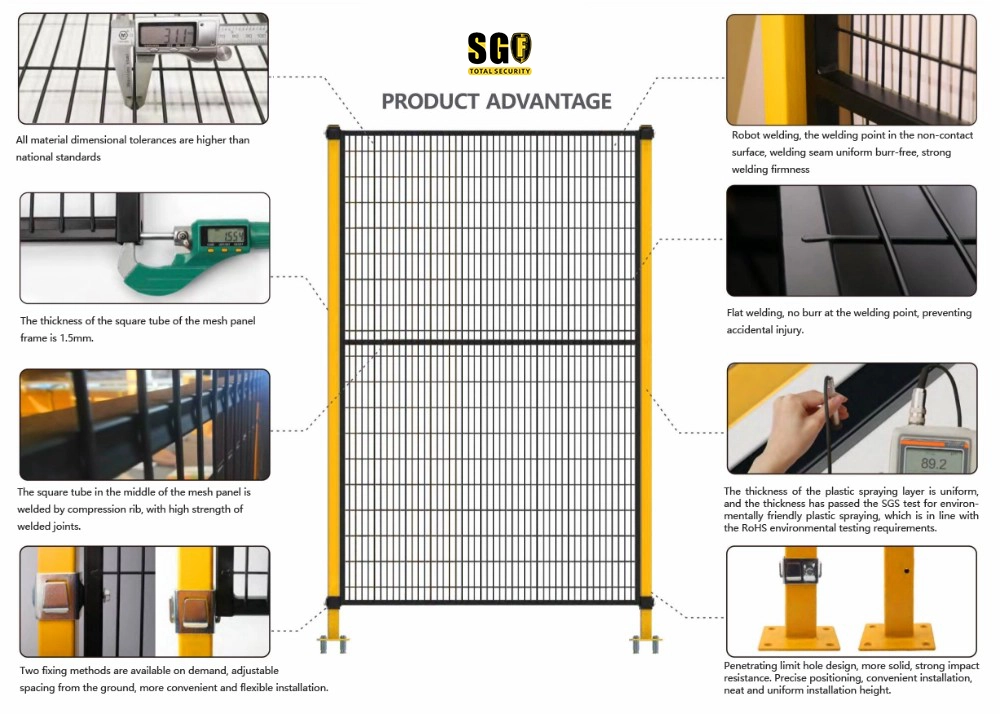
The agreed fence basis used Q235 carbon structural steel, a 20×100 mm mesh opening, and 4.0 mm wire diameter. Compared with a looser or thinner generic fence selection, this specification supports a more robust industrial guarding result for robot-related equipment zones where visibility, enclosure rigidity, and predictable panel behavior all matter. The framed mesh architecture also supports modular post-and-panel installation, which helps shorten field work and makes damaged sections easier to replace.
5. Export packaging that protects parts and keeps project handling organized
The source material also defined packaging discipline rather than leaving it to ad hoc warehouse practice. Panels were to receive edge protection, corresponding drawing-based accessories were grouped by package unit, each pallet used wooden loading support, and the palletized set was wrapped as a whole. For an export-oriented automation customer, this is important because guarding problems often begin after fabrication but before installation, through mixed hardware, scratched finishes, or difficult identification on site.
By treating packaging as part of the technical solution, SGF helped reduce handling confusion and supported more predictable overseas receipt, staging, and assembly.
製品仕様
| 技術的特徴 | SGF仕様詳細 |
|---|---|
| Product system | MDFence modular machine guarding fence |
| Primary application | Robot-integrated equipment safety enclosure and controlled access fencing |
| Steel material | Q235炭素構造鋼 |
| メッシュ開口部 | 20×100 mm |
| 線径 | 4.0 mm confirmed in project communication |
| Door structure | Hinged access door with top header reinforcement |
| Door support | Ground support caster to reduce sag and maintain alignment |
| Safety lock strategy | Customer-local Omron lock procurement with SGF mounting carrier support |
| Installation concept | Post and framed mesh panel modular assembly |
| Packaging method | Protected panels, grouped accessories, wooden pallets, full pallet wrapping |
Risk Controls & Operating Guidelines
- Verify all four layout drawings against final equipment footprints before release to production.
- Keep interlock mounting positions coordinated with the customer’s exact Omron hardware and control logic before door fabrication freeze.
- Use reinforced top header members and support casters on wider or frequently used hinged doors to reduce alignment drift.
- Separate hardware packs by drawing number so overseas site teams can identify installation sets quickly.
- Confirm anchor positions and floor condition in advance to protect fence line straightness and door performance during commissioning.
SGFエンジニアリングインサイト: In automation projects, the most reliable guarding package is the one that connects structural rigidity, access control logic, and logistics discipline from the beginning. For GBIM, MDFence was not positioned as a commodity fence, but as a deployment-ready machine guarding system that aligned door mechanics, Omron-ready safety integration, and export packaging into one workable engineering path.

