JA
JA  EN
EN  DE
DE  RU
RU  PT
PT  ES
ES  IT
IT MEFENCE INDUSTRIAL SAFETY FENCING | FOOD & BEVERAGE PRODUCTION
Food & Beverage Line Reconfiguration: How Mefence Turns Industrial Safety Fencing into a Reusable Asset
Shorter SKU life cycles, seasonal products, co-branded launches, and pilot runs force food and beverage plants to redraw production zones more often. Mefence frameless safety fence replaces welded, layout-specific barriers with a modular reconfigurable fence that can be dismantled, moved, cut on site, and reused when the line changes.
Why Fixed Welded Fencing Becomes a Cost Problem
In a production plant going through capacity optimization, a welded square tube fence is not just a barrier. It becomes a layout-specific installation. When a filling line, pallet flow, or robot workstation moves, the old perimeter often has to be cut out and discarded. The business then pays twice: once for removal and again for new fencing, fabrication, and site work. Traditional framed fence, chain link fence, barrier tape, and rope barriers each leave gaps in this operating model—either they cannot be economically reconfigured or they do not provide a clear workplace safety barrier.
That distinction matters for warehouse zoning, pedestrian vehicle separation, forklift path barrier planning, and automated equipment guarding. Food and beverage operations need visible area demarcation without locking the factory into one production map. Mefence is designed for non-high-impact separation and guarding; it is not a certified anti-collision barrier. Where direct impact containment is required, the higher-spec Machine Fence line should be evaluated.
| レイアウト要件 | Mefence design response |
|---|---|
| Frequent line moves and temporary partitions | Plastic clip fixing supports no-welding installation, dismantling, and modular reuse. |
| Irregular walls, pipes, and equipment footprints | Frameless welded mesh panels can be cut on site instead of waiting for a new factory drawing. |
| Clear separation around mixed traffic | Yellow-black industrial safety fencing makes pedestrian and vehicle routes visibly readable. |
| Cables or visual shielding at the perimeter | T-shaped ridges create routing space; wood slats can be inserted where visual screening is needed. |
Structure and Evidence for a Reconfigurable Fence
1. A clip-fixed system that moves with the layout
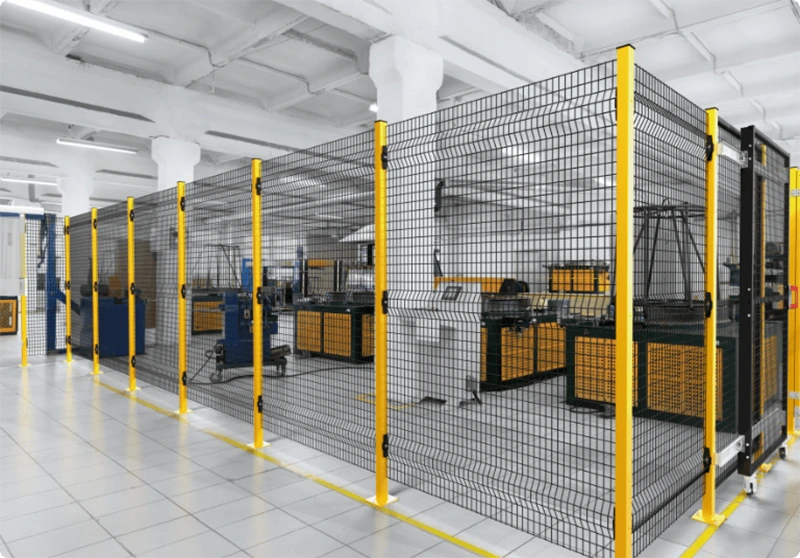
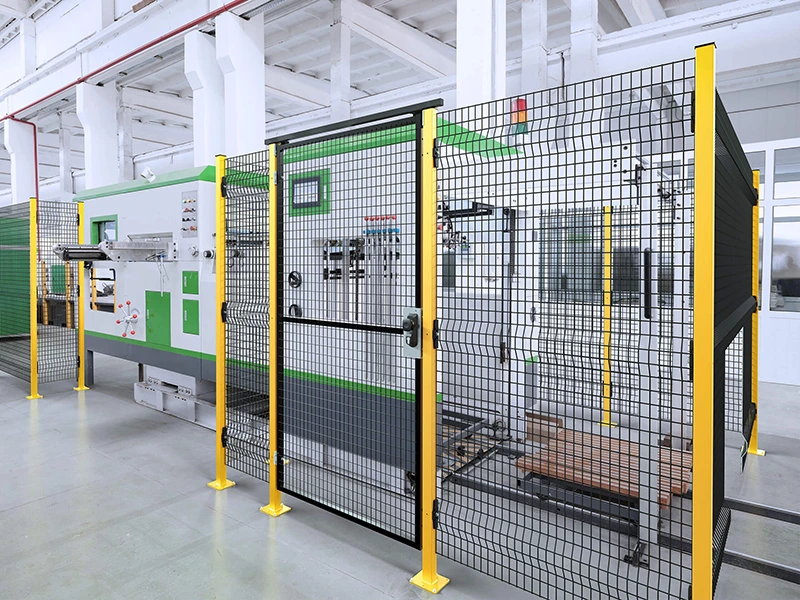
Mefence uses a frameless design: the welded wire mesh panel is fixed to steel posts with plastic clips and self-tapping screws. This removes the square-tube welding step from site assembly. The fastening logic allows panels to be released without destroying the fence, then installed again at a new position. For a plant adding a seasonal SKU line or consolidating production, the fence can follow the new layout instead of becoming a sunk cost.
2. On-site cutting for retrofit conditions
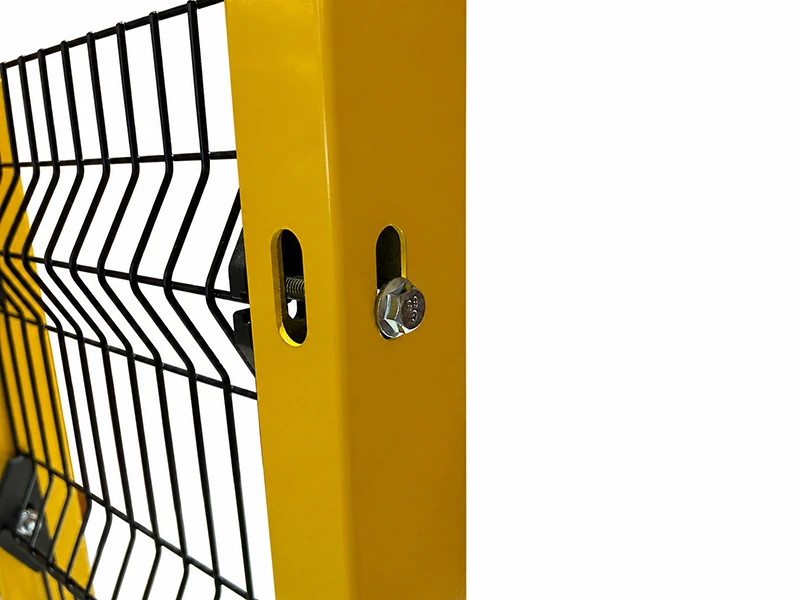
The connection detail is visible in the slotted post holes and bolt-mounted connector. Mefence panels are available with 3 mm or 4 mm wire diameter, 20×100 mm or 50×50 mm mesh opening, panel widths from 200–1400 mm, and heights from 200–3000 mm. The frameless panel can be adapted on site to work around pipe runs, columns, conveyor edges, and unusual wall corners. That makes it a practical on-site cutting fence for short retrofit windows.
3. 3D welded mesh for routing and visual control
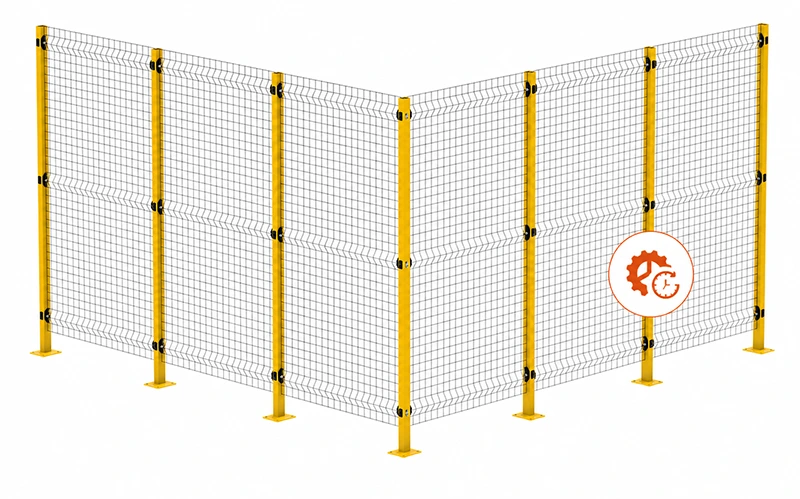
Multiple horizontal T-shaped ridges give the 3D welded mesh its folded profile. The geometry creates useful clearance for cable management fence applications and can accept wood slat inserts for visual shielding. Posts are available in 40×60 mm or 60×60 mm sizes, with base plate post installation and expansion bolts where floor fixing is required. The system is powder coated steel, with standard yellow and black or a custom color for site demarcation.
Where Mefence Fits During Production Changeovers
- ロボットワークステーションエンクロージャ: create a visible robot safety fence perimeter without welding a permanent frame to the floor.
- 倉庫ゾーニング: separate storage areas, tool cribs, and material segregation zones while preserving floor space.
- Pedestrian vehicle separation: define forklift paths, AGV or AMR lanes, and controlled access points with a clear yellow-black boundary.
- ワークショップ隔離: establish a temporary partition during equipment relocation, pilot production, or line-side retrofit.
The result is not simply faster area setup. A modular reconfigurable fence can be removed, transported, and installed at another position—or another plant—when a factory is consolidated. One-person, three-step installation is stated in the product video, with installation time reduced by 50% or more. The exact saving still depends on floor conditions, access, and project scope.
What Engineering and Finance Teams Should Confirm
Before specifying an industrial safety fence, define the separation purpose first: area demarcation, machine guarding, AGV lane control, or pedestrian vehicle separation. Then confirm the panel height, mesh opening, wire diameter, post size, floor-fixing method, gate locations, cable routes, and any need for wood slat inserts. Mefence provides a documented starting range—Q235 carbon steel, powder coating, 3 mm/4 mm wire, 20×100 mm or 50×50 mm mesh, 200–1400 mm panel width, and 200–3000 mm panel height—so the layout can be checked against the actual site before ordering.
Move the Fence Instead of Writing It Off
For food and beverage groups reorganizing capacity, Mefence changes the financial role of industrial safety fencing. Clip-fixed, frameless, on-site adaptable modules can be treated as reusable plant assets rather than welded construction attached to one production map. Share your current and planned layout to review a Mefence 3D safety fence arrangement for warehouse zoning, machine guarding, and production-line reconfiguration.