JA
JA  EN
EN  DE
DE  RU
RU  PT
PT  ES
ES  IT
IT 

Why OSHA Guardrail Standards Are Critical for Workplace Safety
In any work environment where employees are exposed to fall hazards, from construction sites to warehouse mezzanines, a robust safety plan is non-negotiable. The Occupational Safety and Health Administration (OSHA) has established clear and enforceable standards for guardrails to provide a critical physical barrier against potentially life-threatening falls. Adhering to these standards is not just a matter of compliance—it’s a fundamental commitment to protecting your workforce.
OSHA’s regulations, found within 29 CFR 1910 for general industry and 29 CFR 1926 for construction, outline the specific requirements for ガードレールシステム on all walking and working surfaces where a fall hazard exists. These standards apply to a wide range of environments, including elevated platforms, stairways, landings, and unprotected edges.
Understanding the Core OSHA Guardrail Requirements
An OSHA-compliant guardrail is more than just a simple railing; it is an engineered system designed to withstand specific forces and meet precise dimensional criteria. The primary requirement is that the entire system must be capable of withstanding a force of at least 200 pounds applied in a downward or outward direction at any point along the top edge.
The Three Essential Components of an OSHA-Compliant Guardrail
A complete ガードレールシステム consists of three main parts, each with its own set of requirements:
- Top Rail: This is the uppermost horizontal member of the guardrail. It serves as the primary point of contact and must be smooth-surfaced to prevent punctures or lacerations.
- Midrail: Installed halfway between the top rail and the walking/working surface, the midrail is crucial for preventing workers from sliding under the top rail.
- Posts: These are the vertical support members that anchor the entire system to the working surface, providing the necessary strength and stability.
Key Dimensional and Strength Specifications
To ensure compliance and maximum safety, your guardrail system must meet the following technical specifications:
| コンポーネント | OSHA Requirement |
| Top Rail Height | 42 inches (plus or minus 3 inches) above the walking/working level. |
| Top Rail Strength | Must withstand a force of at least 200 pounds. |
| Midrail Height | Must be installed midway between the top rail and the working level. |
| Midrail Strength | Must withstand a force of at least 150 pounds. |
| Post Spacing | Must be spaced no more than 8 feet apart on center. |
Inspection and Maintenance: A Continuous Responsibility
Installing an OSHA-compliant ガードレールシステム is the first step; maintaining it is a continuous responsibility. OSHA requires that all fall protection systems be inspected regularly to ensure their structural integrity. Any components that are damaged, corroded, or missing must be repaired or replaced immediately to ensure the system remains capable of providing adequate protection. The system must also be kept free from sharp edges or projections that could cause injury.
Guardrails as Part of a Comprehensive Fall Protection Plan
Crucially, OSHA standards for guardrails are one component of a complete fall protection strategy. When guardrails are not feasible or during their installation, employers must provide alternative forms of fall protection. This includes providing workers with the appropriate personal protective equipment (PPE), such as harnesses and lanyards, and ensuring that all employees receive comprehensive training on how to use the equipment safely and correctly.
In conclusion, the OSHA standard for guardrails is a critical element in creating a safe work environment. Employers must ensure that their guardrail systems are properly designed, correctly installed, and regularly inspected to meet all requirements. By taking these proactive steps, employers can protect their workers from serious falls and foster a culture of safety and health on every job site.
Interlock Switch Mounting Without Drilling: Why Alfence T-Slot Posts End Phantom Stops
Bolting an interlock switch bracket through a powder-coated steel post drills the coating, drops swarf into the cell and leaves a rust line — and when the hinged leaf sags, the tongue misaligns and the PLC reports a phantom guard fault. Alfence mounts sensors, e-stops and conduit in the T-slot groove of a 40×40 mm or 45×45 mm aluminum post, with door hardware sized to keep the safety switch aligned.
Phantom Safe Torque Off Stops: T-Slot Guarding Fence Posts Mount Interlocks Without Drilling
Painted steel guarding posts force maintenance to drill for interlock switches, dropping swarf in the cell and breaking the coating where rust starts. Sagging hinge doors then misalign the interlock tongue and the PLC trips Safe Torque Off while the gate is closed. Alfence industrial safety fence mounts sensors, e-stops and cable routing into the T-slot aluminum profile post without drilling, and uses hinged, folding or sliding door frames that keep interlock geometry stable - protecting OEE through phantom stops and line changes.
Automotive Plant Industrial Safety Fence: Keep the Robot Cell Close to the Hazard
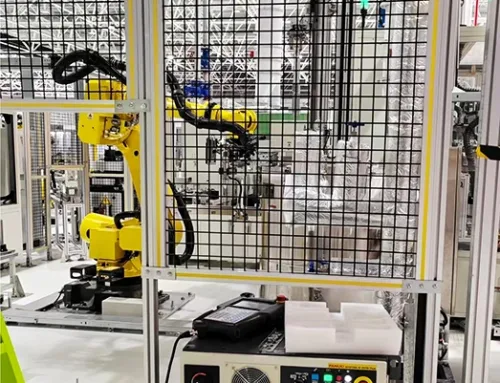
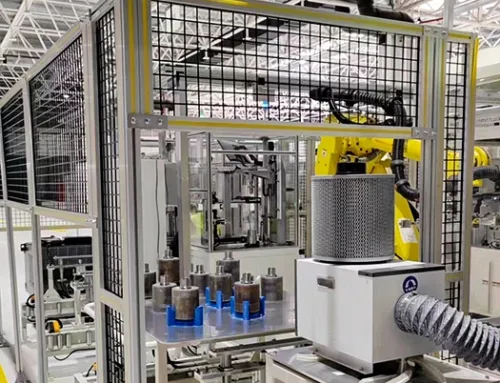
Automotive plants cannot afford to lose production floor to an oversized machine guarding perimeter. Alfence combines 20×100 mm mesh with slim 40×40 mm or 45×45 mm aluminum posts for a compact, reconfigurable industrial safety fence layout, with final clearance confirmed by the project risk assessment.