EN
EN  DE
DE  RU
RU  PT
PT  JA
JA  ES
ES  IT
IT WAREHOUSE SAFETY | HSAFETY
Machine guarding barrier for warehouse zones where training cannot reach everyone
A machine guarding barrier gives high-turnover warehouses a visible, physical boundary: yellow steel guard rails and optional reflective tape help new or insufficiently trained personnel recognize restricted forklift and equipment areas before a mistake becomes an impact.
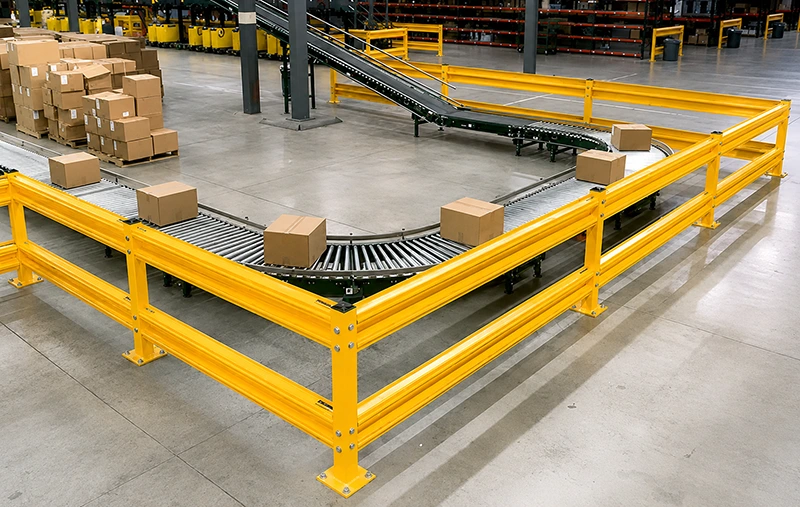
Why a physical boundary fits a high-turnover operation
In a distribution center, loading dock, or busy warehouse aisle, people change shifts, contractors arrive, and temporary workers may not remember every pedestrian-vehicle separation rule. Painted lines, rope barriers, verbal briefings, and steel pipe railing depend on attention at exactly the moment a forklift is reversing or turning. A concrete bollard can stop a vehicle, but it is difficult to reposition and does not create a continuous visual line around conveyors, rack ends, or equipment.
Hsafety warehouse guard rails replace “every person must remember the rule” with an industrial guard rail that remains in place. The yellow safety coating is readable from a distance, while reflective tape can be specified for lower-light aisles or loading dock protection. That makes the intended boundary legible to a new starter before formal training has fully covered the site. It does not replace induction, traffic planning, or supervision; it adds a passive control that does not disappear when staffing changes.
| Design point | Hsafety warehouse guard rail response |
|---|---|
| Primary risk | Forklift impact protection for racks, walls, conveyors, electrical cabinets, machinery, and pedestrian routes |
| Core structure | Q235 carbon steel corrugated guard rail, square-tube posts, bolted connections, and floor-mounted base plates |
| Rail configuration | Single rail or double rail; 2-rib W-beam guardrail or 3-rib thrie-beam options can be reviewed against the risk zone |
| Recorded project configuration | 1,000 mm overall height, 80×80×6 mm posts, 160×160×16 mm base plates, and double rails for a multi-zone layout |
| Visibility and finish | Yellow powder-coated finish as shown; hot-dip galvanized steel, other colors, and reflective tape are selectable options |
| Layout flexibility | 1,500 mm standard rail modules plus custom-length panels for straight runs, corners, and irregular equipment boundaries |
Evidence in the structure: from visible warning to physical protection
1. A boundary that stays visible beside moving vehicles
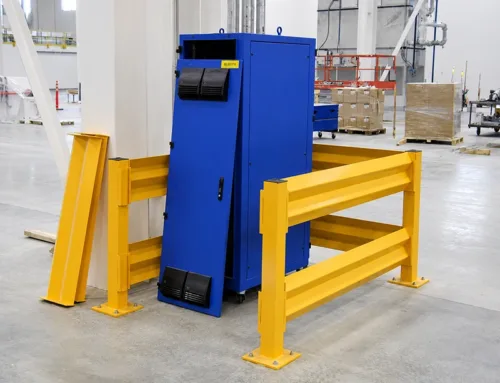
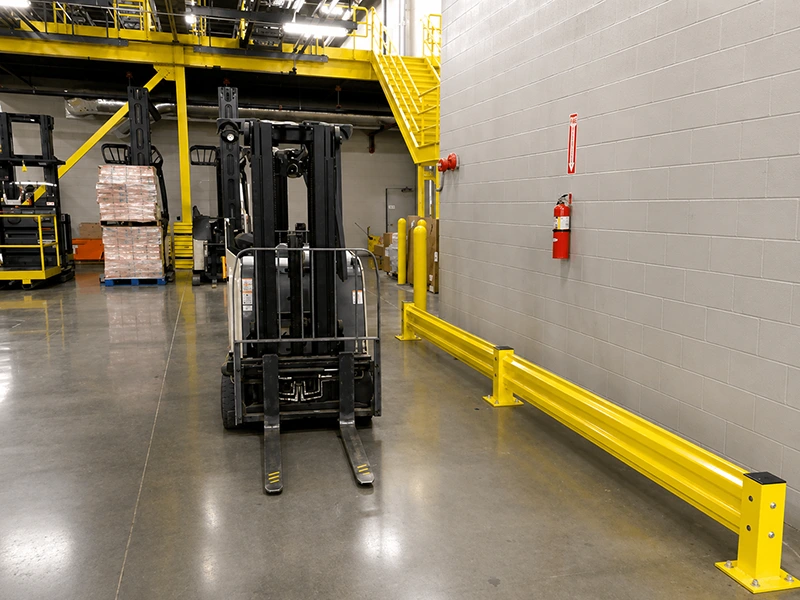
At a warehouse wall or vehicle route, the problem is not only impact force. It is also that an untrained person may not recognize where the safe walking line ends. This machine guarding barrier uses a continuous yellow steel guard rail to mark the separation between forklift traffic and fixed assets. The corrugated beam is more than a painted strip: its wave profile forms a stiffened steel panel, while the double-rail arrangement gives the protected edge a clear, substantial presence. The final selection still needs site-specific impact and anchorage review.
2. Double corrugated rails protect rack ends where routes converge
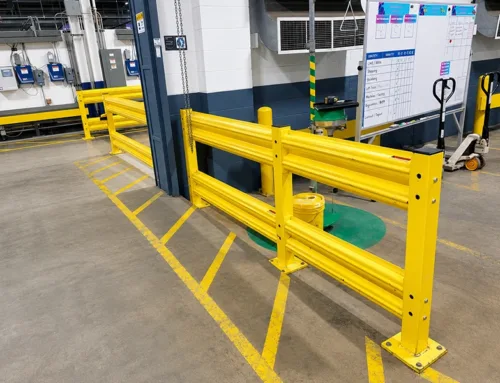
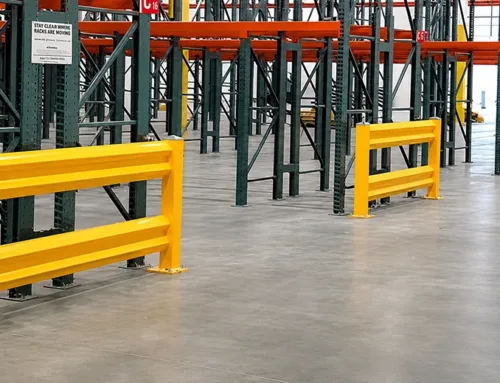
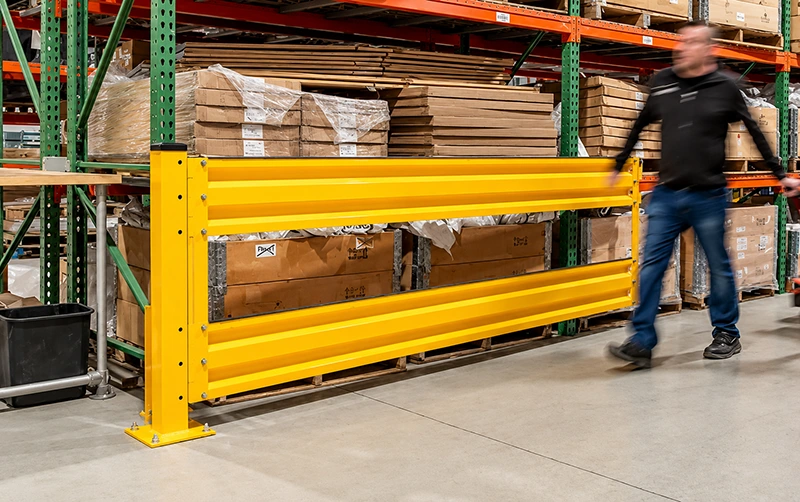
Rack end protection is a common weak point: forklifts turn toward pallet positions, and a small steering error can damage an upright or inventory. The photographed double-beam warehouse guardrail is floor mounted on square base plates with multiple anchor positions. Hsafety uses bolted guard rail system components rather than requiring a welded rail fabricated in the aisle. That supports staged installation, replacement, and modular guardrail planning while keeping the physical separation clear for pedestrian-vehicle separation.
3. Components can be specified before the crew arrives
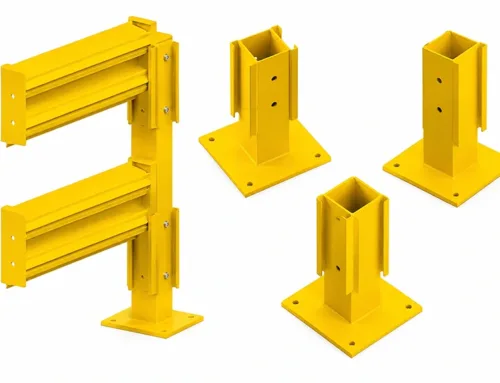
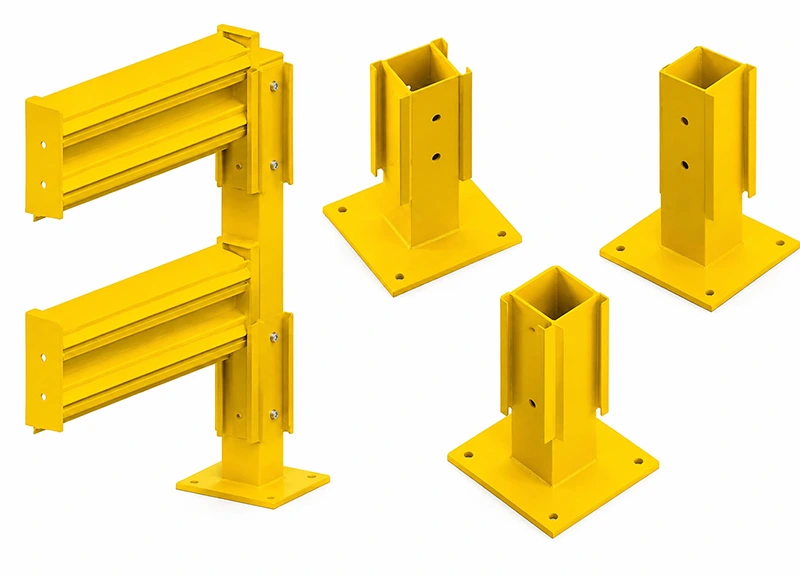
The white-background component view shows the parts that turn a warning line into an installed barrier: twin corrugated beams, square posts, side brackets, exposed fasteners, and a base plate with floor-fixing holes. Standard information covers Q235 steel, approximately 310 mm rail width, 85 mm wave height, and 3 mm or 4 mm rail thickness; the final drawing should confirm the applicable model and dimensions. For a recorded four-zone layout, 1,500 mm modules were combined with 680–1,140 mm special panels to close 11,900–17,100 mm runs rather than leaving improvised gaps.
Where the machine guarding barrier earns its place
- Warehouse and distribution center: protect rack ends, walls, palletized inventory, and aisle edges from forklift impact.
- Conveyor and sorting areas: create a continuous equipment isolation barrier around straight runs, turns, and transfer points.
- Loading docks and plant rooms: separate vehicles from electrical cabinets, pipework, doors, and other assets that are costly to repair.
- Production lines and robot cells: use the steel guard rail as external asset protection; pair it with machine safety fence where internal machine guarding is required.
Because the protection effect does not depend on an individual remembering every instruction, it remains present through shift changes, onboarding gaps, and contractor turnover. It helps reduce forklift damage to equipment, protect racks and walls from impact, and avoid accident downtime. It also gives EHS and facility teams a tangible control to review during workplace safety planning, without treating the product as an unverified highway guardrail or a substitute for engineering calculations.
Specify the barrier against the site, not a generic aisle
Before quotation, provide the protected assets, forklift routes, rail height, straight and corner lengths, concrete floor condition, desired single-rail or double-rail layout, and visibility requirements. Confirm whether the project needs 2-rib or 3-rib guardrail, 3 mm or 4 mm panels, powder coating, hot-dip galvanized finish, reflective tape, or a lift-out section. Hsafety can then align the guardrail post, guardrail base plate, anchors, brackets, end caps, and custom-length guard rail to the drawing. Anchors, concrete thickness, impact loads, and replacement criteria must be checked for the actual installation.
Make the safe boundary obvious from the first shift
For high-turnover warehouses, training remains necessary—but it should not be the only line of defense. A yellow, modular, floor-mounted machine guarding barrier gives every worker the same visible limit and gives the site a physical layer of forklift impact protection. Send your zone lengths and protected assets to plan a warehouse safety barrier that fits the route.