PT
PT  EN
EN  DE
DE  RU
RU  JA
JA  ES
ES  IT
IT 
 |
Off-the-shelf Proteção de Máquinas is fine for standard conveyors, but what happens when your turnkey solution involves a high-pressure testing chamber or a massive 6-axis robot with a high reach? A standard 2-meter fence may not satisfy the risk assessment for containment. For system integrators tackling special purpose machinery projects, the ability to customize barrier height and layout without incurring massive fabrication costs is a competitive advantage. Discover how our engineered-to-order Cerca de Segurança Industrial solutions protect your most critical and volatile operations. |
Case Study: Securing a High-Pressure Valve Testing Room
In a recent project for a client in Singapore (shown above), the challenge was unique. The facility required a secure enclosure for a High-Pressure Testing Room situated right next to a busy tool crib and walkway. Standard fencing was insufficient due to the potential risk of high-velocity fluid or component failure during testing.
We designed a custom solution utilizing extra-tall 2440mm posts and specialized framed panels. This increased height ensured that any potential debris would be contained within the cell, protecting personnel in the adjacent material handling area. Furthermore, because the aisle width was restricted, we integrated a custom-height sliding door that maintained the full protective barrier even across the entrance. This ability to mix-and-match standard components with custom dimensions allowed the integrator to deliver a compliant, high-performance safety cell on a standard project timeline.

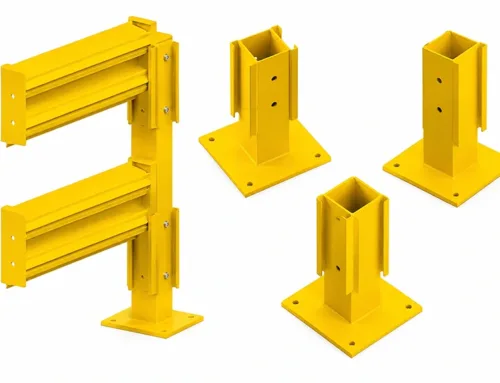
The backbone of customization: Heavy-duty Q235 steel posts with reinforced base plates.
The Structural Backbone for Custom Applications
Customization requires a strong foundation. You cannot simply extend a weak post and expect it to hold. Our system is built on Aço carbono Q235 posts with a 60x60mm profile and customizable wall thickness (up to 2.0mm).
This structural rigidity allows us to support taller panels or integrate heavier panel materials—such as polycarbonate (PC) sheets for visibility with impact protection, or solid steel sheets for welding flash containment—without compromising stability. The reinforced base plate, anchored with four M10 expansion bolts, ensures that even a 2.5-meter tall fence remains rigid. For automotive manufacturing clients requiring enclosure of large robotic gantries, this structural integrity is non-negotiable.
Beyond Geometry: Tailoring Protection to the Process
Every automated production line has different hazards. A customized fence isn’t just about dimensions; it’s about function.
Does your assembly system generate flying chips? We can swap the wire mesh for sheet metal. Do you need to monitor a display inside the cell? We can install a clear acrylic window section. By utilizing our modular frame architecture, we can create hybrid panels that offer specific protection exactly where it’s needed. This flexibility allows you to say “Yes” to complex customer requirements, positioning your firm as a provider of sophisticated, high-value segurança da automação industrial solutions rather than just a commodity equipment reseller.
Perguntas Frequentes
1. What is the maximum height you can manufacture for safety fencing?
While our standard posts are 2000mm or 2200mm, we can manufacture custom posts up to 3000mm or more depending on the structural requirements. For extreme heights, we may recommend utilizing larger post profiles or additional bracing.
2. Can you integrate solid panels for welding areas?
Yes. We offer solid steel sheet panels specifically for welding cells to block arc flash and sparks. We can also provide hybrid panels with a solid bottom half and a UV-filtering polycarbonate top half for safe visibility.
3. Does custom fencing take significantly longer to produce?
Not necessarily. Because we use a modular manufacturing process, changing the cut length of a post or the dimensions of a mesh panel adds very little overhead. We can often deliver custom-sized solutions with lead times comparable to standard orders.
4. Can we mix standard and custom components in one project?
Absolutely. This is the most cost-effective approach. We recommend using standard modules for the majority of the straight runs and only utilizing custom-sized panels or posts where necessary (e.g., to close a gap or clear an obstacle).
5. Is the custom fencing tested for impact resistance?
Yes. Our custom configurations utilize the same welding techniques and materials as our TUV-certified standard products. For specific high-impact applications, we can perform additional engineering calculations to ensure the design meets ISO 14120 safety factors.